My wife and I enjoy occasional long “road trips,” in which the road is part of the trip. We are of the age where hiking, kayaking, and such vigorous activities are less attractive. Looking out the car windows has become our preferred road-trip activity. As such, and because interstate travel can be mentally exhausting and boring at times, we normally take to the back roads, the secondary roads that allow one to drive into America.
This blog post is a continuation of my chapters on “Travel” in my books BS2: An autobiography (Chapter 13) and BS3: Etcetera (Chapter 2). In those chapters, I wrote about my travels (often with my wife) to all fifty states; and internationally to England, Ireland, Israel, Italy, Japan, and Wales.
This post is a form of writing often referred to as a “travelogue.” Such articles may have been more common in the past when everybody didn’t travel everywhere. Mark Twain wrote about his trip to the Holy Land in 1867, way before most of his readers had that pleasure. My wife and I didn’t get there until 2017 (150 years later).
Anyway, such writings often provide “travel tips” – to others about where they might want to visit and what they might want to see. Rick Steves does not have to worry about my meager offerings. As far as I know he has never written a travel guide for Cherry County, Nebraska.
Last year’s big road trip was to “Lake Michigan.” My wife and I started that portion of the trip in Chicago, and then drove around that great lake counterclockwise, hugging the shoreline as much as possible. Those “travelogues” were posted on this blog last year on October 10, 2025 (A Michigan Vacation) and October 12, 2025 (A Wisconsin Vacation).
For me, the trips are also lessons in history. I usually zero in on some facet of the trip that is of special interest to me – and bone up on that topic. Last year, when viewing the Great Lakes, I got extremely interested in the transportation systems (e.g., the “locks” and great ships) used to move the commerce of this country (e.g., Midwest grains to market, iron ore to steel mills). As such, I eventually got very interested in that infamous ship of haunting-ballad fame – the Edmund Fitzgerald (blog posts on October 25, 2025, and January 27, 2026).
Presidential Libraries
Taking road trips out of Omaha to “new” places is extremely difficult, because all the “new” places are far away. All the close-up trips are “old”, and you must drive forever to get to the start of the “new” areas.
The idea for this year’s trip came about when my wife suggested that we should visit all the presidential libraries, which struck me initially as an extremely ambitious goal for two people in their seventies. In case you are wondering, there are now 18 official presidential libraries in the United States, stretching from Massachusetts to California.
We had previously visited only two such libraries: Hoover’s in nearby Boone, Iowa; and Truman’s in nearby Independence, Missouri. We had a lot of libraries left, with the nearest being the Eisenhower library in Abilene, Kansas. Eisenhower was my favorite past president, partly because we share the same birthday (October 14).
So initially, a road trip to Kansas (and maybe on to New Mexico) was in the early planning stages when I ran across an article on the internet about a new presidential library being built for Teddy Roosevelt in my home state of North Dakota, which was scheduled to open on July 4, 2026 (America’s 250th birthday). The focus of the 2026 road trip started to change after I read that article. And then a notice came in the mail about my 60th and “last” high school reunion, which was scheduled to be held in Bismarck during the summer of 2026. That reunion announcement became the frosting on the cake.
The 2026 road trip quickly evolved into a 9-day trip from Omaha, through central South Dakota, to North Dakota, with a return through the western portions of the state of Nebraska – the panhandle portion of the state bordering Colorado and Wyoming.
The focus of the trip for me quickly became Theodore Roosevelt and two of his contemporaries that helped build the West – Buffalo Bill Cody and my great-grandfather Daniel Francis Thomas. My “historic” questions included one about whether they had in any ways interacted with each other. As it turned out, there were a couple of interactions that I described in my recent posts (July 26, 2026, and August 2, 2026) regarding “Buffalo Bill and the Mormons.”
The Agenda and Goals
This year’s trip had five primary goals:
1. To visit the recently opened Theodore Roosevelt Presidential Library in Medora, North Dakota.
2. For me to attend my 60th and “last” high school reunion in Bismarck, North Dakota (Bismarck High School, the class of 1966).
3. To connect with my one and only sister, Marianne (BHS, 1970), who would be joining us for the North Dakota portion of the trip (including my high school reunion).
4. To visit our “Senger/Keller” relatives living in Bismarck (my Aunt Arlene, and four of my cousins).
5. To view a nighttime outdoor performance of the Medora Musical in Medora, North Dakota.
This year’s trip, as it developed, also had five secondary goals:
1. To visit the Johnny Carson wing of the Elkhorn Valley Museum in Norfolk, Nebraska.
2. To visit and shop at Brown Sheep Company, Inc., in Gering, Nebraska.
3. To visit the “Japanese Hall” at the Legacy of the Plains museum in Gering, Nebraska.
4. To visit Buffalo Bill Cody’s Scout’s Rest Ranch in North Platte, Nebraska.
5. To visit the world’s largest railroad classification yard (the Union Pacific Bailey Yard and Golden Spike Tower) in North Platte, Nebraska.
Along the way, via the route selected, we also checked out the “road” and what was near it:
· Neligh, Nebraska.
· The “Cowboy Trail” – a bike trail that runs through northern Nebraska on what used to be Chicago & Northwestern railroad line to the Black Hills of South Dakota (and gold).
· “Hidden Paradise” and the “Bunkhouse” at Long Pine, Nebraska.
· The Niobrara River at Valentine, Nebraska.
· The Oahe Dam north of Pierre, South Dakota.
· Lake Oahe (from Pierre to Bismarck).
· The South Unit of Theodore Roosevelt National Park.
· Carhenge and Car Art Reserve (near Alliance, Nebraska).
· Scott’s Bluff National Monument, and
· Chimney Rock (the most famous landmark on the Oregon Trail).
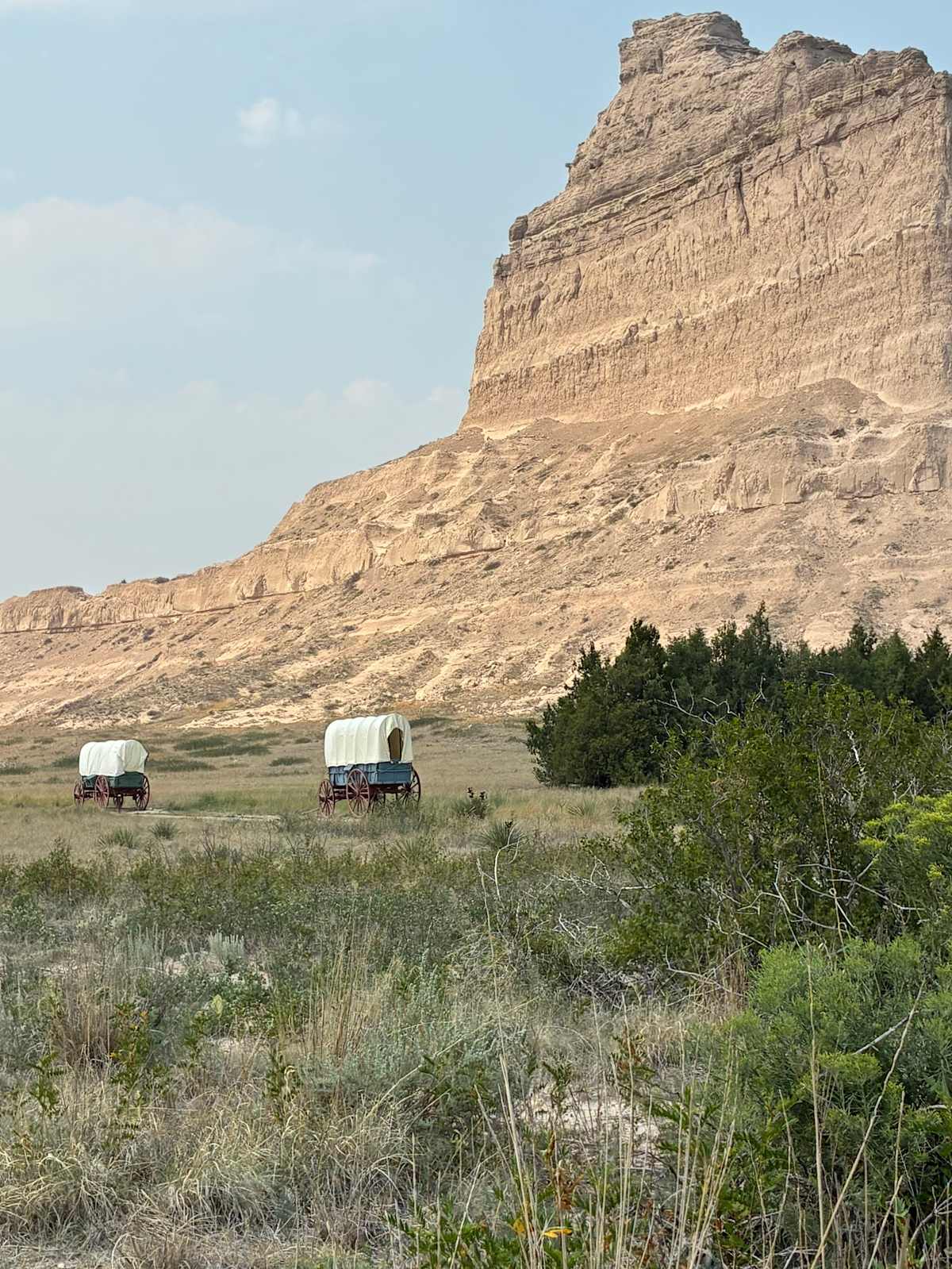
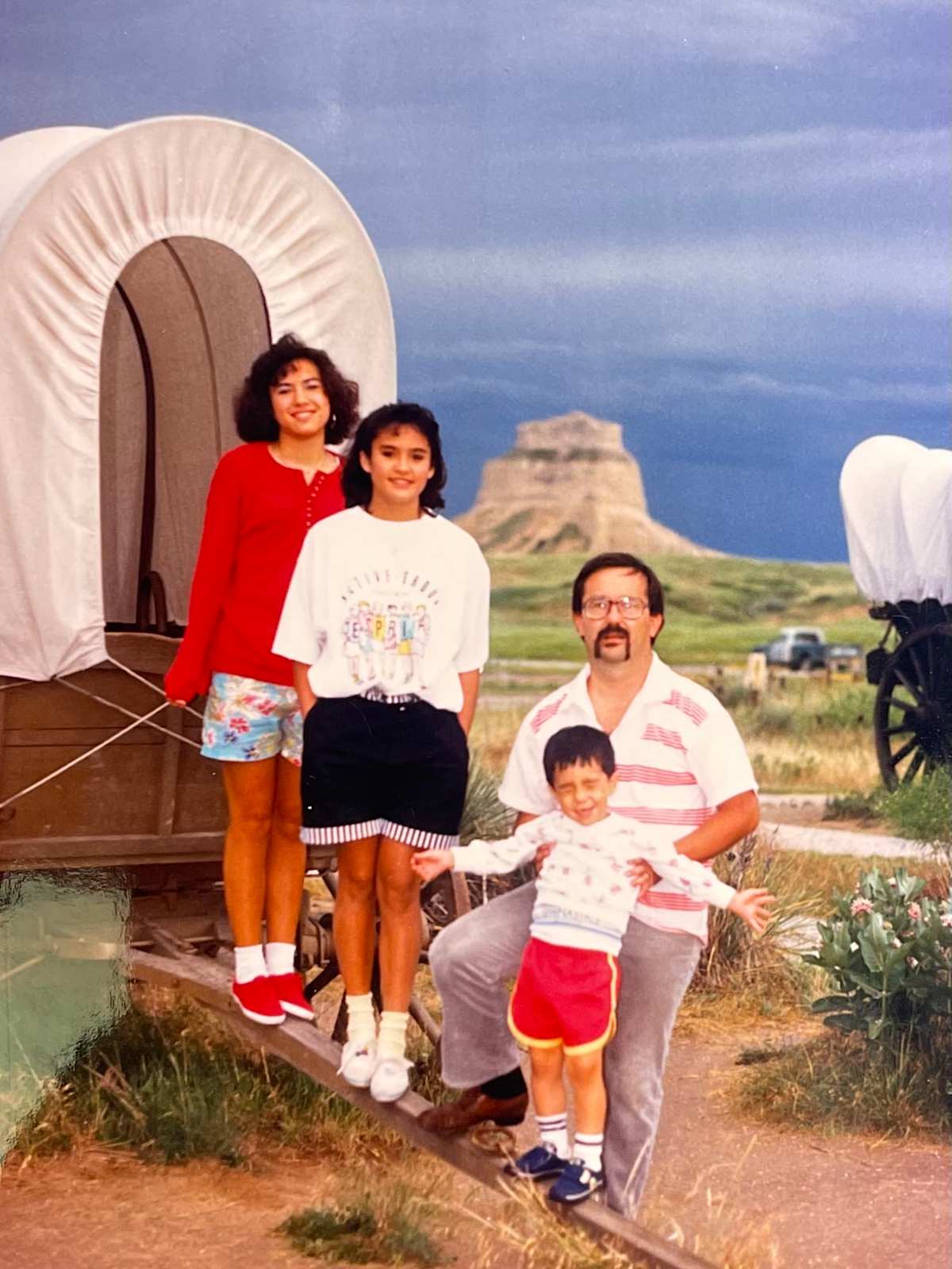
The Ultimate Road Trip: The photograph that introduces this post was taken during our trip. It shows two covered wagons alongside Scott’s Bluff National Monument. To me, that photograph, captures the ultimate road trip – when you pack up all your stuff into one wagon and hit the road (er’ trail) for parts unknown. The photograph below was taken on July 4, 1987, the last time my family took a road trip to Scott’s Bluff National Monument.
Along the way, we also got to:
· Check out seven free breakfasts at seven different motels.
· See a lot of growing crops (especially hay) and cattle feeding.
· Drive through two Indian reservations (Rosebud and Standing Rock).
· See the state capitol buildings of South Dakota, North Dakota, and Nebraska (from a distance).
· See a few Union Pacific and BNSF coal, ethanol, grain, and manifest railroad trains (a thrill for a railfan).
· See some local art, city murals, and “decorated” city water towers.
· Go to Sunday Mass at the Catholic church where my parents were wed on January 19, 1948; and where I was baptized on October 28, 1948.
· Observe the drought conditions impacting the various states this year.
· Drive 2368 miles over nine days through three states.
My Next Post
In my next post, I will provide a “day-by-day” description of the trip outlined above and report on how things went. Also, maybe a few travel tips.