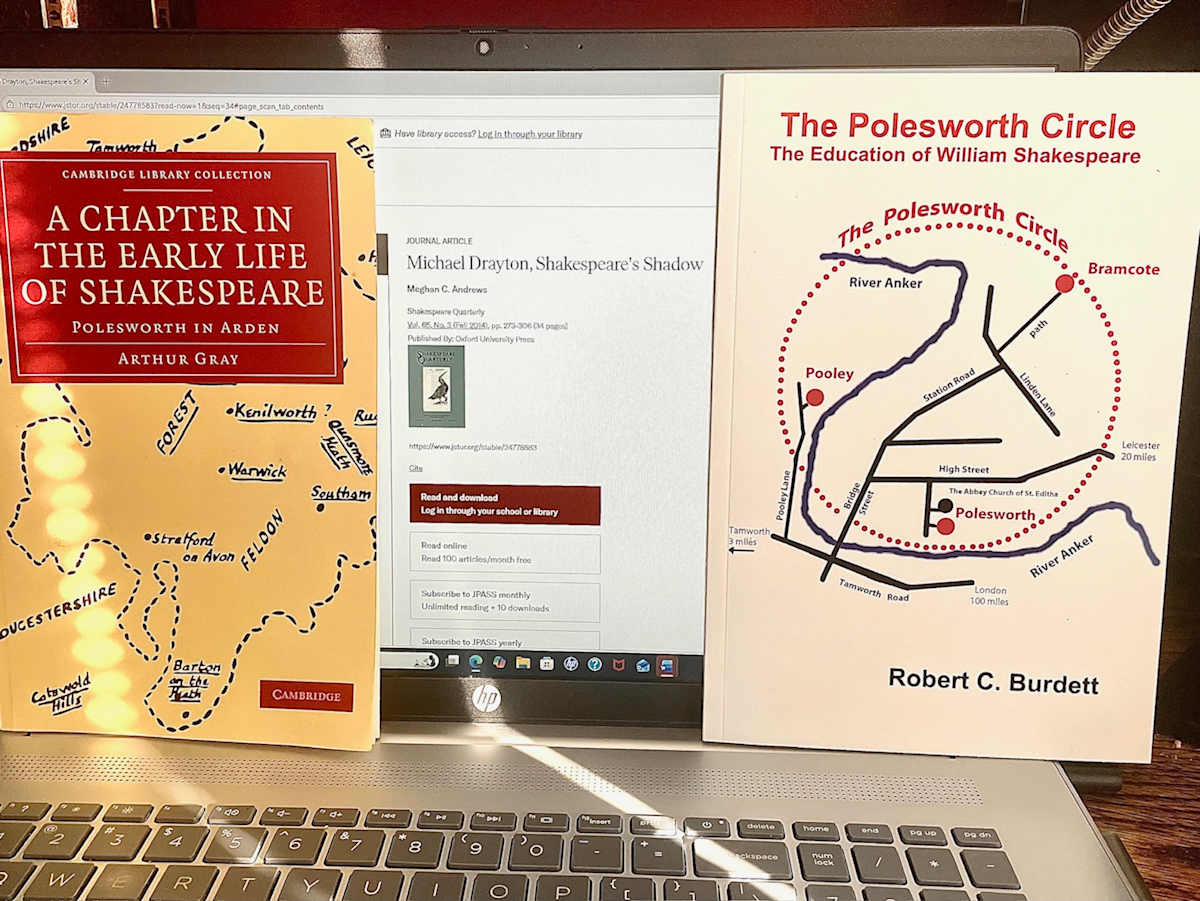
This post is “kind of a review” of an article in the Fall 2014 issue of Shakespeare Quarterly by Meghen C. Andrews, entitled “Michael Drayton, Shakespeare’s Shadow.”
[See: Andrews, Meghan C. “Michael Drayton, Shakespeare’s Shadow.” Shakespeare Quarterly, vol. 65, no. 3, 2014, pp. 273–306. JSTOR, http://www.jstor.org/stable/24778583.]
I used the “kind of a review” phrase above because I had an alternative motive – to see if Andrews’ article provided any support for my theory that Raphael Holinshed, the great chronicler of England, taught both Michael Drayton and William Shakespeare how to tell stories (as suggested in my historical play The Polesworth Circle: The Education of William Shakespeare).
Comparisons
In the photograph accompanying this post, Meghen Andrew’s article is on my laptop’s screen between copies of Arthur Gray’s book, A Chapter in the Early Life of Shakespeare (which theorized that both Drayon and Shakespeare were educated at the abbey school in Polesworth) and my book (which further theorized that Drayton and Shakespeare were both taught at that time by Raphael Holinshed, who was then the steward at the Burdett estate at nearby Bramcote).
In his book, Gray downplayed any possible connections between Drayton and Shakespeare during their London years. He wrote, “In truth, Drayton, who had unsuccessfully attempted stage-writing himself, was incapable of appreciating high dramatic invention. … Perhaps we should assume that he was not particularly well acquainted with Shakespeare in the days when both of them were in London.”
In my book, I also questioned their interactions in London; “Shakespeare, Drayton, and Donne were contemporaries in London. How come there are no buddy-buddy stories about them hanging out together?”
In contrast, Meghen Andrews, in her article, saw all sorts of connections and interactions between Drayton, Shakespeare, and their writings. In her 33-page article she outlined the similarities between their works, what they wrote about, and their use of words. She wrote about the connections she saw, for example, involving a play entitled The True Tragédie of Richard Duke of York, and the use of words such as “pluck” therein.
I encourage those interested in this topic to read Andrews' article to fully understand the connections that she noted. I believe that the connections that she writes about support my “Polesworth” theory.
In the last paragraph of her essay, Meghen concludes that, “Drayton … might have been the first of Shakespeare’s contemporaries to appreciate Shakespeare’s skill and consider him worthy of emulation. Drayton may have been not just Shakespeare’s shadow, but also Shakespeare’s first literary reader.”
Earlier in her essay Meghan noted that; “Michael Drayton is our closest parallel for Shakespeare. His life more closely resembles Shakespeare's than does the life of any other early modern writer. Yet he does not spring to mind when we think of Shakespeare's peers, and their relationship has gone largely unexplored by critics.”
Two Points of Contention
Arthur Gray and I have two problems with Meghan Andrew’s perspective.
As noted earlier, Gray considered Drayton to be an unsuccessful playwriter. Gray thought of Drayton as a great poet for the most part but as a failed playwright. Meghan, acknowledged that that opinion was shared by many others, but she also noted that “between 1597 and 1602, he collaborated on no fewer than twenty-five plays for Philip Henslowe” and that “evidence suggests that six of Drayton’s twenty-five plays were direct responses to or influenced by Shakespeare’s work.”
Meghan also noted that Drayton had invested in the lease of the Whitefriars playhouse – “one of a handful of early modern playwrights to make such an investment, even if the company soon faltered. Far from being strictly a poet, Drayton possessed strong connections to London’s theatrical world.” Meghan concluded by suggesting that, “had fewer of his plays been lost or had the King’s Revels not been a short-lived and ill-fated endeavor, Drayton might be better recognized as a playwright as much as a poet.”
My problem with Meghan’s perspective involves timing. She writes from a point of view that all the connections between Shakespeare and Drayton began after they arrived in London, as they acted and wrote, as they interacted with others at The Middle Temple.
I believe that their connection began 10-20 years earlier when they were both pages at Polesworth. Meghan, in the title of her article, suggested that Drayton was Shakespeare’s shadow. I believe that that relationship – that imagery – started much earlier when they were both in the shadow of Raphael Holinshed at Polesworth/Bramcote.
Shared Background
Note how Meghan began her essay; “This essay considers a Warwickshire native, the son of a butcher-tanner, who became one of the foremost poets and playwrights of early modern England. Born in the early 1560s, he moved to London around 1590 and made a living through his pen.”
Meghan was writing about Michael Drayton but at first blush it looked like she was writing about William Shakespeare – because of their shared background. She further wrote; “It would have been natural for two young writers, fresh from Warwickshire and sharing several friends, to gravitate toward each other, especially as they were drawn to the same genres. Both writers had a strong interest in England's history.”
Why England’s History?
Why? Why did both writers have a strong interest in England’s history? I think that is a fair question. They could have had a shared interest in a lot of other things; why England’s history? Why did Shakespeare write his historical plays? Why did Drayton write England’s Heroical Epistles – his most popular work, per Meghan Andrews.
Meghan doesn’t get into details about why Shakespeare became interested in history. She did believe that Shakespeare’s interest in history influenced Drayton, as noted in the quote below, concerning England’s Heroical Epistles.
“Unsurprisingly, we find Shakespeare's influence in some of the most authoritative parts of the Epistles. At the end of Margaret's epistle (1597), among notes otherwise adapted from Holinshed ….”
There is that name again – Holinshed. It is my belief that both Shakespeare and Drayton were indeed interested in history. As I theorized in my book The Polesworth Circle, I believe that Holinshed, the great chronicler of England, kindled that interest in both Drayton and Shakespeare, while he taught them.
And then there is the "English history" of Arden of Faversham: My ancestors, first Sir Robert Burdett (1507-1548) and then Sir Thomas Burdett (1532-1591), were Raphael Holinshed's employer and literary patrons (they supported his chronicling). Thomas Arden was murdered in 1551 by his wife Alice, her lover Mosby, and two thugs named Black Will and Shakebag. Sir Robert Burdett and Thomas Arden were in Parliament together for a short time. The Burdetts knew Thomas Arden. Sir Thomas Burdett, after his father's death, was apparently interested in the circumstances of Thomas Arden's death, to the extent that he was one of the "them" (as a patron) that convinced a reluctant Raphael Holinshed to write a lengthy account of Arden's murder in his Chronicles (in the midst of a survey of King Edward VI's reign).
I also believe that Sir Thomas Burdett and/or Holinshed later “encouraged” some anonymous playwright (possibly Shakespeare or Drayton?) to write The Tragedy of Master Arden of Faversham. Some experts believe that that play, possibly the first "domestic homiletic tragedy," was performed as early as 1585 (five years after Holinshed's death).
[Reference The Tragedy of Master Arden of Faversham, edited by M. L. Wines, for more information. On pages xlv-xlvi of that book, Wines notes that Black Will's name somehow found its way into a "bad quarto" of The True Tragedy o Richard the Third. In a note on page xlvi, Wine also noted that the aforementioned (by Meghan) The True Tragédie of Richard Duke of York, an early version of Shakespeare's Henry VI, Part 3, was published and performed between 1594 and 1595 by the Earl of Pembrokes' Men, which was Shakespeare's company for a time. I cannot write that I fully understand all of these apparent connections.]
The Middle Temple – Henry Rainsford – Ann Goodere
Meghan Andrews theorized that Shakespeare and Drayton, while in London, knew each other and socialized at the Middle Temple, one of London’s four Inns of Court.
She wrote, “Shakespeare and Drayton both possessed an extensive social network at the Middle Temple and were members of each other’s extended network there. … Another man who connected Shakespeare, Drayton, and Greene was Middle Templar Sir Henry Rainsford, a lifelong friend of the latter two. Drayton almost certainly met Rainsford via the Temple through his early patron Sir Henry Goodere the Younger, a member of the Middle Temple and Rainsford's brother-in-law.”
Andrews suggests above that the above connection with Rainsford started after Shakespeare and Drayton arrived in London. As I theorized in The Polesworth Circle, I believe that this connection started years earlier (maybe 1575-1580) when Shakespeare and Drayton were in Polesworth. That connection involved Anne Goodere (the daughter of Sir Henry Goodere the Elder – a then teenage girl who later became the wife of above noted Sir Henry Rainsford).
At a young age, beginning during their days in Polesworth, Anne Goodere was Michael Drayton’s “idea” – the subject of some of his poems (e.g., Amour 13, Amour 24, Mirrour). Michael Drayton loved Anne Goodere. He admitted as much in 1606, when he reprinted Idea., The Shepheards Garland (the eighth eclogue). Drayton loved the wife of Sir Henry Rainsford – long before she became Rainsford’s wife, long before the days of the Middle Temple.
Female Characters
This is a minor and subjective topic, but Meghan Andrews believed that “Drayton and Shakespeare were “two of the decade's greatest creators of female characters—to be particularly attracted to the tragic female voice.” Meghan credited this in part as a natural extension of their coed education (versus an all-male schooling at the likes of Oxford and Cambridge).
I concur and believe that part of their education took place at the abbey school at Polesworth – a school that began as a Benedictine nunnery school – that provided for young boys as well as girls. It is my theory that Sir Henry Goodere’s daughter Anne went to school there with Drayton and Shakespeare. Afterall, it was Sir Henry Goodere (the Elder) who maintained the school and who was the early backbone of the Polesworth Circle. That, I surmise, is where Drayton and Shakespeare observed “the female voice" up close and personally.
Summary
In her essay, Meghan Andrews noted that “the larger question of why Drayton modeled himself on Shakespeare remains open.” I have thrown in my two cents – that leads back to their youth. I contend that both Shakespeare and Drayton actually “modeled” Raphael Holinshed.
In her essay, Meghan Andrews noted; “I acknowledge that there is an element of speculation to some of this essay’s conclusions.” I also acknowledge that there is an element of speculation with Gray’s “Polesworth” theory and my “Holinshed” theory. I also concur with her earlier observation that this matter “has gone largely unexplored by critics.” I wish that was not the case. I believe that Meghan Andrews', Arthur Gray’s, and my theories and conclusions are plausible and that they support the premise that Shakespeare wrote Shakespeare.
I found Meghan Andrews’ article to be very interesting. One of the weaknesses in my “Polesworth/Holinshed” theory, as presented in The Polesworth Circle, was the absence of any significant interactions between Shakespeare and Drayton after Polesworth. Meghan filled that gap nicely with her literary analysis and her comments regarding their social lives at The Middle Temple and Clifford Chambers (the Rainsford estate). Meghan's article helped convince me that Holinshed, Drayton, Shakespeare, the Gooderes, and the Rainsfords were not ships passing in the night. I believe that they knew - and to some extent - loved each other.
I thought about contacting Meghan to discuss this topic but was saddened to read that she had died on June 20, 2023, at age 36, after a valiant three-and-a-half-year battle with early onset colon cancer. Her obituary can be found at: https://www.crousefuneralhome.com/obituary/meghan-andrews.
Rest in Peace – Meghan Cordula Andrews, Ph.D. Thank you for your contributions to English literature.