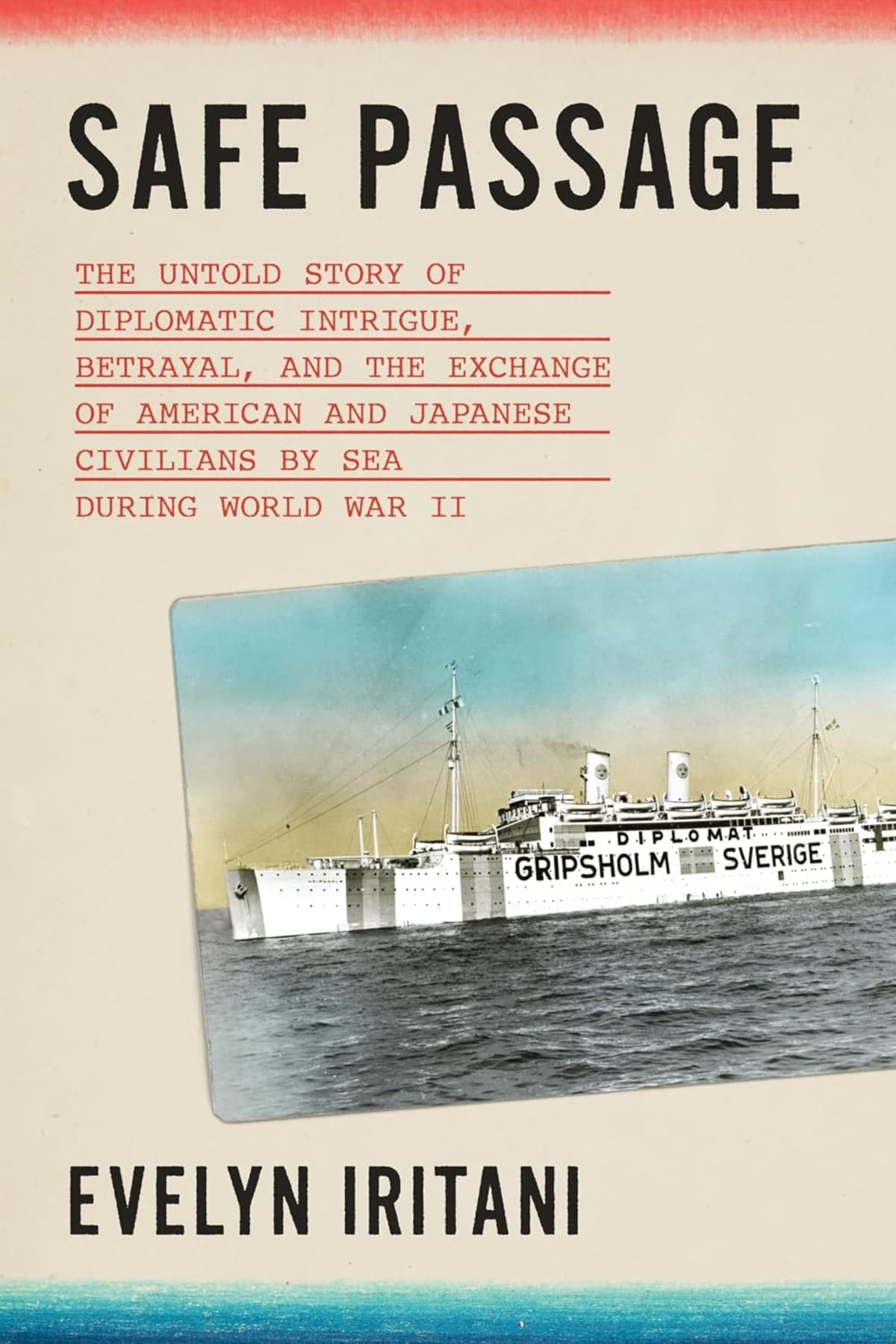
This is a book review of Safe Passage: The Untold Story of Diplomatic Intrigue, Betrayal, and the Exchange of American and Japanese Civilians by Sea During World War II, by Evelyn Iritani (2026).
The book focuses on the second negotiated exchange of civilian prisoners, by the governments of Japan and the United States, which occurred in the fall of 1943, in the middle of World War II. I was interested in this book because my wife’s families, of Japanese ancestry, experienced many of the same traumas (e.g., incarceration, repatriation) during World War II. I documented their stories in my book Families 1450, 4506, and 4711: before, during, and after Manzanar (more later).
The Players
Iritani used the lives of many people to tell her stories regarding the negotiations that led up to the voyage, the voyage itself, and the homecomings that occurred after the prisoners were exchanged. Those people included three American teachers who were in Japan when the war began: Daniel Brooke McKinnon, Harold Lane, and Pauline Lane; and Helen Burton, the daughter of a Bismarck, North Dakota politician, who owned a curio store in Peking at the time of the war.
Iritani, however, focused most of her attention on the lives of the four people noted below; one returning from Japan (Emily Hahn), two heading to Japan (George Hasuike and his young son Don), and James Hugh Keeley Jr., the man who worked for months to make the exchange happen.
Emily Hahn – an American writer (The New Yorker) detained in Hong Kong at the start of the Pacific War. Considered an early feminist, she was the first woman to receive a degree in Mining Engineering from the University of Wisconsin, a world-traveler, and the author of over 50 books, including a biography of Chiang Kai-shek. She also enjoyed a good cigar.
James Hugh Keeley Jr. – a Foreign Service officer in the State Department’s Special War Problem’s Division, instrumental in organizing the U.S. Japan Civilian exchanges.
George Susumu Hasuike – a leading Japanese businessman in Los Angles prior to WW II and owner of Three Star Produce Company (and his young son Don Hasuike).
Notes: Throughout this review, page numbers from the book are included (in parenthesis), if you wish to review a quote in context or learn more about a particular topic. The first civilian exchange between Japan and the USA that occurred in the summer of 1942 is briefly noted but not described in detail in this book.
Part 1: Negotiations
Iritani took twelve chapters to explain “The Negotiations” that led up to the second civilian exchange between Japan and the USA. In Part One, she also introduced us to some of the civilians that would be exchanged.
· Iritani introduced James Hugh Keeley in Chapter 1 (The Diplomat).
· Chapters 2 (To Go or Not to Go) and 9 (Betrayed) introduced the Hasuike family.
· Chapters 3 (The Balloon’s Gone Up) and 10 (Reign of Terror) introduced free-spirited writer Emily Hahn.
· Chapters 5 (The Backup Plan) and 8 (Injustice in Paradise) described the unique situations that involved the Japanese people who resided in Peru and Hawai’i.
· Chapter 12, which details the final days leading up to the exchange is entitled “Saying Goodbye.”
The Situation in America:
Iritani does a good job of setting the stage, describing what the world was like leading up to Pearl Harbor. On that date 127,000 people of Japanese ancestry were living in the United States, mostly along the West Coast. Iritani described how many of those people – some technically aliens, some American-born citizens – were rounded up and sent to a series of assembly, military, and “relocation” camps. The courts later agreed that a lot of injustice occurred at that time – but at the time the courts were silent and war is war.
The action was initially popular with most but derided by others. The action became less popular over time, as the U.S. began to win the war and the unfairness of the incarceration became more apparent. FDR even felt some heat at home from his wife Eleanor. “Under pressure, the president agreed to let his wife visit the Gila River WRA camp in Arizona (though he refused her plea to bring a Japanese American family to live in the White House as a symbolic gesture)” (179). To make matters worse, “Across occupied Europe, the Nazis and their supporters defended their treatment of the Jews by citing American policy toward Japanese Americans” (149).
Amidst all this turmoil there was pressure on both sides of the world to get their people home, to safety. Many Americans had been swept up in Asia after the “world” war began. And “as news of America’s mass incarceration of their friends and relatives made its way to Japan, the pressure grew on the government officials in Tokyo to bring their people home” (107). That is when James Hugh Keeley was charged with the prisoner exchange task.
The Repatriation Challenge
The task was easier said than done given the animosity between the governments, the ongoing battles in the Pacific, and the math constraint – an “obligation to trade people on a one-to-one basis” (187). Keeley had to overcome a series of conflicting agendas and problems:
· “It was the people behind barbed wire – officials, journalists, religious leaders, and teachers – whom the Japanese government wanted back the most” (147).
· “The Japanese Foreign Ministry insisted on putting together the passenger lists in Tokyo and sending them to Washington, creating a bureaucratic nightmare for Keeley and his staff, who had to locate specific individuals” (107).
· The U.S. “security agencies cast their net wide, refusing to approve many people on Japan’s proposed passenger list, including anyone from Hawai”i, merchant seamen, pearl divers, priests, businessmen, and community leaders” (22).
· “More than half of the people on the Japanese government’s passenger lists who were approved by U.S. security agencies refused repatriation” (110).
The following paragraph from Iritani’s book summarizes Keeley’s predicament. “Of the six thousand people placed on Japan’s priority list over the course of the negotiations … the [U.S.] government security agencies had objected to two thousand on security grounds. Of the remainder, about 75 percent had ‘declined’ the opportunity to repatriate … [and] the Japanese government would not accept the approximately five thousand Japanese nationals who had volunteered to go to Japan but weren’t on the government’s list, calling them substandard – [Too many farmers, not enough businessmen.]” (150).
Somehow, after delays and postponements, “one-for-one” lists were agreed to, and the second prisoner exchange was scheduled. The MS Gripsholm, which had been docked for months, was readied for its voyage.
Part 2: The Voyage
Iritani took fourteen chapters to document the voyages of the MS Gripsholm (to and from Mormugao, India); and the Teia Maru (also to and from Mormugao, India) – Mormugao being the port where the prisoner exchange occurred between October 16-22, 1943.
· Chapters 13 and 14 reviewed the loading of the MS Gripsholm at the Port of New York and New Jersey, and the loading of the Teia Maru in Yokohama. I will have more to say about these two ships below.
· Chapters 15, 17, 19, 23, and 25 documented the travels of the MS Gripsholm at various points along that ship’s route – as it first carried Japanese repatriates to India, and then Americans back to the USA. The Gripsholm traveled to the east of South America, below the continent of Africa, and then trough the Indian Ocean on both legs of its trip – with stops in Rio de Janeiro, Brazil; Montevideo, Uruguay; and Port Elizabeth, South Africa.
· Chapters 16, 18, 20, 22, and 24 documented the travels of the Teia Maru at various points along that ship’s route – as it first carried the America-bound prisoners to India via Shanghai, Hong Kong, Manila, Saigon, and Singapore; and then the Japanese repatriates back to Yokohama, via Singapore and Manila.
· Chapter 21 (The Trade) described the unloading and reloading of the civilian prisoners in Mormugao, India.
· Chapter 26 was entitled “A Diplomat’s Revenge.” It covered, among other things, some infighting within the State Department directed at Keeley’s boss, Breckenridge Long, because “Americans under Japanese control were dying … [and] Long’s arrogance and shortsightedness had contributed to [those] ‘tragic results’” (294).
I personally didn’t like the way Iritani bounced back and forth between the two ships (Gripsholm = odd chapters; Teia Maru = even chapters). The back and forth confused me. If you read the book, you may want to consider staying with a ship – by reading the odd and even chapters straight through (as identified above) or following the paths of the Japanese repatriates (15, 17, 19, 22, 24) and American repatriates (16, 18, 20, 23, 25) from start to finish, as summarized below.
Iritani included a very helpful two-page map of “The Voyages of the MS Gripsholm and Teia Maru, 1943” before her books Prologue.
The Ships
“Military officials were loath to give up seaworthy vessels, but the State Department was able to charter two Swedish luxury liners to use as exchange vessels; the MS Gripsholm and the SS Drottningholm” (20). The Gripsholm “was the first diesel-powered cruise ship to cross the Atlantic” (211). It was almost as long as two American football fields and decorated opulently.
The Teia Maru was “the MS Aramis in better times, when it was owned by the French and operated as a luxury liner carrying passengers between Europe and Asia” (216). At the time of the exchange, it was shabby and “dangerously overcrowded, carrying 1,516 passengers plus crew, nearly twice its legal load” (217).
USA to Japan
As described in Chapters 13, 15, 17, 19, 21, 22 and 24.
In the days leading up to the scheduled voyage of the Gripsholm, from the Port of New York and New Jersey, there were some logistic problems. The Japanese repatriates were being collected from all over the United States, but mostly from the faraway West. They were then being transported on four Northern Pacific Railroad “specials” to New York City, which must have been a monumental challenge from a railroad perspective.
The first three “specials” arrived as scheduled, depositing their 198, 190, and 237 passengers on time. The fourth “special” containing passengers form Phoenix (135), Santa Fe (100), and Granada, Colorado (35) had some mechanical problems near Glendive, Montana, which put the Gripsholm’s scheduled departure in doubt (204). Fortunately, the train did arrive in time to allow the ship to set sail as scheduled on September 2, 1943. “The final total of Japanese that went aboard the Gripsholm was 1,348” (211).
“Though it was operating as a relief ship, its Swedish crew members were under orders to provide their wartime passengers with a first-class sailing experience” (227). And they did.
The trip was not without incident: a Japanese Peruvian barber had gone crazy and jumped overboard (251), one of the crew members, “Arne Nielsen had hung himself (253), and three babies “were born on the Gripsholm” (264).
The ship swap in Mormugao, India on October 16-21, was accomplished with only one further incident, which I will note in the next section of this review.
The Japanese repatriates, now on the Teia Maru departed India on October 21, 1943. “Boarding the Teia Maru was like going from a luxury hotel to boot camp” (269). The first-class sailing experience was over, the Teia Maru was overcrowded, and the passengers were soon picking out worms from the rice served at meals. The passengers could quickly determine for themselves who was winning the war.
Not all the repatriates made it to Yokohama. “The Japanese officials in Singapore [the first stop] painted a dismal picture of what would lie ahead … If they continued to Japan, they would face serious hardship, including a shortage of food and the possibility of being drafted into the military” (279). About 100 people chose to remain in Singapore. Some other passengers also got off later in Manilla. On November 14, the Teia Maru sailed into Yokohama harbor” (312).
Japan to USA
As described in Chapters 14, 16, 18, 20, 21, 23 and 25.
“Nearly half of the Teia Maru’s passengers were missionaries, priests, or nuns, which gave the feel of a Bible camp on steroids grafted onto a low-cost cruise ship. … 504 Protestants, representing 35 denominations, and 169 Catholics” (232).
“To preserve that precious commodity, the Japanese turned the water on for only an hour each morning and evening” (233).
The ship swap in Mormugao, India on October 16-21, was accomplished with only one incident of note, “the Reverand James Hillcoat Arthur, a fifty-eight-year-old Presbyterian missionary in China, suffered a stroke at dinner and died” (268). His death occurred after he had transferred to the Gripsholm in Mormugao, but before that ship had sailed. He was buried in a Mormugao cemetery overlooking the port.
The American repatriates, now on the Gripsholm after leaving Mormugao, were now experiencing a luxury cruise and they were FREE. “A highlight for many of the missionaries was their visit to Rio’s most famous landmark, the statue of Christ the Redeemer” (290).
Those on board did not know it at the time, but their “relief” ship was nearly sunk by a Japanese submarine in the Atlantic Ocean, somewhere between South Africa and Uruguay. The submarine, identified as the I-8, spotted the ship sailing unaccompanied on November 8. The commander, who had not yet been notified that “an exchange ship is in the area and should be given safe passage [the title of the book] (288),” prepared to launch a torpedo at the ship.
“But before he could issue the command to fire, the Gripsholm’s lights went on, illuminating the ship’s distinctive markings. ‘It is a relief ship,’ yelled one of the Japanese submariners. The commander – relieved or disappointed? – called off the attack (287). The submarine received the aforementioned notification two days later.
Part 3: The Homecoming
Iritani took eight chapters to document “The Homecoming” – actually, the “homecomings” that occurred in both the USA and Asia. Iritani also used these eight chapters to end the war and move onto the American occupation of Japan.
· Chapters 27 (An Anxious Arrival), 29 (Adrift), and 33 (An Honest Women) described how Emily Hahn quickly moved on with her life, quickly writing China to Me (an instant hit) and marrying Charles Boxer, the former head of British army intelligence in Hong Kong – who she had had an affair with (and a child), as previously described in Part 1 of Safe Passage.
· Chapters 28 (An Alien Land), 30 (A Traitor Again), and 34 (The Emperor Speaks) described how George and Don Hasuike moved on with their lives – by first moving to occupied China, then being repatriated (for a second time) back to Japan by the USA after the war, and eventually back to the USA (where Don lived when Iritani interviewed him for the book).
More Exchanges?
“In the spring of 1944, the Japanese government sent word that it would not move forward with a third exchange until it had received a satisfactory explanation for the alleged U.S. sinking of more than seventeen hospital ships during the first three years of the war, a violation of international law” (331).
The attack on the Buenos Aires Maru in November 1943 was the most controversial. Ten days after the Gripsholm had left Rio on the last leg of its trip home, an American B-24 Liberator bomber sank that hospital ship (painted white with large red crosses) – leaving 158 people missing and presumed dead (331).
Another incident occurred on March 28, 1944, when the submarine USS Queenfish sank the Japanese hospital ship Awa Maru, killing 2003 of the 2004 onboard (337-8), after apparently receiving and ignoring a “LET PASS” order.
There would be no more civilian prisoner exchanges until the war was over. After the war was over, “during the peak of the effort in the spring/summer of 1946, U.S. ships deposited more than 185,000 men, women, and children a week in Japan” (353). Most of those people, like the Hasuikes (from China), were returned from the other parts of Asia that Japan occupied during the war.
Back to the USA
“Most of the other Japanese American repatriates stranded in Japan were looking for a way to return to the United States. But that wasn’t a problem the U.S. government – or most Americans – cared about” (356). By scrimping and saving, [Don Hasuike’s] aunt Kiyo was able to collect enough money to bring her nephew back to California” (357).
“Of the 124 Japanese American children repatriated to Japan on the Gripsholm exchanges, 108 eventually made their way back to the United States” (363).
Families 1450, 4506, and 4711 (versus Safe Passage)
As I noted at the start of this review, I was attracted to Safe Passage because of its many similarities to my book Families 1450, 4506, and 4711: before, during, and after Manzanar.
First, there were similarities in layout. Iritani’s three parts: The Negotiation, The Voyage, and The Homecoming, reminded me of the subtitle of my book.
Iritani wrote about one of “my kin,” late in the book, on page 364, when she wrote about the “No-No Boys” and the others who were exiled to the maximum-security prison at Tule Lake, California. She wrote, “Between 1944 and 1946, 5,589 Japanese Americans, the vast majority of them from Tule Lake, renounced their citizenship; 1,327 of the renunciants ended up being deported to Japan AFTER the war” (364, my emphasis).
In my book, “Family 4711” was the Shiroyama family. My connection to that family is that Sechiko “Marie” Shiroyama was my mother-in-law’s sister. Aunt Marie’s husband was Asahachi “Henry” Shiroyama (hereafter “Kin-Henry). Henry’s younger brother was Kiyoshi “Dick” Shiroyama (hereafter “Kin-Dick”).
Anyway, as documented in my book, “Kin-Dick,” his wife, and two children, were four of the 5,589 Japanese Americans that were deported back to Japan between 1944 and 1946. In Chapter 14 of my book, I told that story – the story of how a graduate of the University of Minnesota and a pharmacist by training got swept up by the U.S. government, imprisoned at Manzanar, and eventually deported to Japan.
The story about George Hasukie in Safe Passage reminded me very much of the story of “Kin-Henry.” Both were arrested quickly after Pearl Harbor. Both were shipped off to Department of Justice Camps – George to Fort Missoula (Montana), Henry to Fort Lincoln (Bismarck, North Dakota). Both were subject to “hearings” without legal representation and due process, before being incarcerated away from their wives and children.
In Safe Passage, Iritani wrote that George’s wife May “sent another letter to Attorney General Francis Biddle requesting that she and her children be reunited with her husband” (49). In my book, in Chapter 15 (ISN-23-4-J-966-C1), I wrote about the letter that my Aunt Marie wrote to the Honorable Francis Biddle on March 29, 1943, requesting a review of her husband’s case. My Aunt Marie, sometimes while hospitalized, sometimes with the help of “Kin-Dick,” wrote numerous letters to Biddle and to the Honorable Edward J. Ennis, Director, Alien Enemy Control Unit, trying to get her family reunited.
In Safe Passage, Iritani wrote about the confusion and mixed emotions of the incarcerated. She noted “the tug-of-war between adopted homeland and ancestral homeland was tearing families and communities apart” (108). “Humiliation piled upon humiliation” (195).
“[Don’s] mother had made it clear that the only way they could be with their father was to leave the only place they had ever called home. ‘Shikata ga nai,’ May told her children. ‘It cannot be helped.’ He was a fourteen-year-old kid. What choice did he have” (196)?
In my book, I had a section (on page 193) regarding the phrase “Shikata Ga Nai.” That Japanese phrase acknowledges that life can be harsh and sometimes unjust BUT it adds a caveat – that one should come to terms with the circumstances and work hard to improve the situation.
When “Kin-Dick” was on the boat headed back to Japan, he was with his wife Hatsuye, son Yoshiaki (“Brian”), and daughter Frances. That was the only way that that family could remain together. Humiliation piled upon humiliation! Shikata Ga Nai!
The good news, and there would be a lot of it, was that “Kin-Dick,” after the war, got a job with the U.S. Military in Japan (as a translator) and located my American-born mother-in-law (then an orphaned teenager living along the coast in southern Honshu). “Kin-Dick” and Aunt Marie eventually helped my mother-in-law return to the country of her birth, where she later married my father-in-law and gave birth to my wife. Shikata Ga Nai!
“Kin-Dick” later returned to California where he died in June of 2003. His wife passed away in December 2014. His son, Brian, who was on that boat returning to Japan after the war, also returned to the USA. He subsequently served in the United States Air Force, and at one time was the Director of Security and Terrorism Counteraction.
What I Learned
In the Epilogue of the book, Iritani noted some similarities between the Japanese American internment fiasco and Trump’s handling of some immigration matters.
“In his second term in office, President Trump invoked the Alien Enemies Act again when he designated a Venezuelan criminal gang a threat to national security and ordered U.S. officials to begin rounding up and deporting alleged gang members without due process” (365).
Iritani also noted that, “When I began working on this book, a screenwriter told me that I would have a difficult time selling a story that had no clear villains and heroes. ‘There is no one for the reader to root for or root against,’ he told me. He was right on at least one point: terrible wrongs were committed by both governments in the Pacific War” (375-6).
Iritani wrote an interesting book on a sad topic, weaving the personal stories of those impacted – into the history of the time – in a fair and balanced manner. There were no clear villains or heroes, just a lot of souls caught up in a mess beyond their control.