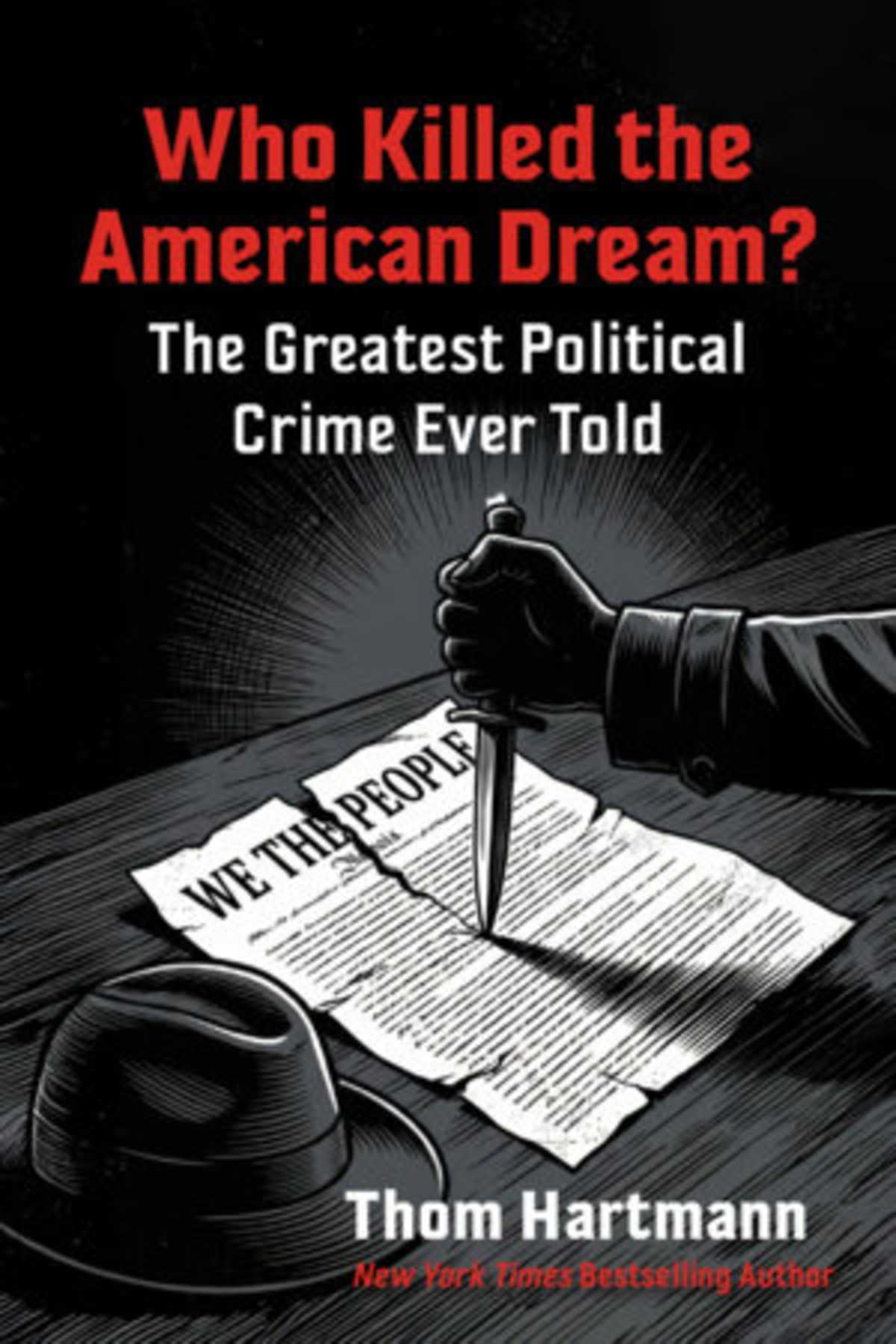
This post is a book review of Who Killed the American Dream?: The Greatest Political Crime Ever Told, by Thom Hartmann (2026).
Thom Hartmann is a New York Times bestselling author of over 30 books and America’s #1 progressive talk show host, heard on Free Speech TV and SiriusXM nationwide. Thom is a very persuasive writer and progressive influencer.
Note: Throughout this review, page numbers from the book are included [in brackets], if you wish to review a quote in context or learn more about a particular topic.
In a Nutshell: Per the book, the greatest political crime ever was the 1886 “decision” by the United States Supreme Court in the case of Santa Clara County v. Southern Pacific Railroad, which “ruled” that corporations are persons under the Fourteenth Amendment to the Constitution. Per Hartmann (Chapter 4), the mastermind of the crime was Supreme Court Justice Stephen J. Field. The triggerman was J. C. Bancroft Davis, the Court’s reporter of decisions.
Hartmann tells a concise version of the story in the book’s seven-page prologue. He then adds the gory details in chapters 1-4. In chapters 5-7 he discusses corporations (as compared to real people). In chapters 8-11 and 17 he blames that decision/crime for virtually every problem facing America today. In chapters 12-15 he suggests how the crime can be “undone” via an amendment to the Constitution (since a rebellion hasn’t yet happened). Chapters 16 (The Global Stakes) and 18 (The Media Oligopoly) discuss some tangential issues related to the crime.
The first question I found myself asking as I read Hartmann’s book was, if this was “the greatest crime ever,” why didn’t anyone else seem to notice – at that time or since. The crime, as Hartmann described it, seems to demand some sort of formal investigation, some sort of correction, or at least a promise not to do it again.
After further investigation, I have concluded that others (including other courts and jurists) have noticed some “irregularities” in the handling of the case but have for the most part moved on believing that justice, a bit messy at times, was done.
The Case in Brief / The Decision
The case was kind of mundane. The Southern Pacific Railroad had intentionally not paid some property taxes that Santa Clara County (in California) had assessed. The county sued to get the money. The railroad contended that, for tax purposes, they were getting less favorable treatment than other “people” – a violation of the Equal Protection Clause of the 14th amendment. The dollars involved were insignificant to a “Class 1” railroad, but the SPRR (and its rich “oligarch” owners) were trying to make a point – and become richer in the long run.
The decision went to the railroad in a 9-0 vote on some unrelated technical issues concerning who owned the fenceposts along the railroad’s right-of-way (i.e., the ranchers owned the fenceposts/property – not the railroad). The majority opinion of the court did not address the Equal Protection Clause. As such (in similar instances) no precedent was established. Except, in this case, as noted below under “Irregularities,” a precedent was somehow established.
Wikipedia (Santa Clara County v. Southern Pacific Railroad Co.) provides a nice summary of the case (e.g., facts, headnote, defense argument, judgment, significance) that for the most part is consistent with Hartmann’s book. I will discuss the irregularities of the case in a bit. But first, I want to write about the concept of “corporations” (as Hartmann described them in Chapters 5-7).
Corporations (Chapters 5-7)
Hartmann in the three chapters of his book cited above noted that until this case, corporations were not legally equivalent to people. “We the People” in the Constitution did not include corporations.
In Chapter 5 (The Seventy-Year Legal War), Hartmann noted that Queen Elizabeth had “created” the first modern limited liability corporation in 1601 – the British East India Company [47]. In some respects, it was a “business” extension of Britian – with its own military, courts, and laws [57].
In Chapter 6 (The First Corporate War), Hartmann provides a novel and non-traditional explanation of The Boston Tea Party. He contends that; “The Boston Tea Party was, in reality, fundamentally a rebellion against raw corporate power” [57]. Per Hartmann, The Boston Tea Party wasn’t about “taxation without representation.” It was about “tax breaks for giant corporations without representation” and government-granted monopoly [59]. As such, per Hartmann, The Boston Tea Party happened because unfair tax breaks were given to the British East India Company (via the Tea Act of 1773).
In Chapter 7 (What the Founders Knew), Hartmann states that, “James Madison, Alexander Hamilton, and others understood that corporations were useful tools for specific purposes: building a canal, establishing a bank, constructing roads and other essential infrastructure. But they were only tools to be regulated by We the People through our elected representatives, not autonomous entities with their own rights. The Constitution grants Congress the power to regulate commerce. It gives states responsibility for chartering corporations. But it doesn’t grant corporations any rights whatsoever” [68].
“Corporations were creatures of state law, to be kept on a short leash by state legislatures close to the people” [65]. “Corporations were simply viewed as tools of commerce, and when a tool broke or became dangerous, you threw it away” [71].
Hartmann did acknowledge that over time, especially after the Civil War, business became more complicated, especially for the new national railroads that operated over state lines, employed thousands, and controlled vast wealth [49]. He also noted that “New Jersey pioneered ‘charter mongering,’ offering weak regulations and low taxes to attract corporate charters. Other states followed (including Delaware, where more than half of American corporations are today chartered) …” [71].
The 14th Amendment to the Constitution was adopted on July 9, 1868. It was intended to protect free slaves after the Civil War, but shortly after its adoption the railroad oligarchs, their friends (like Davis and Field), and rich stable of attorneys began to “pervert” (per Hartmann) the amendment to affirm corporate personhood.
The Crime / Irregularities
It should be noted that: “In 1877, the railroads brought four different cases to the Supreme Court, arguing that they deserved constitutional protection as ‘persons’ under [the Fourteenth] amendment. They lost all four” [21].
Exactly what happened before, during, and after the Supreme Court hearing is confusing. As noted previously, the Court ruled unanimously (9-0) for the railroad based on technical matters unrelated to the 14th Amendment. The majority opinion does not refer to the 14th Amendment or “corporate personhood.” There is nothing in the wording of the majority opinion that would suggest that corporations are “persons.”
Given the above, J. C. Bancroft Davis, the Supreme Court’s official reporter documenting the decision wrote, in an introductory summary called the headnote, “The defendant Corporations are persons within the intent of the clause in section 1 of the Fourteenth Amendment to the Constitution of the United States, which forbids a State to deny any person within its jurisdiction the equal protection of the laws” [2].
In his book, Hartmann notes: “That sentence appears before the decision itself. It looks official. It’s printed in the United States Reports, the official record of Supreme Court decisions. But it’s not part of the decision. It’s not law; it’s just Davis’s statement. And Davis’s statement directly contradicts what the decision actually says” [15].
Judges sometimes recluse themselves from cases in which they have a potential conflict of interest. I do not know if such actions are ever taken by “court reporters.” Hartmann, in Chapter 5 (The Triggerman), notes that Davis “was also heavily invested in railroads, and had briefly been president of a small railroad on the east coast” [30].
So where did Davis’s headnote come from? After writing it – but before publishing it – Davis wrote a letter to Supreme Court Chief Justice Morrison Waite stating: “I have a memorandum in the California Cases Santa Clara County v. Southern Pacific R.R. Co. as follows. In opening, the Court stated that it did not wish to hear argument on the question whether the Fourteenth Amendment applies to such corporations as are parties in these suits. All the Judges were of the opinion that it does” (31, my bold).
In his response, Waite wrote: “I leave it with you to determine whether anything need be said about it in the report inasmuch as we avoided meeting the constitutional question in the decision” [31]. It should be noted that these letters were exchanged as “Waite lay sick and dying from heart failure” [32].
In his book, Hartmann then asks the question “What Actually Happened? Did Waite really make that announcement before oral arguments? Did all the justices really agree that corporations were persons? The historical evidence suggests neither occurred. First, there’s no record of such an announcement in the official transcript of oral arguments. Second, the decision itself contradicts it. … Third, no other justices left any record whatsoever of agreeing to such a radical position. … And fourth, the timing is suspicious” [32].
And if the court didn’t want to hear arguments, why did they? In pages 23-26 of his book, Hartmann quotes both Sanderson (the SPRR attorney) and Delmas (the Santa Clara attorney) concerning the relevance of the 14th Amendment. If the court “did not wish to hear arguments,” why did they seemingly allow such arguments to take place during the hearing?
As to Davis’s “headnote,” there is one other factor that should be considered – what is referred to in legal terminology as dictum (e.g., dictum proprium, gratis dictum, judicial dictum, obiter dictum, simplex dictum). Dictum (Latin: “something that has been said”) is a statement of opinion considered authoritative (although not binding), given the recognized authority of the person who pronounced it. Hartmann does not discuss this term in his book; you will not find the word dictum in the book’s index. So, given the above definition, even if Supreme Court Chief Justice Waite did make the above “authoritative statement” it would not be binding – it should not be the basis of a legal precedent.
Wikipedia (9-19-26) summarizes the “Significance” of all the above as such: “At the very least, this is an unusual exception to the normal understanding of the workings of the Court's rule of stare decisis – the reliance on precedent. It is an instance in which a statement which is neither part of the ruling of the Court, nor part of the opinion of a majority or dissenting minority of the Court has been cited as precedent in subsequent decisions of the Court.”
As to precedent, Hartman wrote: “Courts subsequent to the publication of Davis’s case summary had already relied on the headnote, so the precedent was established. Unwinding it would require admitting that the Supreme Court’s official reporter had committed fraud and that generations of lawyers and judges had been fooled. Nobody associated with the Supreme Court, and certainly nobody in corporate America, wanted to admit that. So, the fraud has stood for a century and a half. It became law through repetition” [36]. To Hartmann this was “the greatest political crime ever told.” To me, at the very least, it appears to be a grave injustice.
Domestic Repercussions (Chapters 8-11, 17)
In chapter 8-11 and 17, Hartmann seemingly blames the above injustice (corporate personhood) for virtually all the ills that plague our nation today.
In Chapter 8 (The Crime Pays Off), Hartmann drags up the Citizens United Supreme Court ruling that bugs the hell out of Democrat progressives in a section entitled “Citizen’s United: The Oligarchs Strike Back.” Hartmann writes: “We now live in what some political scientists call an oligarchic democracy, a system where wealth – both individual and corporate – determines political outcomes more than votes” [85].
In Chapter 9 (The Numbers Don’t Lie), Hartmann, citing statistics on wages, housing, education, healthcare, and union membership, states that: “This is the economic and political landscape that is today’s America, courtesy of corporate constitutional rights” [90]. He further notes: “Just three white men own more wealth than the entire bottom half of Americans. … These numbers should have sparked revolution” [90-91].
In Chapter 10 (The Cover-Up), Hartmann suggests that corporate oligarchs have covered their misdeeds by “Turning Poverty into a Moral Failure” [94] and making “Immigrants as the All-Purpose Villain” [97].
Chapter 11 (The Deflection Playbook) starts by suggesting that: “Perhaps the most sophisticated deflection Republicans [apparently synonymous with corporate oligarchs] mobilized to conceal the corporate theft of human rights is the so-called culture war itself. ‘Woke’ has become the oligarch’s all-purpose enemy because it’s a flexible label that can be applied to civil rights advocacy, diversity initiatives, LGBTQ equality, labor activism, honest history, and even environmental protection” [102]. As noted above, Hartmann seemingly blames corporate personhood for virtually all the ills that plague our nation today, including (I suspect) culture-war disagreements regarding abortion?
And lastly, in Chapter 17 (Corporate Immortality and Unequal Risk), Hartmann writes that “… corporations and their senior executives exclusively risk capital while working-class people risk everything else, including their families and their lives” [151]. He cites “The Deepwater Horizon Example” [160] as evidence.
How to Undo the Crime (Chapters 12-15)
In chapters 12-15, Hartmann suggests what can be done to undo the crime, noting that a “… constitutional amendment to end corporate constitutional rights is one way we can undo the crime [108]. Another alternative he suggests is to “Change the Court” [119].
The Concluding Chapters
In Chapter 16 (The Global Stakes), Hartmann writes that: “While this bizarre doctrine of corporate constitutional rights began here, it’s no longer just an American problem. Through trade agreements, international treaties, and the global spread of American legal concepts pushed by corporate-friendly law firms, … American oligarchs have exported corporate constitutional rights worldwide. As a result, democracy is under assault pretty much everywhere” [139]. To the above list he adds the World Bank, the International Monetary Fund, and the World Trade Organization [140].
In Chapter 18 (The Media Oligopoly), Hartmann blames six media corporations (Comcast, The Walt Disney Company, Paramount Skydance, Warner Bros. Discovery, Fox Corporation, and Sony Pictures Entertainment) and the Sinclair Broadcast Group for “The First Amendment Theft” [163] by “Hiding the Death of the American Dream” [167-8] via “The Stories They Won’t Tell” [168-171]. Towards the end of the chapter, he writes of “The Supreme Court’s Complicity” [171] – connecting the books narrative back to J. C. Bancroft Davis’s headnote in the case of Santa Clara County v. Southern Pacific Railroad.
Some Final Thoughts
I enjoyed the book, especially the prologue, which essentially told the story. Chapters 1-4 added some interesting details, while being somewhat repetitive. The remainder of the book was partisan (progressive) but interesting, informative, and generally well written.
Study Guide: At the end of the book Hartmann included a twelve-page study guide, which I believe would be of value in an academic situation.
The Crime: I believe that Hartmann wrote an interesting story about an interesting legal mystery. Hartmann is a good storyteller. I don’t agree with Hartmann that Davis’s headnote is the greatest political crime ever told – but I agree with him that the “corporate personhood” precedent was established via an injustice.
The Repercussions: I believe that Hartmann got carried away, trying to blame Davis’s headnote for all of today’s ills. But, in some cases, I must admit that he was convincing.
The Progressive Agenda: I found Hartmann’s presentation of the “progressive” agenda to be more coherent than most. I would recommend this book to any progressive, socialist, Democrat, or communist trying to present a coherent argument to an undecided voter.
Partisan Language: I did not like some of Hartmann’s more radical and partisan language, especially those that might encourage “revolution.” In particular, I did not like Hartmann’s reference to the “five corrupt Republican Supreme Court Justices” on page 75 of his book (as regards the Citizen’s United case). I will write more about this matter in my next post.
Beware 1: Capitalism (versus socialism and communism) is still viewed positively by most Americans. That is why progressives are adding adjectives in front which are not viewed as positively (e.g., “corporate” capitalism, “crony” capitalism, and “oligarch” capitalism. Be careful not to throw the baby out with the bathwater.
Beware 2: It took me a while to recognize that Hartmann had an alternative motive in documenting the Supreme Court decision on Santa Clara County v. Southern Pacific Railroad. The purpose of the book was not to better understand or solve a “crime.” It was to cancel the United States Supreme Court. Via his writing, Hartmann linked an action that might be construed as “corrupt” to “five corrupt Republican Supreme Court Justices [75], and a suggestion to “Change the Court” [119]. That was the main purpose of the book. The courts, one of the three branches of our government, have been a thorn in the side of the progressive agenda of late. One option (just short of revolution) is to eliminate, pack, or otherwise neuter the judicial system. I will write more about this matter in my next post.
Oligarchs: The term “oligarch” as used by Hartmann when he referred to the founders of the Southern Pacific Railroad [9-10] and the three men who own more wealth than the bottom half of Americans combined [169] pose a problem for the Republican party – and a villain for the “progressive” wing of the Democrat party. In the old days, generous foundations (Rockefeller) and free libraries (Carnegie) helped mollify that problem. Alas, now days some our oligarchs are associated with Artificial Intelligence, which, if some are to be believed, will kill us all in ten years. That is a serious problem that the Republicans will have to speak to before the November 2026 elections, if they want to continue to govern.