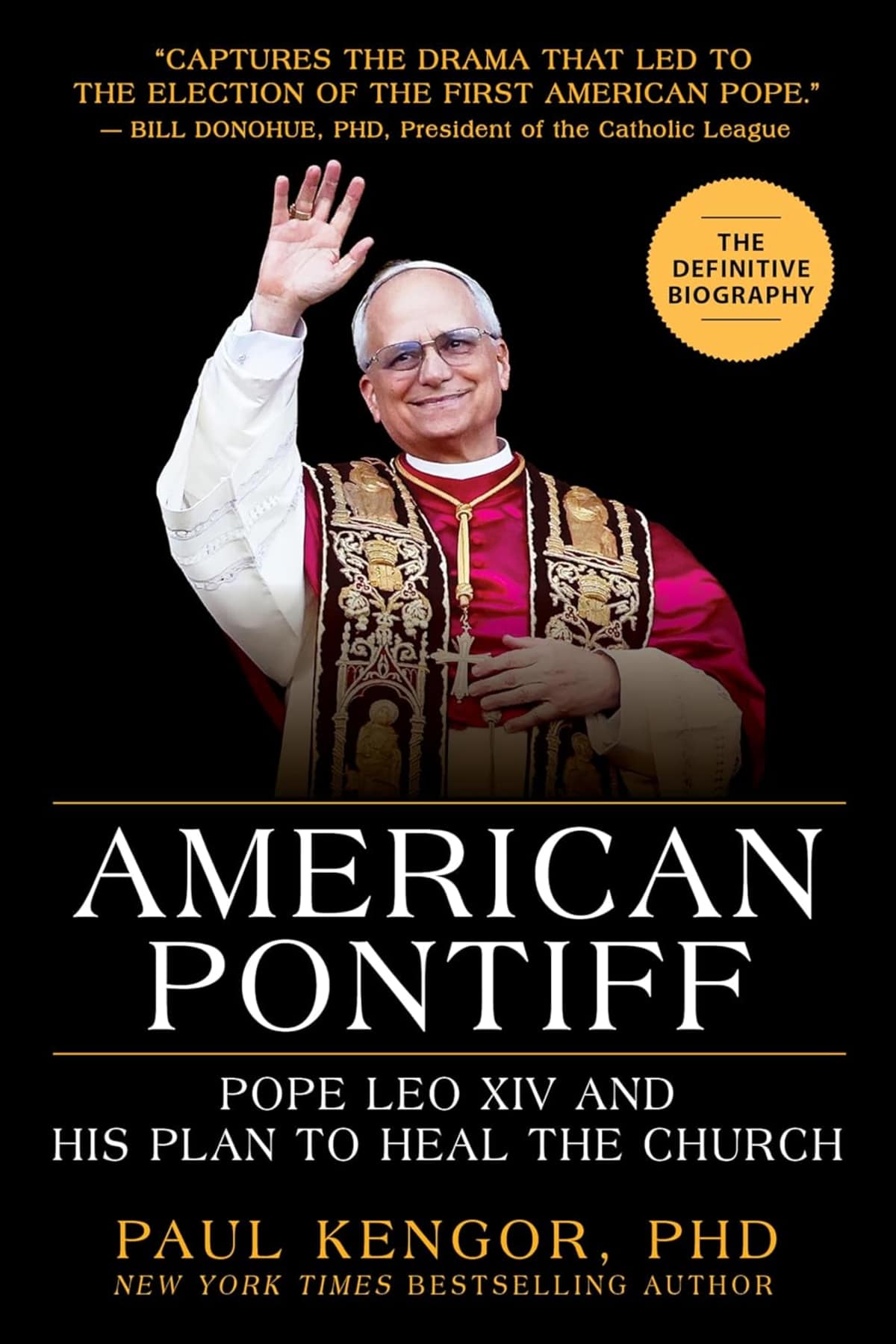
This is a review of American Pontiff: Pope Leo XIV and His Plan to Heal the Church by Paul Kengor, Ph.D. (2026). The book actually covers two popes, with much of the book spent analyzing the pontificate (2013-2025) of Pope Francis (Jorge Mario Bergoglio).
I first wrote about Pope Francis in my book A Catholic Prays Scripture (Volume 4): concerning God’s “word” and the “future.” In Chapter 6 (Your “Future” Prayer), I wrote about Pope Francis’ love for a book entitled The Betrothed by Alessandro Manzoni, and how I believed that book impacted his ministry of “mercy” (more towards the end).
Note: Throughout this review, page numbers from Kengor’s book are included (in parenthesis), if you wish to review a quote in context or learn more about a particular topic.
About The Author
Paul Kengor, Ph.D. (University of Pittsburgh’s Graduate School of Public and International Affairs) is the editor of The American Spectator and the author of over twenty books on religion and politics, including, for example, A Pope and a President, God and Ronald Reagan. Kengor is also a frequent contributor to the likes of MSNBC, C-SPAN, EWTN, and FoxNews. He is also a frequent public speaker and lecturer.
In the back of the book, in the “Acknowledgements” section, he wrote about his publisher’s request to write a book of about 40,000 to 50,000 words, in 1 to 3 months, on the new pope BEFORE that pope was determined. Kengor agreed, noting that “a writer writes, and I love to write, especially about the subject dear to me: the Catholic faith” (349). The book turned into 112,000 words and it took just a bit longer to complete.
As to the title of the book, I have only one criticism, the use of the words “His Plan” in the subtitle. The book does provide “A List” of things that the new pope needs to consider doing, but I would hesitate to call it Pope Leo XIV’s “plan.”
The Structure of the Book
The first two chapters cover the history of the papacy from the first pope (St. Peter) to the last pope (Francis). The next set of chapters (3-7) cover the events surrounding the selection of Robert Francis Prevost as the 267th pontiff of the Roman Catholic Church. Chapters 8-10 describe Prevost’s previous life – his birth, his family, his education, and his careers as priest, bishop, and cardinal. Chapters 11 and 12 discuss two names, “Leo” and “Augustine,” and what those two names (and associated people) mean to the Catholic Church. Chapters 13 and 14 are entitled, “Pope Leo XIV’s First 40 Days” and “The Future of Leo XIV and the Church.”
“To Make a Mess of Things”
Throughout the book, Kengor made repeated references to Pope Francis’ calls for Catholic youth “to make a mess of things.” Francis used those words early in his papacy (in 2013 to Argentine pilgrims going to World Youth Day); and he used those words towards the end of his papacy (“wreak havoc, make a mess,” in 2024, while speaking in East Timor).
While that charge may have been appropriate for the younger generations – a variation of “get involved, ask questions, push your leaders” – what proved to be disturbing was that “Pope Francis had committed himself to (in his own words) “make a mess of things” (x). “And when Francis said that he wanted a mess, he said so with a laugh. But the chaos was not funny, and the faithful were not amused. The lost sheep wanted answers from their shepherd who, above all, was supposed to lead them rather than lose them" (333-4).
The “mess” and “chaos” that ensued led to an inexplicable and baffling papacy. Kengor wrote, “As someone who had been a Francis ‘pope-splainer,’ defending him countless times in articles, public lectures, on podcasts, TV, radio, and every format when asked to comment on his latest bewildering action, I became overwhelmed and exhausted and just stopped” (19).
Kengor suggested that the “mess” may have been what ultimately led to the selection of Robert Francis Prevost as Francis’ replacement. “So many of the cardinals had hungered and ached for a pope who would clean up the mess and bring back unity, peace” (x).
The Mess
So, what exactly was this mess that Francis made?
In a previous post (December 5, 2025) on this blog, entitled “The New Oxford Review (and Pope Francis),” I noted some of those issues. In Chapter 2 of his book (“I Want a Mess”: The Francis Papacy), Kengor added to my list. Among the issues identified by Kengor were:
· The Vatican’s “scandalous agreement with communist China” (22).
· Pope Francis’ apostolic letter Traditionis custodes, which seemed to be aimed at the traditionalists in the church who preferred the ancient Latin Mass (24-29).
· Fiducia supplicans (“On the Pastoral Meaning of Blessings”), which authorized the blessing of same-sex couples.
· Pope Francis’ vindictiveness towards the cardinals who dared to submit dubia (Latin for “doubts”) to Pope Francis, seeking doctrinal clarifications. Kengor goes into detail on Francis’ especially vindictive treatment of Cardinal Raymond Leo Burke. “Burke was targeted and damaged by Francis. He was persecuted by the Jesuit pope” (49).
ALL WAS NOT A MESS! Kengor on pages 37 and 38 noted many of the good things that Francis did during his papacy. For example, Kengor noted that, "Francis was superb on the scourge of human trafficking, prostitution, child labor, and modern forms of slavery. He saw these things as evil and said so. ... Francis was strong on issues of basic human dignity. ... But alas, with the good, there was no denying the bad and the ugly and the confusion and mess of things."
The Conclave
In Chapters 3-7, Kengor wrote about the events that happened before, during, and after the conclave that elected Pope Leo XIV.
Kengor wrote about many of the “odds-on favorites” going into the conclave, such as cardinals Pietro Parolin from Italy and Luis Antonio Tagle from the Philippines (vii).
Note: Cardinal Tagle was something of a family favorite. My aunt had met him when he visited some friends many years back in Bismarck, North Dakota.
Kengor wrote about the makeup of the conclave – the 133 “cardinal electors,” who would be voting for the new pope. As pope during the preceding twelve years, Pope Francis had picked 108 of those electors – most of them considered to be “Francis-like” and “liberal.” Conservative Catholics feared that Pope Francis had stacked the deck. But many of those new cardinal electors were from 25 countries that had never had a cardinal before, and these “periphery cardinals were not known to be especially liberal” (69). Ten of the cardinal electors were technically from the United States, including Robert Francis Prevost.
While Robert Francis Prevost’s name was not on many of expert’s “new pope” short lists, it turned out that he had one huge advantage over the other cardinals. Via his work in the Roman Curia (the governing and administrative body of the Church), he was known by many of the other cardinal-electors. Kengor did a nice job of describing that part of Prevost’s resume.
“Prevost began his service in the Roman Curia in 2019 as a member of the Congregation for the Clergy” (190). During the following year he got a second appointment to the Congregation for Bishops. By the end of 2022, he had “shared curial membership” with 36 cardinals.
AND THEN CAME 2023, the year he was appointed (by Francis) prefect of the highly visible Dicastery for Bishops AND the year he was promoted to cardinal (September 30th, by Francis). By the end of 2023, Prevost held positions “in at least eleven curial bodies” (190), sharing memberships with 103 other cardinals. He had more of these shared curia memberships than anyone else. Prevost apparently took his “networking” seriously. The other cardinals knew him (and apparently liked and respected him).
Kengor also wrote about the pre-conclave, in which the cardinals of the world met informally to share their thoughts and get to know one another. Per Kengor, “What quickly emerged from the pre-conclave meetings is that a substantial, if not large, majority of cardinals wanted someone who was not like Francis, …” (41).
While theoretically secret, the various votes (details or informed speculation?) from the conclave have leaked out. The leaks suggested that by the fourth vote, the various cardinal elector factions had zeroed in on Robert Frances Prevost as the pope to clean up the mess and halt the chaos. The leaked results suggest that he received over 100 votes during the final vote, many more than the 89 required.
Robert Francis Prevost
So, who is Rober Francis Prevost, “Bob” to many of his friends and fellow clergy? He was relatively unknown at the time of his election. While very active, he had (via his nature) kept his head down, which may have helped him avoid the rath of Pope Francis – indeed may have helped him obtain Pope Francis’ admiration. Beginning in Chapter 8, Kengor told the story of Robert’s birth, family, education, and career.
Kengor suggested that “Prevost is surely the most genuinely universal Holy Father in the history of the Roman Catholic Church” (137). His mother hailed “from a mixed-race family of Hispanic and Black Creole” (133). His father was of Italian and French descent.
Per Robert’s two older brothers, he was destined to be a pope. “He just had this calling, I believe, since birth” (131). “They actually referred to him as ‘holy,’ so much so that it became a nickname for him” (142).
Robert quickly moved up the ecclesiastic ladder, from a parish altar boy to a minor seminary student in Holland, Michigan, from 1969 to 1973 (144-5). From there, it was on to Villanova University, near Philadelphia, where he got a degree in mathematics (more later). The Catholic Theological Union (CTU), in the Hyde Park section of Chicago, was his next stop, where he obtained a Master of Divinity degree in 1982 (151). His early stops in Holland, Michigan and Philadelphia were at institutions affiliated with the Augustinian order. Prevost was very much an Augustinian from the beginning.
“After he graduated from CTU and took his solemn vows in 1981, [Prevost] was invited to study canon law in Rome” (152). “On June 19, 1982, 26-year-old Robert Francis Prevost was ordained a priest in the Order of Saint Augustine” (156). He then went on to earn his “doctorate in canon law from Rome’s Pontifical University of St. Thomas Aquinas” (159).
Many of Prevost’s early “Augustinian” assignments were in Peru. “The geopolitical reality is that this was a scary, threatening time for a foreign priest to be sent to Latin America” (162). Three priests were martyred in Peru in 1991. The Russian KGB was creating turmoil, via what came to be called “liberation theology.” In his book, Kengor notes how close Prevost came to almost becoming a victim” (167).
Before he moved on to the Roman Curia, he had two other major clerical challenges. On September 14, 2001, he became the head of all the Augustinians in the world. He held that position until September 2013 (170). In 2014 he was made a bishop by Pope Francis, and on September 26, 2015, he was appointed bishop of Chiclayo, Peru (177). There he shepherded his flock until he was called to Rome.
Pope Leo XIV or Pope Augustine?
What is in a name? The phrase/question originated from Shakespeare in Romeo and Juliet. In Chapters 11 and 12 in his book, Kengor wrote about the names Leo and Augustine.
On the day that he was elected to be the next pope, Prevost had to do two things right away. First, he had to officially accept the job and all that goes with it. Secondly, he had to choose a papal name. Kengor took almost all of Chapter 11 (What’s in a Name? The Leo Legacy) to discuss that matter. It was a much more complicated decision than one might ordinarily expect; there are ramifications. The first part of the process is to eliminate all the names that you might want to avoid (e.g., Pope Francis II?).
The name ultimately chosen, Leo XIV, was a marvelous choice. The thirteen previous “Leos” were great, starting with Leo the Great (391-461 AD), a contemporary of St. Augustine (354-430 AD). But, most commentators, including Kengor, suggested that the best connection to the past – and the “Leo” that Prevost was probably thinking of – was the most recent papal Leo: Leo XIII (pope from 1878-1903 AD).
“By invoking the name of Leo XIII and Rerum Novarum, today’s Pope Leo has thoughtfully told us much about how he sees the world” (215). Pope Leo XIII’s historic papacy was known for its numerous profound statements and documents, including Rerum Novarum, which has become the foundational text on Catholic social teaching.
At the time of Rerum Novarum, Pope Leo XIII was trying to help the world navigate the Industrial Revolution. “Leo XIV is dealing with major upheaval in today’s post-modern world, including the tech-information revolution and especially the new threats posed by artificial intelligence” (215). Pope Leo XIII faced – and Pope Leo XIV faces – similar challenges.
Kengor also noted that “it was Pope Leo XIII who gave the world the St. Michael the Archangel Prayer, which he composed after a dramatic vision of hell” (213). Over the years, Catholics have recited that prayer less frequently as a body. Maybe under Pope Leo XIV the prayer will make a comeback.
In Chapter 12 (Son of Augustine), Kengor discusses Augustine, one of the 38 saints who have received the title of “Doctor of the Church,” for their contributions to theology (the study of God) and doctrine. Prevost’s life has been impacted by Augustine’s considerable writings (e.g., 112 books), including Confessions.
Kengor asks the question, “Seeking to be a pope of unity, one wonders why perhaps Robert Francis Prevost did not choose the name Augustine for his papal name, in keeping with his papal words, motto, and coat of arms” (235).
Kengor sets up the answer to his own question, by noting that “There has never been a Pope Augustine” (235). Kengor then adds, “More so because for 1,100 years, every newly elected pope had picked a name that had been used by some other previous pope” (236).
Kengor goes on to note that Pope Francis had been the pope that broke that 1,100-year stretch, and maybe a Pope Augustine, back-to-back with a Pope Francis, might be too much for the masses to handle.
Kengor concludes, “And so, the Church now has arguably the best of two worlds: a pope inspired by both Leo XIII and Saint Augustine. The world has an Augustinian pope, a son of Augustine committed to the Leonine legacy of unity – a double unity badly needed in the post-Francis Church” (236).
The Challenges
In Chapter 14 (The Future of Leo XIV and the Church), Kengor lists and comments on thirteen challenges on the new pope’s plate, including: reversing the decline in Catholicism and Christianity; guarding tradition; dealing with Traditionis custode; rescinding or refining Fiducia supplicans; and dealing with “Francis’s legacy of fissures, battlelines, and leaks.
In Chapter 13 (Pope Leo XIV’s First 40 Days), Kengor lists some of the things that Pope Leo XIV did, during his first forty days, to address the challenges noted above, including: reconstituting the John Paul II Institute, recognizing the contributions of two of the five dubia cardinals (Caffarra and Burke), and making a major statement on the family (on the first day of Pride Month). I was very much encouraged after reading this chapter.
Miscellaneous
Below are a few random items that caught my attention as I was reading Kengor’s book.
Western Media: In October of 2012, during the synod on the New Evangelization, Prevost, then the prior general of the Order of St. Augustine, said the following:
“Western mass media is extraordinarily effective in fostering within the general public enormous sympathy for beliefs and practices that are at odds with the Gospel. For example, abortion, the homosexual lifestyle, euthanasia. Religion is at best tolerated by mass media as tame and quaint when it does not actively oppose positions on ethical issues that the media have embraced as their own. However, when religious voices are raised in opposition to these positions, mass media can target religion, labeling it as ideological and insensitive in regard to the so-called vital needs of people in the contemporary world.”
I very much agree with the above statement. If you wish to hear the pope say more about this matter, click here.
On May 12, 2025, during his first 40 days, Pope Leo XIV spoke to the Vatican Press Corps, quoting at one point Mathew 5:9 (“Blessed are the peacemakers”). In his book, Kengor asked the question, “Do journalists ever think of themselves as peacemakers” (244)?
Mathematician: As noted previously, Pope Leo XIV has a degree in mathematics from Villanova University. In his book, Kengor quotes others as saying, “Often, the kind of person who wants to become a priest is the kind of person who sees order and beauty and truth and the transcendentals of nature in the world, and the people who see these things are naturally attracted to mathematics” (148). Kengor adds that, “Prevost inherited a Francis papacy that confused the faithful with its disorder. Math, on the other hand, seeks to bring order out of chaos” (149).
Fulton John Sheen: In “An American Postscript” in the book’s epilogue, Kengor writes about Fulton J. Sheen, the “previous” most famous American Catholic. Via his election, Pope Leo XIV now receives the torch once carried by Bishop Sheen. “The Sheen period represented a golden era of American Catholicism” (344). The question becomes, will that golden era ever return, and if so, will Pope Leo XIV lead us there.
The Names: My immature side surfaced as I read some of the Italian names in Kengor’s book – Cardinal Pizzaballa, the Latin Patriarch of Jerusalem (53), and Baldassare Reina, the new head of the John Paul II Institute (268). I can almost picture the Saturday Night Live skits.
Cardinal Blase Cupich: In his book, Kengor referred to Cardinal Blase Cupich as “Francis’s American point man” (33). Cupich was appointed Archbishop of Chicago, by Pope Francis, in 2014. I have not followed Cupich’s career closely enough to comment on Kengor’s “point man” reference; but Cupich is something of a hero in Omaha – a local boy made good. Born, raised, educated, and ordained in Omaha, he was once the pastor of St. Bellarmine Parish, just a couple of miles down the road from where I write.
Kengor brought up Cupich’s name at the end of the book in a section of Chapter 14 (The Future of Leo XIV and the Church) entitled “Avoiding Polarization Amid the Minefields). In that section, Kengor wrote that, “Pope Leo had two bad weeks in late September and early October 2025 directly resulting from residual effects of Francis. First, he faced a debacle created by Francis ally Cardinal Blase Cupich, who outrageously offered a lifetime achievement award to pro-abortion U.S. Senator Dick Durbin …” (338).
The American Church struggles with how to handle Catholic politicians who publicly defy Catholic teachings. In Durbin’s case, his bishop has long denied him communion. Given that history, a lifetime achievement award seemed beyond the pale. Durbin, to his credit, declined Cupich’s award. Just another day and minefield in the life of the new pope.
Doctrine versus Indoctrination: In his book, Kengor discussed the nuances of doctrine versus indoctrination, which Pope Leo XIV says is “immoral” (209). Kengor goes on to say, “The Catholic Church needs doctrine; it is based on doctrine. There exists in the Church a long line of doctrinal clarity and consistency from the time of St. Peter and the Apostles to the modern popes and Magisterium” (209).
Not everyone is a fan of doctrine, but it appeals to a subset of humanity searching for both consistency and truth. Indeed, there is evidence that doctrines and dogmas have attracted many millennials to the Church in recent years, many of them males. I believe that many in the church, certainly us conservatives and traditionalists, were concerned that Pope Francis had been confusing those in the pews as to what Catholics should believe. Our great hope is that Pope Leo XIV will alleviate these concerns.
Pope Francis and The Betrothed
As I noted at the start of this post, in my book A Catholic Prays Scripture (Volume 4): concerning God’s “word” and the “future, I wrote about Pope Francis’ love for a book entitled The Betrothed by Alessandro Manzoni. I have come to believe (as an armchair psychiatrist in Omaha) that that book deeply impacted Pope Francis’ thought process, which, in turn, affected his pontificate.
In a 2013 interview with the Jesuit magazine America, Pope Francis stated, “I have read The Betrothed, by Alessandro Manzoni, three times, and I have it now on my table because I want to read it again. Manzoni gave me so much.”
In the March 2014 issue of New Oxford Review, in an article entitled “Reading Francis Through Manzoni,” Francis J. Manion wrote, “… the main themes of [The Betrothed] include: … the scandal of clericalism closed in on itself, always seeking the comfort of worldly respect and ease, even to the neglect of priestly duties .…”
The cast of characters in The Betrothed included: Lucy, a girl who just wanted to get married to Renzo; The Cardinal; and The Priest – who when intimidated by a villainous nobleman, refused to marry Lucy and Renzo.
I believe that when Pope Francis read The Betrothed for the fourth time, he developed a deep-seated DISDAIN for the clergy – for HIS clergy – and how those clergy sometimes fail to show mercy and empathy to the likes of Lucy – who just want to get married.
I believe that this disdain rose to the surface subsequently whenever “his clergy” got in the way of “mercy,” regardless of the situation and relevant doctrines (e.g., maybe when two same-sex people just want to get married). This was an inherent tension and frustration for Pope Francis – and all of those caught up somewhere in the middle – between mercy, empathy, and doctrine. In a sense, The Betrothed had become part of Pope Francis’ Bible.
The Holy Spirit
We Catholics believe (at least I do) that something special happens when a new pope is selected. When the cardinal electors huddle in the Sistine Chapel, I believe that the Holy Spirit is present – more so than usual – to help those present find “the right guy for the job at that moment in time.”
I believe that the Holy Spirit was active when Pope John Paul II was elected in 1978 (evangelization). I believe that the Holy Spirit was active when Pope Benedict XVI was elected in 2005 (doctrine). After reading Kengor’s book, I have come to believe that the Holy Spirit led the cardinal electors in 2025 to Robert Francis Prevost (unity). I am not sure what to make of the Holy Spirit’s role in the election of Pope Francis in 2013. I should note that the last sentence was very difficult to write.
I have come to appreciate that the Catholic Church didn’t need 267 consecutive “doctrinal” popes, or 267 consecutive “mercy” popes, or 267 consecutive “warrior” popes. The Church, over its 2000-year history, has had all these types (and many more).
What did the Church (conclave and Holy Spirit) see in Pope Francis? “Mercy” is my kneejerk response, but did he foster it? Was it a righteous target impacted by poor execution? Did mercy get swallowed up by empathy? Was Pope Francis a leader that few (sinners?) would follow? Did mercy get in the way of doctrine, or did doctrine get in the way of mercy?
I remind you (and myself) that we Catholics do not believe that the pope is a god. The pope is not the emperor of Japan. The pope is a human, with human foibles that accentuate with age and isolation. Jesus did us a favor when he gave the “keys to the kingdom” (Mt. 16:19) to Peter, the man who had denied Jesus three times before he was crucified. Jesus thus warned us, upfront, not to look for “perfection” in a pope.
Conclusion
I found Kengor’s book to be very readable. He is a good storyteller, turning what could have been boring religious pontifications into a very readable story. I found the book to be a little repetitive at time – from chapter to chapter. It could have used a bit more editing (the pot calling the kettle black) but, as the author noted, it was written on a tight deadline. In general, the book reassured me that all was right again – or at least heading in the right direction.
As to Pope Leo XIV, I am encouraged by his first 40 days (as documented by Kengor) and the days that followed. As a mathematician (okay engineer), conservative, Midwesterner, and a man named Robert (nicknamed Bob), I believe that the chaos of the recent past will be calmed. I pray for a new golden era of American Catholicism.
Since Kengor finished his book, Pope Leo XIV issued (May 25, 2026) his first encyclical Magnifica Humanitas, which expressed concern for the human person in this new age of artificial intelligence. Leo has also had a few dustups with Donald J. Trump over Trump’s actions against Iran, and Trump’s threat to annihilate the Iranian civilization. Trump could certainly benefit from Pope Leo’s input and Pope Leo might benefit from a review of what a “just war,” is – as it relates to a religiously intolerant country promoting jihad, while developing nuclear weapons.