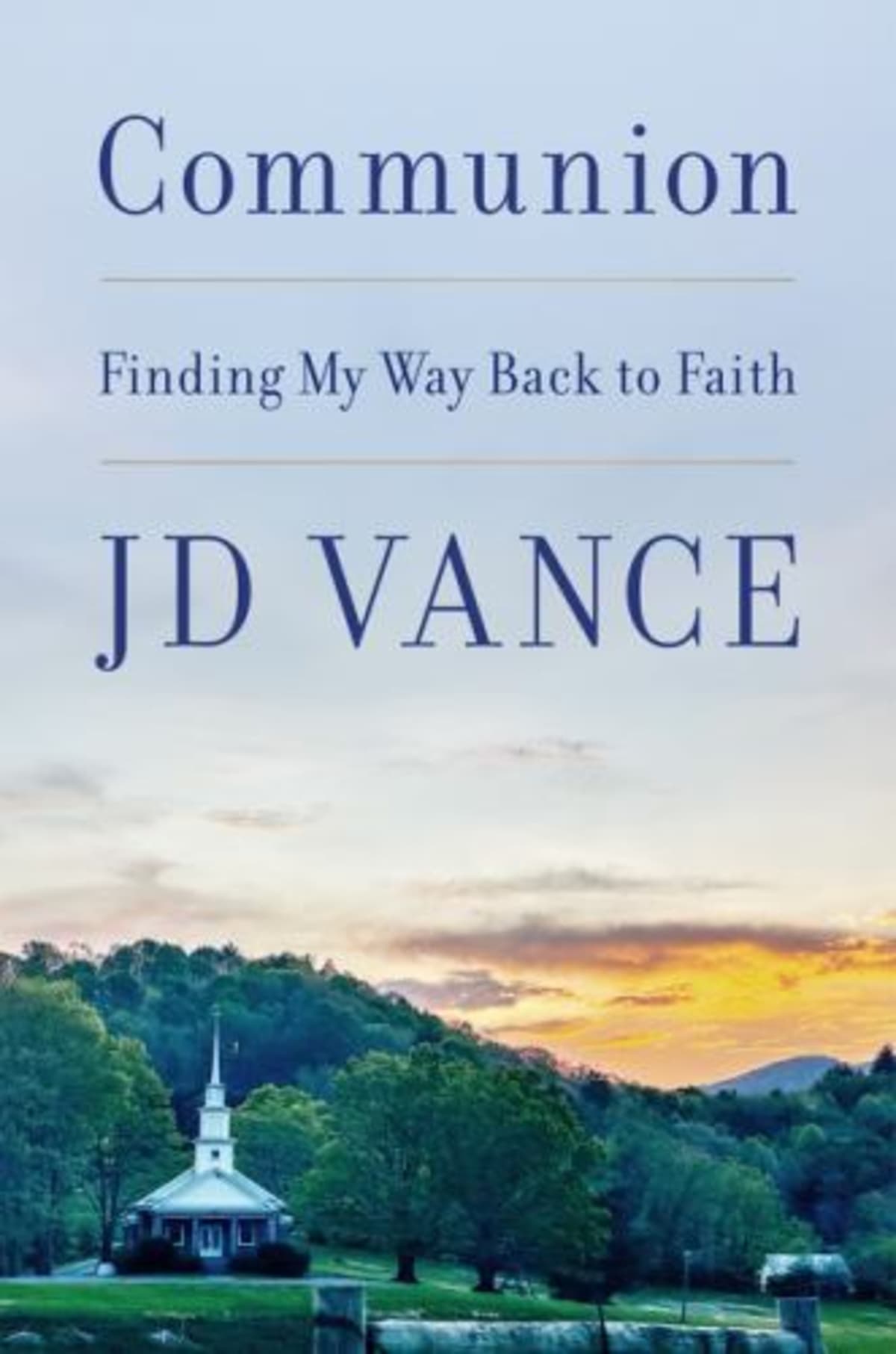
This post is a book review of Communion: Finding My Way Back to Faith by JD Vance (2026). I was attracted to the book because 1) I like JD Vance politically, and 2) I am always interested in “Catholic conversion” stories. What leads a person to choose to go through all the work (e.g. the RCIA/OCIA process) to become a Catholic – to convert from what they were? JD Vance, from an evangelical background, was baptized into the Catholic faith in mid-August of 2019.
Note: Throughout this review, page numbers from the book are included (in parenthesis), if you wish to review a quote in context or learn more about a particular topic.
Note: When I read the book, I found out that Vance somehow avoided the RCIA/OCIA process via a “personal study.” He did note, however, that he “liked that the Church required you to work a little to join” (172).
My latter interest (conversion) probably led to my biggest disappointment in the book. Most of the book seemed to deal with non-religious matters (e.g., biography, family, politics, culture, policy) – instead of religion. The caveat to that observation is that Vance’s religion seems to be intwined into his life (e.g., politics and policy), so that it is difficult at times to separate them. Indeed, he himself notes that, “The Christian faith is not a weird little compartment of my life … It is the lens through which I see the world” (214).
So Why the Change?
From his book, I concluded that Vance’s conversion was (in my perceived order) intellectual, sacramental, and practical. His biggest obstacle was how “foreign” the Catholic Church appeared to him at times.
But the very first decision that he had to make was whether he wanted to be a Christian (of any kind). While he came from an evangelical background, he apparently had never been baptized. What faith he had was related to the faith of his Mamaw (grandmother who “loved Jesus”), but that faith had withered when he was out on his own (in the Marine Corps in Iraq and as a college student at Yale). But even during those times he seemed to have an openness to faith; he was searching.
Intellectual: Vance’s searching involved a lot of study and reading over the years. While at Yale, he and a few friends took an online university course on the Hebrew Bible. He read some C. S. Lewis books and contemplated his own faith. One of those books was The Screwtape Letters, “written from the perspective of one demon counseling another demon on how to deceive a young man into abandoning his Christian faith” (46). At first, it didn’t take, as Vance noted on page 48, “You might have expected my reading to lead me to deeper engagement with my faith. Instead, I felt jaded.”
But Vance was persistent. By page 158, as he “continued to flirt with Catholicism,” he wrote, “What felt comfortable at this point was to intellectualize faith. So I read a lot of books. G. K. Chesterton’s The Everlasting Man had a particularly insightful quote about the nature on mankind [which he then quoted].”
“I kept reading. I read about Saint Thomas Aquinas and natural law. I read academic treatises on Christian doctrine. I revisited some old Christian apologetics … and I reread C. S. Lewis’s collected works. I can say in good faith that this time I found Christianity more and more intellectually coherent and true. … Catholicism’s historical continuity was powerful” (159).
Vance later wrote that, “I am most comfortable engaging with the intellectual elements of the faith: What do we believe (174)? … Catholic teachings touched the part of my heart and mind that demanded I focus on the things that actually matter” (175).
Sacramental: While Vance was initially intellectually attracted to Catholicism, the sacramental nature of the Church, also attracted him – in particular the sacrament of Penance (aka “confession”).
“The fact that there was a sacramental ritual around guilt – of publicly confessing something, admitting you did wrong, and performing an act of penance – attracted me to Catholicism” (125). “It’s like therapy, but with less whining and more guilt. … And you can also recognize that even a very damaged person is still responsible for their misdeeds” (124-5).
“Real grace comes through practice. This is why we demand that you have a sacramental life: going to church, taking Communion, doing confession. … The idea of grace as a process rather than a singular moment was profound to me “(163).
Practical: Vance’s renewed interest in Christianity and eventually Catholicism also had a practical component. “Having a boy felt like an opportunity to fix something in my past, to give my son the things I hadn’t had. And it also forced me to accelerate my religious journey. I knew I wanted to raise my kids in some church, but I didn’t know which one. As hypothetical children became a very real child arriving soon, I began thinking about my faith in a far more intentional way” (134).
One other practical issue was this observation by Vance; “If there was a single person in my life who most embodied the Christian ideal, it was my Uncle Dan” (160). Uncle Dan was a Catholic, who apparently lived the faith and became a visible “testimony” to JD.
An Intellectual Complication
Vance declared early in his book that it was “not a work of Christian apologetics” (6). He further noted that he has “an open spirit about specific questions of doctrine and faith” (7). I, on the other hand, am more doctrinal in nature. My four books in the “A Catholic Prays Scripture” series are more about Catholic apologetics than prayer.
Vance and I share (and have apparently shared for some time) one doctrinal issue regarding the literary nature of the Bible. I specifically addressed this issue in Volume 4 of my series, concerning God’s “word” (in Chapter 7 entitled “Does God Care?).
Vance noted his concern early in his book. He was writing about a time when he was searching for truth. He wrote: “In Dad’s church I also encountered a skepticism of modern science that was new to me. If I must believe, as a matter of faith, that God created the Earth six thousand years ago, then I couldn’t believe that the universe was billions of years old, or that evolution had produced man in his modern form over hundreds of millions of years. Much of what I learned in science class was not just false, according to this way of thinking, but a direct assault on faith” (20).
Vance was able to get beyond this concern, but I fear that many others don’t. I will not belabor this issue anymore, at this time, except to note that Catholicism, as a religion, or denomination (if you prefer), is more accepting of “literary form” than Vance’s dad’s church (or his Manaw’s beliefs).
Obstacles
As part of his conversion to Catholicism, Vance had to overcome some issues. He had to overcome the situation noted above, the skepticism of modern science. He also had to get around the feel of Catholicism (somewhat foreign/Italian) versus evangelical Protestantism – “the uncomfortable fact was that the Christ of the Catholic Church seemed a little different from the Jesus I’d grown up with” (157). Vance also had to overcome cultural issues. Many of the people he worked and interacted with were suspicious of, or hostile to, organized religion.
And lastly, his wife Usha “was raised in a Hindu family” (109). As regards this fact, Vance wrote, “Usha has said that the business of converting to Catholicism – studying and thinking about it – was ‘good' for me” (175). Vance noted in the book that she had been part of his journey, when he took the online course on the Hebrew Bible – “As in law school, Usha did the reading and I mostly listened to the lectures” (114). He also noted that she was with him when they toured the ancient Christian churches in Europe.
Vance’s Big Fear
“My big fear isn’t death but that we inherited a great civilization and are slowly letting it fall into disrepair” (263). Vance wrote that while he was visiting a cathedral in Burgundy, France, “I couldn’t stop thinking about the emptiness of the cathedral and what that said about Europe’s cultural decline and Christianity’s slow evaporation from the continent” (171).
Vance lays much of the blame for the above to the “elites” that govern or otherwise influence our lives. He cited the Munich Security Conference in 2024 as an example. “[It] had about as much Christianity as a 1959 meeting of the Soviet high command. There were no mentions of God” (196). Vance further noted that the host of the conference, German Chancelor Olaf Scholz, was the first German chancellor to take God out of his oath of office.
Charlie Kirk
Vance also wrote briefly about Charlie Kirk, who was perhaps his “best friend and closest confidant in the world of politics” (280).
I was never a friend of Charlie Kirk as such, but I was a fan. I admired much of what he did during his too short life and wrote about him in two of my past blog posts (“‘The Nation,” the ACLU, and Charlie Kirk (Part 1)” on September 17, 2025; and “Baby Boomers and Charlie Kirk (Part 2)” on September 21, 2025).
As to Kirk, Vance wrote, “Charlie was a person of profound faith. After his death, public commentators debated whether he, a lifelong evangelical, was on the verge of converting to Catholicism. … He called himself the most Catholic evangelical in the world, and he admired the Catholic Church’s ancient traditions and respect for Mary. … My guess is that he would ultimately never have become Catholic, but who knows” (283)?
Conclusion
If you are interested in JD Vance the man and/or are looking for an update to his first “autobiography” (Hillbilly Elegy), I would recommend this book. As previously noted, in addition to Vance’s conversion story, the book contains a lot of information on politics and policy.
Right now, today, Vance is my pick to replace Trump, on January 20, 2029, as the 48th President of the United States. I favor him over Marco Rubio, Ron DeSantis, or any of the others being discussed. I favored him before I read this book and the book reaffirmed that choice. It will be interesting to see if he can escape Trump’s “loyalty demanding” wrath over the next two years. I suspect that the chances are less than fifty-fifty.