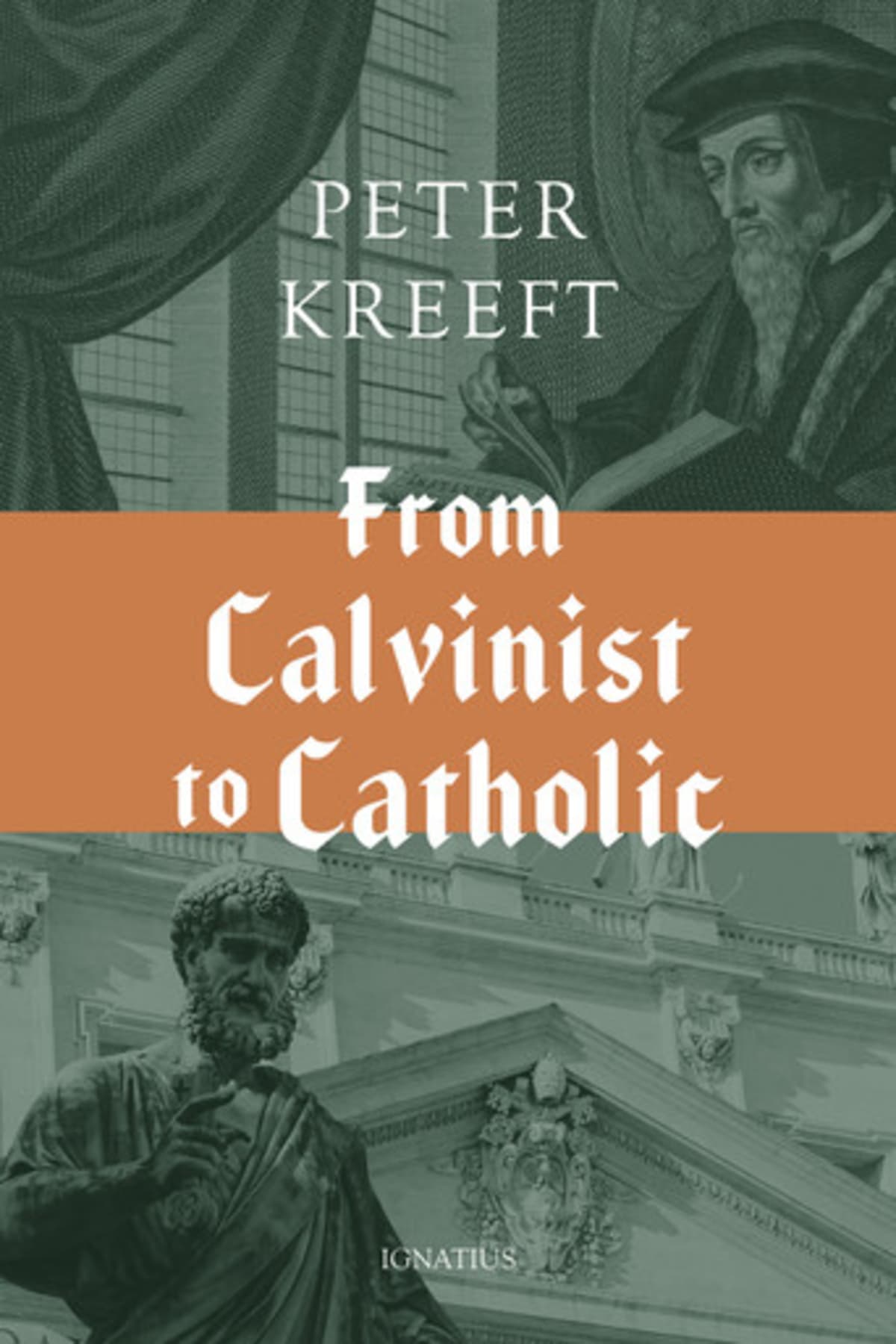
Well, this is kind of weird. I am writing a review of a book after reading a review of a book – that book being From Calvinist to Catholic, an autobiography by Peter Kreeft (copyright 2025).
The review, Enjoyably Evangelical, was written by Kevin DeYoung, the senior pastor at Christ Covenant Church in Matthews, North Carolina. I ran across DeYoung’s review in the October 2025 issue of First Things. Let me begin with a few quotes from DeYoung’s review that enticed me to read (and review) Kreeft’s From Calvinist to Catholic.
A Review of Enjoyably Evangelical
DeYoung begins: “Not many people need to write an autobiography – especially not philosophy professors. Not many people who take the time to write an autobiography will do so in under 200 pages. But Peter Kreeft is unlike most people (and most philosophy professors). For starters, there is his sheer output: more than one hundred books, covering everything from apologetics to surfing to Socrates to C. S. Lewis to the Catholic Catechism.”
“Almost the entire ‘autobiography’ is the intellectual story of Kreeft’s conversion and an apologia for the Catholic faith. … If a man is to be a Catholic, however, I hope he is the Peter Kreeft kind – full of good cheer and with a Protestant-like appreciation for the Bible, a personal relationship with Jesus, and the need for grace (even if we disagree on the nature of that grace).”
“Kreeft presents an enjoyably evangelical version of Catholicism. And he does not describe his conversion as a rejection of Protestantism so much as a growing-up out of Protestantism into the adulthood of Catholicism.”
DeYoung ends his review by respectfully defending his Calvinistic views, but he does so lightly and respectfully – noting that “even when I disagreed (strongly at times), it was impossible not to like the apologist.”
Peter Kreeft – the Author
I must admit that I knew of Peter Kreeft many years before reading DeYoung’s review. I have a relatively small library of apologetic books in my study, maybe a couple of hundred. I accumulated most of these books while I was attending the Archdiocese of Omaha Catholic Biblical School (2003-2007) and while writing the four volumes of my A Catholic Prays Scripture series (copyright 2023). Two of the books in my library were written by Peter Kreeft. I often quoted Kreeft because he explained the complex simply, a skill that I don’t normally associate with professors of philosophy.
The book that I found most useful, the one that I quoted from in each of my four volumes, was Catholic Christianity: A Complete Catechism of Catholic Beliefs based on the Catechism of the Catholic Church. Chapter 2 (…Prays…) of my first A Catholic Prays Scripture volume was structured around Kreeft’s “A TRIP” acronym – “Prayer is the greatest of all trips we can take: a trip to heaven” – where A = adoration, T = thanksgiving, R = repentance, I = intercession, and P = petition.
The other book that I quoted from was You Can Understand the Old Testament: A Book-by-Book Guide for Catholics. I quoted Kreeft when I wrote Chapters 4 (A Tribute to Joshua) and 5 (Daniel’s “Dream” Prayer) in my book A Catholic Prays Scripture (Volume 3): concerning some biblical characters.
Kreeft Likes Lists
In his review, DeYoung noted that Kreeft liked lists. I had never thought of Kreeft in that manner – but, after some reflection, I agreed with DeYoung. In recognition of Kreeft’s love of lists, DeYoung then listed seven of his favorite lines from the book. I have included three of my favorites from DeYoung’s list:
· On the freewheeling way of being a kid in the 1940s: “Our play had more freedom, and our work and thought had more order.”
· On the frugality of the Dutch: “Dutch Calvinists make Scotchmen look like wasteful profligates. . . . How can you tell a Dutch house? By the paper plates on the clothesline.”
· On what atheists do not see: “Religion is indeed a crutch, as the atheists argue. And until the atheist confesses that he is a cripple, he will not be in the market for a crutch.”
So, in keeping with DeYoung’s use of lists in his review, much of my review will consist of three lists of Kreeft’s best lines (in my opinion) from his book. In the remainer of this review, I show the page number(s) from Kreeft’s book where I found the various quotes that I used [in brackets], if you ever care to examine Kreeft's quotes in their context.
My Favorite “Miscellaneous” Lines
· God is infinite in mercy, very tricky, and provides many backdoor entrances to His commodious Heavenly mansion in addition to the Church, which is His visible front door. [8]
· … Why are Calvinists forbidden to have sex standing up? Because it might lead to dancing. (Dancing, card playing, and moviegoing were the three “worldly” sins we had been warned against. Divorce, drinking, and Democrats gradually replaced them.) [20]
· I think God has designed everyone to have both a special talent and a special handicap, to deter us from both despair and pride. [83]
· When I first read Shakespeare, I intuitively saw him as a Catholic … . [83]
· To put the point simply, the Church invented the Bible, which is the book that tells us that the Bible did not invent the Church; Christ did. … In other words, how can we trust the canon (list of books that are infallible divine revelation) if we can’t trust the canonizer, the Church that told us what the canon was? … So in order to be a Bible-believing Protestant, I had to be a Church-believing Catholic! [112-113]
· Even before I ever had any thoughts about embracing Catholicism, I had an instinctive love of three distinctly Catholic things: the beauty of the liturgy and of cathedrals, angels, and the Catholic dogma of the “Communion of Saints.” [140]
· Yes, I am a critic of the “diversity, equity, and inclusion” police, because I believe in all three of these things and they do not, any more than Robespierre and the “reign of terror” in the French Revolution believed in “liberty, equality, and fraternity” as they claimed they did. For them, DEI quickly became DIE. [150]
The line above regarding Shakespeare caught my eye because it coincided with one of the premises of my book The Polesworth Circle: The Education of William Shakespeare. DeYoung also listed Kreeft’s “DEI” line, but in a slightly different manner.
My Favorite “Eucharist” Lines
If you read my blog posts from September 13, 2025 (Eat My Flesh!) and October 22, 2025 (The 21 Martyrs of Libya); or you read Chapter 3 (A “Eucharistic” Prayer) from my book A Catholic Prays Scripture (Volume 2) on the sacraments; you know that I take the Catholic doctrines regarding the Eucharist very seriously. Some of that seriousness no doubt came from reading Kreeft.
· No Christian in the world denied the Real Presence of Christ in the Eucharist until Berengar of Tours, around A.D. 1000; he was condemned as a heretic, and he repented and was re-admitted to the Church …. [71]
· When Jesus taught the Catholic truth about the Eucharist, in John 6, most of his disciples protested and left him. They were the first Protestants. [72]
· One day I realized that my objections to the “materialistic” Catholic doctrine of the Eucharist were objections to the Incarnation itself! A non-Christian could object to the Incarnation on exactly the same principle as a non-Catholic could object to the Eucharist. [132]
· My simplest definition of “Catholic identity” is that “you are what you eat.” To be in His Body is to have His Body in you. [171]
My Favorite “Authorship” Lines
Peter Kreeft, with over 100 successful books, and I, with my meager offerings, are on the extreme opposite ends of the authorship continuum. Given that, we share some of the same beliefs.
· All our lives are stories. That is why storytelling, or narrative, is the most fundamental and universal of all human arts. [11]
· I have learned that writing books is very easy and, since it is a grace from God, joyful. [177]
· Then two thoughts immediately came to me: first, that authors are often the last people in the world who can be expected to have a fair and accurate judgement about the worth of their works, and secondly, that pride and self-centeredness are at the center and foundation of Original Sin. [189]
What Must I Do to be Saved?
In Chapter 10 [75-76], Kreeft described the “seven most important anti-Catholic objections” that he had before he converted. The very first objection was one that still troubles him today (as regards most other Catholics) and it is the same objection that DeYoung zeroed in on during his review. In Kreeft’s own words:
“The most important Protestant objection, I think, was that Catholics did not know the single most important truth about Christianity, namely, the answer to the question “What must I do to be saved?’”
Kreeft went on to note a question that he sometimes asks his “Catholic” students at Boston College; “If you died tonight and met God and He asked you why He should admit you into Heaven, what would you answer?” Kreeft noted that the answers often begin with the word “I” (e.g., “I did my best,” “I am a kind person), and that fewer than one in ten even mentioned Christ.
Kreeft’s conclusion, then and now, “But these Catholics are not giving the answer that the Catholic Church gives; they are not giving the Catholic answer. … If Catholics have forgotten their ‘evangelical’ dimension of the absolute centrality of Christ, we need to relearn it, and Evangelicals can remind us of it. I suspect that God will not allow the scandal of visible disunity to end until Evangelicals can find in the Catholic Church a home for themselves and their fundamental and biblical (and Catholic!) conviction.
DeYoung, in his review, agreed with the substance of the above, but questioned why this disconnect continues to exist within the Catholic Church; do Catholics need to relearn or “learn” (be taught) this foundational point? DeYoung asks a good question, and he reminds us once again of the centrality of Christ.
Conversions Can Hurt
As DeYoung noted, Kreeft’s autobiography was more apologetic than autobiography. He wrote a lot about the Catholic Church and the things that led to his conversion – his Baptism, First Communion, and Confirmation – when he was a young philosophy student at Yale around 1960.
One area of his “personal” life that Kreeft did write about came late in the book, in Chapter 24 (My Parents’ Reaction to My Conversion). In that chapter he wrote of “hurt” – as noted in the excerpts below:
· I was shocked when my father was shocked – so shocked that the first thing he said in reply was that I had just broken his heart. I think it would have been less hurtful to him if I had become a Buddhist or an atheist. [161]
· My mother’s reaction was as sorrowful as my father’s but less argumentative. [162]
· The fact that I had surprised and hurt them so deeply surprised and hurt me very deeply. My theology was mature, but my psychology was very immature. [161]
· My father made two remarkable religious admissions to me before he died. … “I have to admit that sometimes your church looks more like the New Testament church than mine does.” … The other admission, years later, was: “Peter, I still disagree with your theology, but I believe … God is somehow using you in ways I can’t see.” [164]
There is something sad about the above exchanges, as there are few things worse than broken hearts. But, on the other hand, the exchanges demonstrate both conviction and commitment. Today, a lot of parents, in similar situations, have neither. The choice of religion for them, and their children, is in the same category as the color of the living room carpet. Christianity, Buddhism, Islam, Hinduism, agnosticism, and atheism are just options – nothing to get worked up about. Are we now collectively better off? As a society, do we now hurt more?
Some Final Thoughts
Early in this review, I noted Kevin DeYoung’s two comments on autobiographies: “Not many people need to write an autobiography” and “Not many people who take the time to write an autobiography will do so in under 200 pages.” My humble autobiography BS2 took 242 pages, and it confirms and collaborates both of DeYoung’s comments.
I enjoyed Kreeft’s autobiography, although some of it got unusually “heavy” – the philosopher part of Kreeft appeared at times. I encourage you to read this book or any of the one hundred or so other books that he has written – if you want a practical explanation of the Catholic faith.