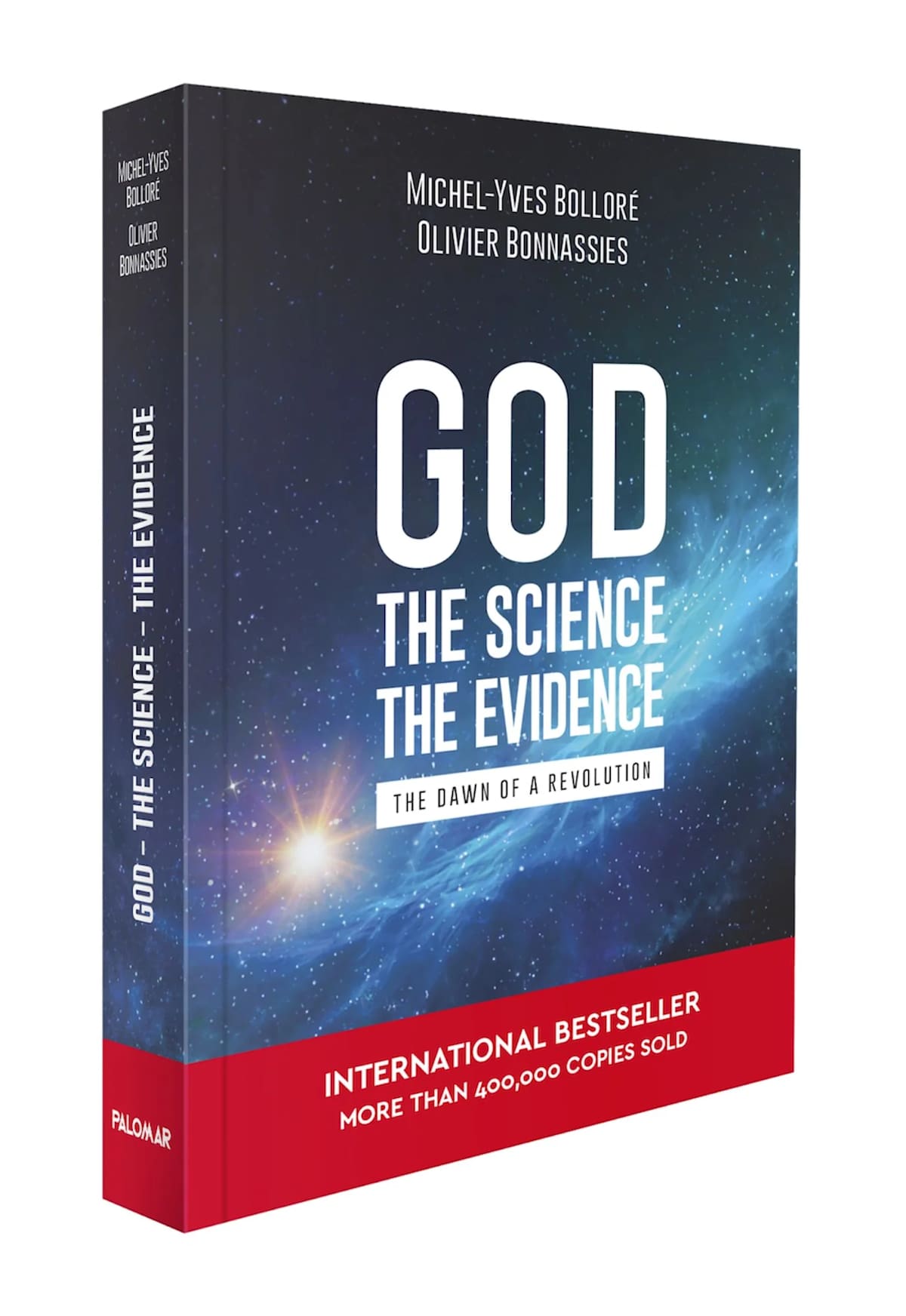
This is a book review of God, the Science, the Evidence: The Dawn of a Revolution, by Michel-Yves Bollore and Olivier Bonnassies (2025). The book is advertised (on the front cover) as an international best seller, with more than 400,000 copies sold.
One thing that has bothered me of late is a perception that the younger generations think they are too smart for God. They are so consumed by “following the science” that they have lost track of God. This is particularly concerning when there are some doubts as to what science says and where it is leading us. And, sadly to say, I fear that some churches have become part of the problem. I will have more to say about this fear later. I will, however, state right now that this book on "God, the science, and the evidence" is a step in the right direction. I pray that many of the book's readers are young and yearning for the truth.
Organization of the Book
Blurbs: A few pages into the book you will observe a picture of a portion of the Universe with the following words centered over the picture, "THE BOOK EVERYONE IS TALKING ABOUT – 15 INTERNATIONAL PERSONALITIES FROM ALL WALKS OF LIFE.”
For each of the 15 “personalities,” there is a photograph, a teaser (e.g., “A Unique Resource!,” “This Book is a Phenomenon”), a mini-biography, and a few paragraphs of quotes expanding on the teaser. All of this is crammed into about half a page per individual.
The only “personality” that I was familiar with was Cardinal Robert Sarah. His teaser was “An Invitation to Wonder.” He wrote, “This book represents an innovation. It demonstrates that it is no longer ‘credible’ to pit science against faith. … It argues that it is permissible to consider the question of God on the basis of science. …”. After reading the book, I must say that I agree with the good cardinal.
Preface: The blurbs were then followed by a brief preface, which pretty much set the tone of the tome. Four brief quotes from the preface:
· “This book is the culmination of nearly four years of research conducted in collaboration with a team of around twenty high-level international specialists and scientists.”
· “Its objective is unique: to shed light for you on the question of the existence or non-existence of a creator God, one of the most important questions of our lives …”.
· “Until recently, believing in God seemed incompatible with science. Now, unexpectedly, science appears to have become God’s ally. Materialism, which has always been a belief just like any other, is seriously shaken as a result.”
· “… We have aimed to make it easy and enjoyable to read for all, while ensuring accuracy. The chapters are independent, so readers can approach them in any order of their choice.”
The Body: The body of the book consists of two main sections. After an “Introduction” (chapters 1-3), the body of the book is subdivided into “Evidence Within the Sciences” (chapters 4-16) and “Evidence from Outside the Sciences” (chapters 17-24).
The End: The book ends with a “Conclusion” (Chapter 25), three appendixes, a glossary, an index of personal names, acknowledgements, a detailed table of contents, and image credits.
I found the book to be more of a reference book than a story. I took the authors at their word, and hopped around through the chapters, without any problems. I must admit that as of today – as I write – I only read 14 of the books 25 chapters – the 14 that I was most interested in. As a reference book, I might wade back in again if the need arises and time presents itself.
Chapter by Chapter:
I will now review the book in the order that the authors presented the material, not in the order that I read what they wrote.
Note: Throughout this review, page numbers from the book are included [in brackets], if you wish to review a quote in context or learn more about a particular topic.
In Chapter 3 (with a god-awful long title), the authors lay out two competing theories impacting the world of science and religion today: “A Creator God Exists” or “Nothing Exists Beyond the Material Universe.” The latter theory is often simply referred to as “materialism.” Per the “materialist” view, nothing exists beyond space, time, matter, and energy.
The authors further state [via a table on page 52] that If nothing exists beyond the material Universe – the Universe cannot have had an absolute beginning or a thermal death; the laws of nature have no particular reason to favor the emergence of life; miracles, prophecies, revelations, and “spirits” (e.g., the devil, angels) cannot exist; and good and evil are subject to limitless democratic decision-making.
Chapter 5 (A Brief History of the Big Bang) provides just that. It begins by noting that, “before Einstein, cosmology was not a science” and that “1905 was the annus mirabilis (miracle year)” [83]. 1905 was the year that Einstein first published, in four articles, his innovative theories on relativity (i.e., time and space are relative based on the frame of reference of the observer). That started the ball rolling. Einstein’s basic theory was confirmed in 1954 via atomic clocks in a high-flying jet plane. But Einstein made one big error, which he later described as “the biggest blunder he had made in his entire life” [90]. That error occurred when he added a “cosmological constant” to his 1917 equations, because he had not yet recognized that the Universe was expanding.
Two other scientists, Alexander Friedmann, and George Lemaitre (who was also a Catholic priest) would later convince Einstein of his error. Lemaitre’s theory on “universal expansion” was subsequently confirmed by Edward Hubble, when he observed a “red shift” (a doppler effect) using a telescope located on Mount Wilson in California. It was there that Einstein saw with his own eyes that the Universe was expanding as Lamaitre theorized. “Hubble’s observation so strongly confirmed the theory of universal expansion that within just a few years it led to a complete reversal of the scientific consensus” [90].
“In 1931, [Lemaitre] put forward a hypothesis that would prove even more impossible for scientists of his day to accept. According to his findings, the Universe had originated in a ‘primeval atom.’ This dense kernel, containing what would become all the matter and energy of the entire Universe, suddenly entered a period of expansion, and at once space and time were created” [90-1]. Gamow and Alpher later “argued that hydrogen, helium, and deuterium atoms must have been created within the first several minutes of the Universe’s existence” [92]. Ironically the catchy term “Big Bang” that now describes the theory was created in 1949 by Sir Fred Hoyle, a cosmologist and astronomer, who was disparaging the concept at the time.
Lemaitre’s theory on the “primeval atom” was validated in 1964, via a chance discovery by two Bell Laboratories astronomers and scientists. Using an immense radio telescope, they discovered a faint “echo” of the Big Bang, which came to be called Cosmic Microwave Background Radiation … “coming from all directions of the Universe at 2.725 kelvins” [94].
“In the decades since, a series of confirmations have verified what is today called the “Standard Model” of the Big Bang” [96]. “Except for pockets of residual resistance, the theory is unanimously accepted” [95].
“The Big Bang was nothing like the random, messy, or dangerous explosion its nickname suggests. It was in fact an extremely organized, multi-phased development” [99]. This extraordinary event began 13.8 billion years ago and took place according to several different very ordered chronological phases: e.g., at one second (disappearance of antimatter), at 15 minutes (matter setting), by 380,000 years (formation of the first atoms and light).
“Where is God in all this? The Big Bang forces us into a corner. To put it bluntly, it brings us face-to-face with the idea of God. The absolute beginning of the Universe is where physics meets its maker, a creative cause exterior to the Universe” [107].
Chapter 8 (The Big Bang, A Noir Thriller), in true noir fashion [including 16 black and white photographs of the victims on page 129], described how Nazi Germany and the Soviet Union (under Stalin) forced into exile, imprisoned, tortured, and killed their scientists that supported the Big Bang theory. In a twist of fate, some of those scientists made their way to the USA where they helped develop the nuclear weapons that ended World War II.
“The materialists would not have unleashed such extreme violence upon scientists who theorized the expansion of the Universe and the Big Bang had they not been convinced that these theories made a strong case for the existence of God. The use of force is, here more ever, an admission” [128].
“… Lenin was slowly gripped by the conviction that religion is the opiate of the masses, and that a new social order would arise only when the idea of God was annihilated [130]. … “if matter were not eternal, some people – perhaps even nonbelievers – might be tempted to think that it was created by that transcendent cause that some call God” [131].
Chapter 9 (The Fine-Tuning of the Universe) discusses some of the twenty or so parameters that made possible the evolution of the Universe and the emergence of life. Miniscule differences in (or changes to) some of these parameters would make life as we know it impossible.
“The values of these numbers were fixed at the moment the Universe came into being and are invariable in time and space” [183]. Examples include: the force of gravity, the electromagnetic force, the speed of light, the mass of the proton, the velocity of expansion, and the Planck constant.
“Where do these numbers come from? There are only two possible responses: either they are the result of chance, or they proceed from the complex calculations of a highly intelligent creator God” [185]. The odds of “chance,” as discussed in the book, are virtually zero. How close to zero? Sir Fred Hoyle offered this approximation; “… comparable with the chance that a tornado sweeping through a junk-yard might assemble a Boeing 747 from the materials therein” [277]. Think about that!
“Seeing that the Planck constant yields a Universe whose structure permits chemistry, some have called it ‘the theological constant,’ since it seems to be such an integral part of an intelligently designed plan engineered by God” [212].
Chapter 10 (The Multiverse: Theory or Loophole?) discusses one of the arguments that the materialism fans use to dispute the “God theory.” “For such an unlikely [chance] event to occur, one would have to assume the existence of approximately [10 to the 60th power] independent universes … existing ‘elsewhere’” [215] and “No matter how many universes we imagine, an ‘initial singularity’ (the Big Bang) remains necessary in all cases” [218]. The argument appears so bogus to me that I don’t believe it needs to be discussed any further.
Chapter 11 (… One Giant Leap for Our Argument) sums up the seven previous chapters involving cosmology – in seven pages – by noting, “Cosmology alone has provided us with sufficient evidence for the existence of a creator God” [227].
Chapter 12 (Biology: The Incredible Leap from Inert to Living Matter) switches from cosmology to biology and examines how life in our Universe transitioned from inert matter. The authors noted the unsuccessful efforts in the past to produce life from “primordial soup.” How successful has that been? Per the authors, “… the largest inert matter produced to date represents 1/300,000th of what we’d have to synthesize to get the smallest possible single-celled organism” [234].
In my opinion, the most significant development in biology in the last 75 years, was the discovery of the double-helix structure of DNA in 1953 by James Watson and Francis Crick. That discovery “marked a turning point in research … [as] every form of life on Earth makes use of this unique ‘language of life’” [243].
The authors also discuss the complexities associated with the 80,000 distinct proteins (i.e., macromolecules built out of 22 amino acids) that exist, the ribosomes that are responsible for the synthesis of proteins, and the crucial types of proteins called enzymes. “How can we explain the existence of enzymes and their presence at the right place at the right time? No one yet knows” [248].
The authors also discuss the Last Universal Common Ancestor (LUCA), which has been the “key to life” over the past 3.8 billion years. “How could this code … have created itself and become operational all at once, without any subsequent evolution” [250]? To that question and the overall topic, the authors conclude, “… life is the result of precise programming on the part of God, who carefully designed cosmological development to permit life as we know it to develop” [261].
Chapter 13 (One Hundred Essential Citations from Leading Scientists) lists one hundred quotes from leading scholars in various scientific fields that highlight the surprising and thought-provoking nature of recent discoveries in cosmetology and biology. “In the science today, God is more alive than ever” [263].
Two of my favorite quotes were by Robert W. Wilson (“Certainly there was something that set it all off. Certainly, if you are religious, I can’t think of a better theory of the origin of the universe to match with Genesis” (265); and by Brian Greene (“The laws of physics are the closest thing in the world today that I would align with a theological perspective” [271].
Chapter 15 (What Did Einstein Believe In?) lists several quotations by Einstein that reflect his belief that an “infinitely superior” was responsible for the creation of the world. Four of those quotations are listed below:
· “But also, everyone who is seriously involved in the pursuit of science becomes convinced that some spirit is manifest in the laws of the universe, …” [310].
· “I want to know how God created this world. I am not interested in this or that phenomenon, in the spectrum of this or that element. I want to know His thoughts; the rest are details” [311].
· “Coincidences are God’s way of remaining anonymous” [312].
· “Science without religion is lame, religion without science is blind” [312].
To be fully fair, Einstein, like a lot of other scientists, rejected the idea of a personal God and organized religion. “The idea of a personal God is quite alien to me and seems even naïve” [314].
Chapter 16 (What Did Godel Believe In?) was like the preceding chapter, except that this chapter examined the thoughts of Kurt Godel (one of the greatest logicians in history, a member of the Institute for Advanced Study at Princeton, and a friend of Einstein). For fifteen years, Einstein and Godel had a ritual of daily walks through the university park at Princeton.
As regards those walks, Godel wrote, “I went home with Einstein almost every day and talked about philosophy, politics, and the conditions of America. … His religion is much more abstract. … Mine is more similar to church religion. … Mine is more than a person, because God can’t be less than a person. He can play the role of a person.” Since Godel presented himself as a ‘baptized Lutheran,’ we can assume that this last sentence is perhaps a reference to the Incarnation” [331-2].
Chapter 18 (The Alleged Errors of the Bible, Which Are Not Errors) was in the second section of the book that dealt with “Evidence from Outside the Sciences.”
The authors note early in the chapter that, “The purpose of the Bible is to tell us who God is, who we are, how we must live in order to re-join him, and finally, how he has prepared a people capable of transmitting these truths to the world and of welcoming the Messiah announced since the dawn of time” [363].
The authors spend considerable time discussing the Genesis account of creation and some of the past scientific criticisms. They begin by noting that the “the vocabulary of the Hebrew language was extremely limited … around 8000 words” [365]. They also note that, “At the time the Bible was written, the word ‘billion’ and the numerical concept associated with it simply did not exist” [367].
The authors note, that the essence of Genesis is that “the Universe had a beginning and will have and end; that God is outside the Universe; and that between this beginning and this end, all things were made by him alone, progressively over time (as symbolized by the seven days of creation), and man appeared last” [368]. They go onto note that if the Genesi account was rewritten simply as, “God began by creating time, space, and matter” [372], many scientists would agree.
And as to the biblical order of the creation, “… light did indeed emerge from the primordial Universe about 380,000 years after the Big Bang … In the early Universe, therefore, light did appear before the emergence of the stars. Not only is the Bible not in error, but we can even be tempted to see in it an astonishing additional cosmological revelation” [374].
“So there you have it. Our true ancestor, our ultimate origin, our first parent, is matter. … Only a soul, if it exits, breathed into us by God at conception and spiritual nature, differentiates us from a simple hominid. … It’s ultimately more scientifically correct to say that we come from matter than to say that we descend from primates. Metaphysically, it’s much more significant” [379].
I will discuss this chapter further towards the end of this post.
Chapter 19 (Jesus: Who Could He Be?) examines seven answers that have been given historically to this chapter’s title (he was a great sage; a madman; a failed opportunist; a prophet; the Messiah and an extraordinary man, but only a man; or the Messiah and God made man).
The authors present the case for each of the seven possible answers noted above before concluding, “Our last hypothesis is the only plausible answer to the question of who Jesus really is, and it leads us to another resistible conclusion: if Jesus is indeed the Messiah and the Son of God, then God must exist” [414].
The authors then ask their readers once again, “Jesus: Who Could He Be”? The authors then provide a challenge: “The reader has the resources at his disposal to reach a decision, since the possible answers are very few and well documented. Earlier chapters required technical skill, but here, one does not have to be an expert to have an informed opinion. Courage, common sense, and intellectual honesty are enough. Do not go on to the next page until you have made your choice, whatever it is” [414].
Chapter 20 (The Jewish People: A Destiny Beyond the Improbable) examines a host of accidents and historical coincidences [12 bullet points on pages 424-5] that allowed the Jews to return to their historical homeland in Israel. Per the authors, their goal was to “offer a real historical enigma to readers seeking signs of God’s existence. … Can the fate of the Jewish people be explained with a materialistic historical narrative” [446]?
Chapter 21 (Fatima: Illusion, Deception, or Miracle?) was a chapter that I would not expect to find in a scientific publication. In this chapter the authors examine a “miracle” (per the Catholic Church) that occurred in the village of Fatima, Portugal, in 1917.
At that time, via a series of monthly visits, three children claimed that the Blessed Virgin Mary spoke to them. In one of the early meetings the children claimed they were told by the Virgin Mary that a miracle would take place there at midday on October 13, 1917. The word got out and thousands of people gathered there, at Fatima, on that day.
“It appears to them that the sun begins a frantic and frightening dance that goes on for more than ten minutes” [448]. … The spinning of the sun, with the interval of rest, had lasted ten minutes. It was observed, let us repeat, by every single person present without exception: believers, unbelievers, peasants, townspeople, men of science, and even freethinkers” [456].
The authors, in their book included some photographs taken on that day and quoted some of the “most salient reactions published in the secular, anticlerical, liberal republican press” [459]. They also examined six potential answers as to what happened (nothing, a tall tale, a cosmic event, a meteorological phenomenon, a collective hallucination, a hoax, or a miracle). They also examined a connection with a statement by the Blessed Virgin Mary concerning the eventual collapse of the USSR.
Of the six potential answers, the authors went with “miracle,” noting, “and don’t skeptics often demand clear proof that God exists? Well, that is just what the miracle of Fatima is” [451]!
Conclusion and Summary
The authors did a good job of doing what they wanted to do per the preface of the book, shedding light on the existence or non-existence of a creator God. For a book dealing with cosmology, biology, physics, and religion; it is very readable. From a “book binding” perspective, the book (at 597 pages) is very easy to hold and read.
Many of the topics (e.g., the Big Bang, DNA) boggle my mind. I must defer to the authors and their experts for the technical matters. In the preface they indicated that they were striving for accuracy, and my gut feeling is that they were successful.
As regards Chapter 18 (The Alleged Errors of the Bible, Which Are Not Errors), I saw some similarities in thought to some of my writings in my “A Catholic Prays Scripture” series. In volume 4 of that series (concerning God’s “word”), I wrote a lot in Chapter 7 (Does God Care?) about the many literary forms that one can observe in the Bible including, apocalyptic literature, beatitudes, epistles, genealogies, gospels, histories, hymns, lamentations, myths, prayers, prophecies, proverbs, sacred history, teachings, and wisdom literature.
I agree with the authors of this book that the purpose of the Bible is to tell us who God is. I believe that God did this via a host of human authors, over an extended time, using a variety of literary forms.
I agree with the authors that the Bible is “not a work of history … a treatise on the nature of God, nor a book of science, geography, or philosophy” … and that “trying to read or interpret it according to the constraints of a particular genre leads inevitably to misrepresentation” [364]. I think that it is appropriate to read Genesis and conclude that “God began by creating time, space, and matter.” I think that conclusion is much more important than whether, or how, those actions occurred over seven days (as we define them).
I am particularly concerned now about today’s skeptical and educated younger generations that are so intent on “following the science” that they miss the nuances of God, as expressed in the various literary forms of the Bible. I am distressed at the churches that ignore literary form in favor of strict reliance on the literal word. I believe that the emphasis on the “literal” drives many of the skeptical and educated away. And above all, I fear that if someone does not consider literary form when they read the Bible, they may be left behind.
I believe that God, the Science, the Evidence is a must read for those struggling with questions regarding the nature of God.