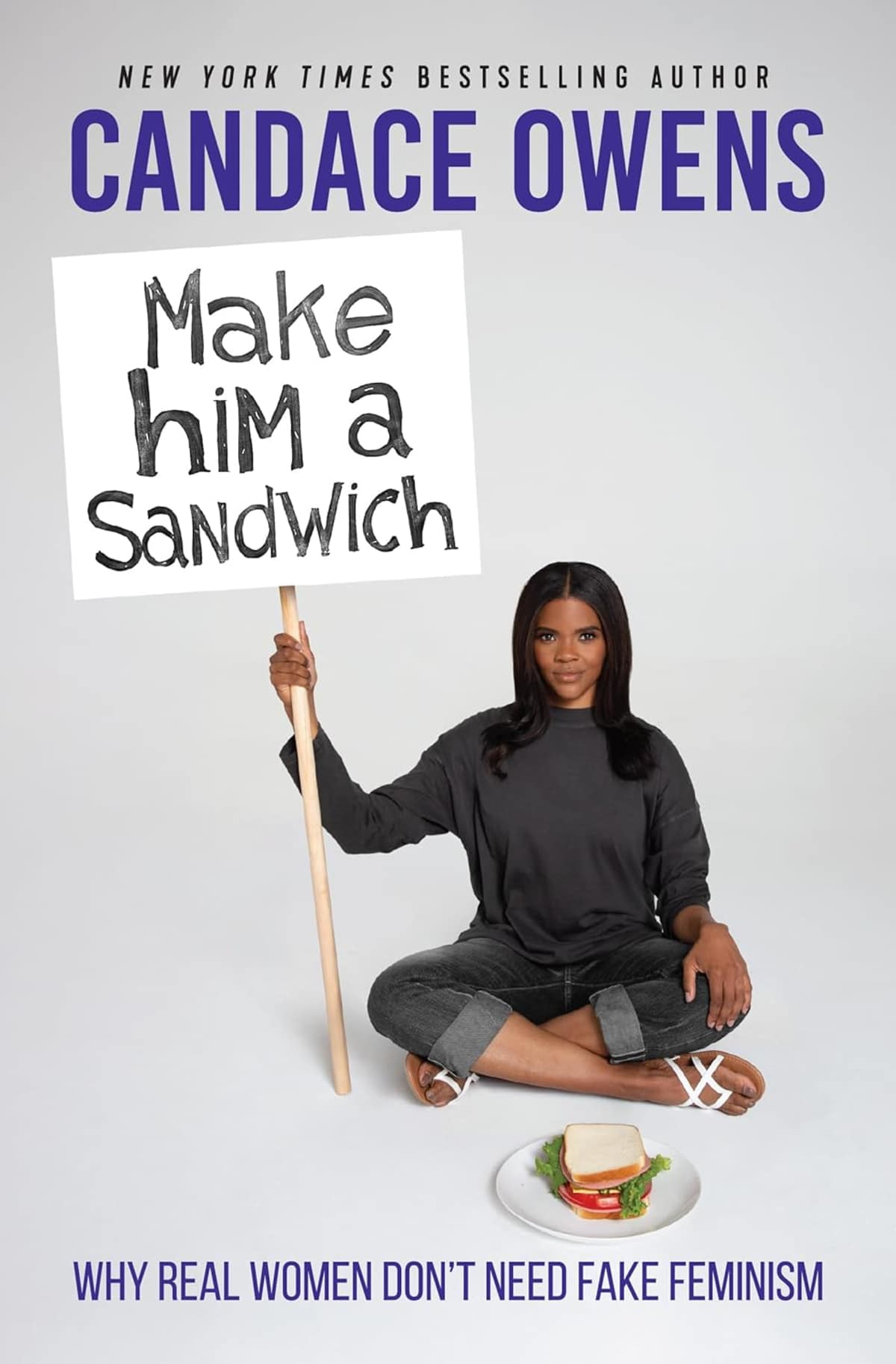
This is a book review of Make him a Sandwich: Why Real Women Don’t Need Fake Feminism, by Candace Owens (2025).
I first saw Candace Owens on Fox News, doing segments for Tucker Carlson. One of those segments indirectly led to the title of this book. On March 15, 2021, she was asked by Tucker to comment on a Grammy performance by a rapper named Cardi B. In her comments, Candace stated that Cardi B’s performance was “a lesbian sex scene being simulated on television.” She added, “This is not about diversity anymore; this is about perversity. We are celebrating perversity in America.”
The above remarks started an exchange on Twitter between Candace, Cardi, and others, which led to Cardi posting a picture of a pregnant Candace making a sandwich for her husband, with the question “that’s what a woman should do?” That question prompted Candace to think, “In exactly what world is making your husband a sandwich deemed an act of humiliation” (versus a lesbian sex simulation on TV). Her answer to the question was, “In a feminist one, of course.” That Twitter exchange led to both the title of Candace’s book and the topic of the book – “Feminism.” Below is a chapter-by-chapter summary of the book.
Chapter 1: Biology
In a section of this chapter entitled “Feminism versus Feminism,” Candace described four waves of feminism, starting with (1) women’s suffrage, during the nineteenth century; (2) the focus in the 1960s on the “perceived cult of domesticity;" (3) the expansion of “their insatiable appetite for social justice,” beginning in the 1990s, “to include battles of perceived racism and classism within society;” and (4) today’s expansion of inclusivity “to “men who believed deep down they were women.”
Candace is of the opinion that a fringe minority has highjacked the Feminism agenda. As to why, she notes that “females possess a touch of tenderness and emotional connectivity that men struggle to produce.” Thus, she declares that it simply “wasn’t in their [women’s] nature. … Put simply, fringe feminists and pedophiles were able to appeal to the emphatic and compassionate nature of women everywhere to mass institute the perverted agenda of transgenderism.”
Chapter 2: Department of Non-Education
The gist of this chapter is that when President Jimmy Carter signed the Department of Education into law in 1979, “education” became the “new secular bible” of the nation. She goes on to note the dramatic increases in abortions and rates of casual sex, after “sex education” was introduced into the curriculum. She also notes that “a fake academic subject of ‘gender studies’ has been foisted on children in an attempt to advance a radical progressive ideology that ultimately renders children weaker and dumber.”
In a section of the chapter entitled “Awaken the Bear,” Candace noted how the 2021 Virginia gubernatorial race, and the comment by former Democratic governor, Terry McAuliffe, that parents should not be telling schools what to teach, has awoken some parents. Candace also noted the recent uptick in homeschooling since McAuliffe made his comment.
Candace ends the chapter by commiserating that, “Fake feminism has convinced too many [women] to turn their backs on Mother Nature. … As women, just the ability to give birth renders us guardians of one of life’s greatest miracles: beginnings.”
Chapter 3: Happily Ever After
The subject of this chapter was very simple – “happiness.” Candace’s main point seemed to be that feminism has not made women happier. She cited statistics on suicide rates, alcohol consumption, opioid use, and gambling to substantiate her claim. She also noted that her own work experiences, after college, had substantiated her own opinion.
Candace also stated that, “women hold entirely different views than men regarding success. “We simply do not equate it to wealth. … women measure success in terms of cultural influence … women achieve power by shaping industries that we inherently understand.” As evidence of the latter, she cited Oprah, as a “brilliant communicator” and Taylor Swift, who “mined compassion and empathy.”
Chapter 4: Beyond the Pale
Candace connects Emma Goldman, a female anarchist of the past, with Margaret Sanger, the founder of the Planned Parenthood Federation of America. Owens described Emma Goldman as an “utter psychopath” and “the single most violent contributor to the death and destruction of America in the twentieth century.”
According to Owens, Emma Goldman was Margaret Sanger’s mentor. As a disciple of Goldman, Margaret Sanger, an avowed eugenicist, became the “chosen social engineer meant to drive a wedge between women and their natural inclination for family.”
Chapter 5: Ugly, Naked, and Afraid
Candace takes on the topic of “body positivity,” which she describes as “a self-destructive pillar of modern feminism.” Candace introduces the topic by discussing a woman name Lena Dunham and her HBO series titled Girls. According to Candace, Dunham “produced a series that was intent on destroying all aspects of femininity, instead offering characters that were unattractive, rude, and, at times, displayed animalistic attributes.”
In the show, Durham, via her character Hannah, embraces ugliness, fatness (obesity), and nakedness (e.g., she liked to show it off). Candace noted that Lena Dunham had captured the “feminist zeitgeist.” She received numerous awards (e.g., Emmys and Golden Globes). In 2013, she was included in Time magazine’s list of the most influential people in the world.
Per Candace, “body positivity” is “being uniquely sold to women by women.” Clinical obesity “would not only be deemed healthy but also beautiful.” Why? Candace attributed this nonsense once again to empathy – “women are emphatic to those that are struggling,” including “a level of empathy for fat women.” Owens concludes, “But our ability to empathize can sometimes trump our ability to think logically.”
Chapter 6: The Kardashian School of Plastic
Owens notes that both the “Durham School of Feminism” (the last chapter) and the “Kardashian School of Plastic” (this chapter) consider nudity to be an act of feminine empowerment. Owens goes over the history of Kim Kardashian’s “nudity,” from her “leaked” sex tape to her various magazine covers (e.g., W, Paper, GQ).
In 2016, actress Chloe Grace Moretz, then nineteen, faced a public Twitter onslaught from rabid feminists when she suggested to Kardashian that “young women … have so much more to offer than just our bodies.” Among other things, Chloe was accused of “slut shaming and espousing archaic values that set back the women’s rights movement.” In the chapter Owens also wrote about Madonna’s ongoing “quest for perpetual beauty and youth.”
Owen’s states that “sexual promiscuity is now mainstream in American culture” and that women like Kim Kardashian “are engaging in a modern form of prostitution.” Owens further concludes that these “routine displays of nudity” and “repackaged narcissism” don’t further female empowerment; instead, they “degrade femininity altogether.”
Chapter 7: Along Came Hannah
Owens wrote about Mrs. Hannah Neeleman, her husband Daniel, and their eight children, who were devout Mormons living on a farm in Utah (Ballerina Farm). Over the years, Hannah managed to amass ten million followers on Instagram, who were apparently interested in her wholesome lifestyle (e.g., baking sourdough bread and milking cows every morning).
Hannahs idyllic social media presence apparently irked Megan Agnew, then twenty-eight and a well-established feature writer for The Sunday Times, who arranged to interview the Neelemans on their farm, before writing an article on Hannah and her family.
Owens noted that, “more often than not, journalists write to affirm their own beliefs and to influence the masses accordingly.” Before commenting on the Neeleman article, Owens analyzed one of Agnew’s previous writings about her ex-boyfriends. Owens also compared Agnew’s “aesthetic of a young female writer” with that of Carrie Bradshaw, a character on the HBO series Sex and the City, and Candace Bushnell, the real-life person who inspired the Bradshaw character – and the creator of the Sex and the City franchise.
Owens suggests that Megan Agnew, Carrie Bradshaw (the character), and Candace Bushnell all had feminist beliefs that contrasted with that of Mrs. Hannah Needleman – and that Agnew’s article reflected their collective beliefs – more so than how the Neelemans viewed their own marriage.
On social media, Hannah Neeleman disputed the published narrative. She wrote: “We were taken aback, however, when we saw the printed article … portraying me as oppressed with my husband being the culprit. This couldn’t be further from the truth … I’m doing what I love most: being a mother, wife, a businesswoman, a farmer, a lover of Jesus. And making meals from scratch.”
There it is again – radical feminists and feminist writers apparently do not like women making meals from scratch or sandwiches for their husbands. Anyway, after the backlash to Agnew’s article, she was promoted and awarded the Feature Writer of the Year award. Apparently, a job well done, according to her employer.
Chapter 8: Hocus Pocus
The “hocus pocus” in this chapter involves “witchcraft,” or a modern-day version of it marked by the perversion of truth. Owens starts by suggesting that “romanticizing witchcraft” was predicted by C.S. Lewis in his novel Perelandra. As to the witch’s spell, Owens suggests that it is perhaps cast “through the unrelenting repetition of the word patriarchy throughout pop culture, even if it is not accompanied with a shred of proof to support it.”
An example of this last point involves Taylor Swift and a line in her album Red, which read, “F*ck the patriarchy.” Owens goes on to write, “Swift’s impact on modern feminist ideology has been nothing short of impressive. I would describe her as the Goldman Sachs of the feminist movement.” Owens adds that this thirty-five-year-old “has brilliantly … marketed herself as an angsty teenager who routinely has her heart broken by guys who are undeserving of her affection.” Owens goes on to list the guys, some of the circumstances, and some of their public responses. Much like the “exes” that Megan Agnew wrote about (previous chapter), Taylor Swift sang about hers.
Owen’s concludes that playing the part of a teenager “grants her access to an army of prepubescent fans prepared to defend her with a sort of rabid, emotional vigor that is unique to adolescents and feminists. … To me, this is public witchcraft via the perversion of truth – the person who has routinely and publicly humiliated men (with a legion of tweens prepared to harass them) has managed to convince the public that she is always the victim.”
I should note that in a previous blog entry entitled “Young Women” (December 16, 2025), I was much kinder to Taylor Swift. My point-of-view, in that post, was that Taylor Swift was the victim of the societal changes impacting young women. Candace Owens, in this chapter, suggests that Taylor Swift is more “cause” than “victim.” Like the Kardashians, Taylor Swift has made a lot of money via her concept of feminism.
Outro: Behind Every Crazy Woman (Nine Rules)
This last chapter, which Candace categorizes as an “outro,” provides an alternative option to the popular adage that behind every crazy woman is a man who made her that way. Candace suggests that “behind every crazy woman is another crazy woman egging her on.” I must admit that the television coverage of the ICE protests in Minneapolis this past January confirmed Candace’s observation.
Owens ended the book by listing “nine true rules for women.” The first rule is “Be Beautiful,” but not in a Lena Dunham or Kim Kardashian kind of way. Candace suggests that it is “natural beauty that should be aspirational.” Rule #4 was “Exercise Compassion, But With Caution.” Candace once again warns women to keep their empathy in check. She wrote, “Feminism created an opportunity for our government to hack our emotions to our own detriment. … When the government wishes to pass legislation, they simply figure out how to make women feel upset about the issue.” I won’t get into rules 2, 3, and 5-8; I suggest you read her book. Rule #9, however, was very simple: Make Him a Sandwich.”
The Blurb
The back cover of a book, when it displays comments from others, is commonly referred to as the “blurb.” Blurbs typically include positive endorsements or reviews. The blurb for this book was different; it contained eight derogatory (three crude) comments about Candace (the person). The quotes were from Cardi B, Lance Bass, Ireland Baldwin, Roseanne Barr, Eminem, Jojo Siwa, Ben Shapiro, and Chrissy Teigen. I recognized all the names but that of Ireland Baldwin.
I am including the three vulgar quotes below, with the asterisk placements used on the blurb. I assume that those quoted used the full words.
· Monster. If I see the b*itch, I’ll knock her the f*** out.” Roseanne Barr
· [Candace] and I do not f**k with each other.” Jojo Siwa
· “Go the f**k away already, you dumb, soulless, pandering, ghoul.” Chrissy Teigen
One of the names that stuck out to me was that of Jojo Siwa. Per my iPhone, Jojo is a singer, dancer, and social media star known for her upbeat personality and electronic dance-oriented pop music, who first garnered fame from 2015 to 2016 on the reality TV series Dance Moms, alongside her mother Jessalynn Siwa.
That was when I first became aware of Jojo, back in 2015, when she was twelve or so years old – or maybe shortly before then, when she was the youngest contestant on Abby’s Ultimate Dance Competition. Jojo was born in Omaha, and she was something of a local star – a cute and vibrant little girl that the Omaha community cheered on.
Jojo has grown up and she has expanded her career into music and social media. Maybe she will be the next Taylor Swift? Wikipedia tried to capture her sexuality under “Personal life” – part of the LGBTQ+, pansexual, lesbian, queer – it kept changing. From her blurb quote, it is obvious that her take on feminism is different than Candace Owens.
Candace, Conspiracies, and Mrs. Macron
I enjoyed Candace’s book and I recommend it. Candace has very strong opinions on a lot of things, which she does not hesitate to share. As such, she has garnered a lot of enemies along the way. From her choice of blurb quotes, we can deduce that she hasn’t been intimidated by her critics.
Candace is also associated with what are often termed “conspiracy theories,” one being that the first lady of France, is a man. The courts are now involved in that one. Candace has also recently drawn the ire of President Trump (along with Tucker Carlson) as being “low IQ.” Trump also added “Crazy” when describing Candace. As to her beauty, Trump wrote, “Actually, to me, the First Lady of France is a far more beautiful women than Candace, in fact, it’s not even close.”
You can decide the question of their relative beauty for yourself. I must say, however, that I find the concept of “beauty” that Candace described in her book – that natural and aspirational kind of beauty – to be the best.