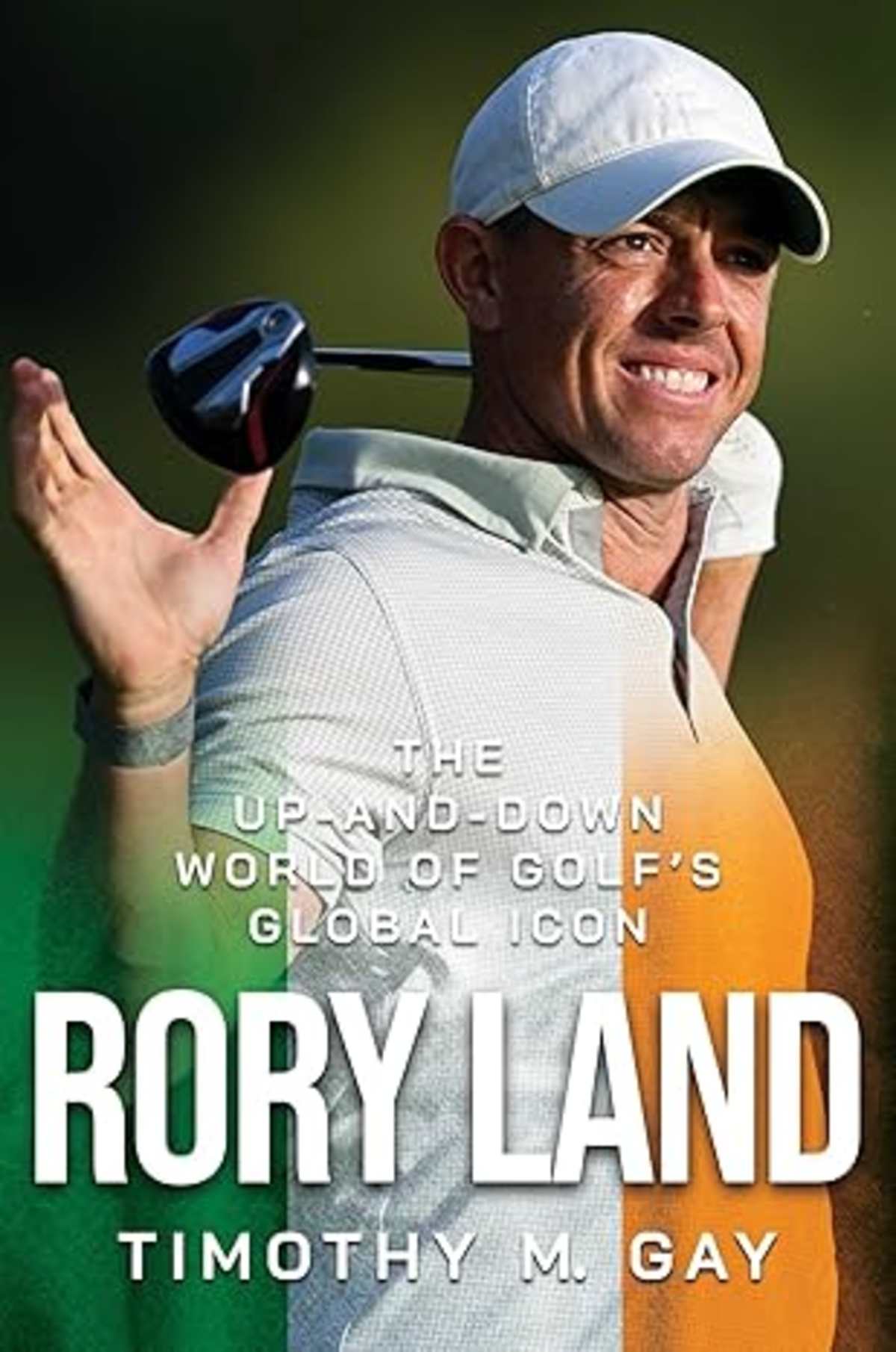
This is a book review of Rory Land: The Up-and-Down World of Golf’s Global Icon, by Timothy M. Gay (2025). The book is a biography of golfer Rory McIlroy, with an emphasis on “rounds of golf.”
I reserved this library book months ago, but the waiting list was long, and I didn’t get my first look at the book until the start of the 2026 Masters. In fact, I was only about eighty pages into Gay’s book when this year’s Masters play began on April 9th.
Note: Gay’s 428-page book does not contain an index, so I have included some [page numbers in brackets] in this review, if you wish to further examine any of the quotes in context, or any of the subjects in more detail.
Rory and the Masters
While the book is somewhat new, it is also somewhat dated. While the book was copyright in 2025, Gay did not write, to any extent, about Rory’s golfing results during 2024. One of the overriding themes in Gay’s book was Rory’s inability to win major tournaments of late (after winning four major titles relatively quickly between 2011 and 2014). In particular, Gay zeroed in on Rory’s inability to win the Masters, which he attributed to “periodic lapses in concentration coupled with a tendency to take unnecessary risks” [365].
As such, it was a bit ironic that right after Gay’s book was published, Rory won the 2025 Masters. It almost seemed as if Rory had accepted Gay’s book as a challenge – but then again Gay was not the only one ragging on Rory for his inability to win the Masters – his inability to complete the grand slam of golf.
I am a Rory Fan
I must admit up front that I am a Rory fan, but I am not completely sure why. It has something to do with his “Paul McCartney-like” British look, the boyish smile, the hop in his step, and his interactions with the kids. Gay termed the latter RMPIMs – Rory McIlroy Public Interaction Moments, which he likened to “the bond that exists between rock stars and worshipful fans” [56]. Gay attempted to answer why Rory is so popular in Chapter 2 (“Because He’s Nice!”).
I must also acknowledge that my admiration for Rory is not unique. Gay notes in his book that Rory “always finishes at the top of lists of most-influential and most-admired golfers, remarkable for a non-American” [388].
I have always been drawn to the more charismatic (and good) golfers – the likes of Arnie and Jack, Lee Trevino, Gary Player, Freddie Couples, Fuzzy Zoeller, and good old “Lefty” (Phil Mickelson). In Rory’s case, it helped that he was (and is) in contention a lot, is followed closely by the TV cameras, and has become something of a spokesman for the PGA (in their battles with LIV Golf). I tended to side with the PGA – and as such abandoned Phil after he abandoned the PGA (and bolstered his bank account).
While I admired Tiger Wood’s game – I tended to root against him (and for the likes of Phil). Maybe Tiger was too good. When I was young, there was only one baseball game on TV each week – on Saturday afternoon – often featuring the New York Yankees. As such, if you were into TV baseball, you either loved the Yankees or hated the Yankees (and routed for the other team). Tiger was in that category for me. He was like the Yankees.
The Troubles
Gay began Rory’s biography by looking back at Rory’s childhood, the lives of his Irish ancestors (the McIlroys and the McDonalds), and the history of the Irish people – as they suffered starvation during the nineteenth century and religious strife during the twentieth. The Troubles is the term often used to describe the ethno-nationalistic conflict in Northern Ireland, which lasted from the late 1960s until 1998 – the violence between Catholics (like the McIlroy clan) and the “Ulster” Protestants (with their English and Scottish heritage).
The Good Friday Agreement of 1998 ended most of the violence, but hatreds and memories linger on. Rory was about nine years old when the agreement took hold, and as such, most of his golf, including his junior amateur years, happened during more peaceful times. Gay noted that Rory does not talk about The Troubles very often, but it did and does impact his life and allegiances.
Back in 1972, Rory’s father’s “Uncle Joseph” was assassinated in his own home by a Protestant militia cell because he had the temerity to move his family into a Protestant neighborhood and/or because he was a successful computer technician (taking a job from a Protestant).
Gay reported on how all the above was lingering in the background when golf was reintroduced to the Summer Olympics in 2016 – forcing Rory to consider playing for Ireland (ethno) or Britian (nationalistic). At the time Rory seethed, “Who am I? Where am I from? Where do my loyalties lie? … Who do I not want to [anger] the most? … I started to resent it. And I do. I resent the Olympic Games because of the position it puts me in” [356].
In the end, he didn't play for either country in 2016, because of the “convenient” fears about the Zika virus and its long-term impact on male virility. In later years, Rory came to terms with the questions above and represented Ireland in the 2020 (Tokyo) and 2024 (Paris) games. As noted by Gay, in those Olympic games “he decided to represent the Tricolor without fully embracing the Tricolor” [355]. In the Tokyo games he missed the podium (bronze) in a playoff. He noted later that, “I have never tried so hard in my life to finish third” [359].
Rory’s Love Life
I hate to admit it but the parts of Gay’s book that I enjoyed the most involved Rory’s love life, from Holly Sweeney (his initial Irish girlfriend of six years) to his wife Erica Stoll – with the likes of actress Meghen Markle (of Prince Harry fame), Caroline Wozniacki (Danish tennis star), and a bevy of models, in between. Gay devoted a whole chapter [14] to “Wozzilroy.” Rory eventually broke off their engagement (after the invitations were in the mail). Yikes!
Gay included a series of wonderful quotes in his book about Rory, romance, and girls. “[Rory] is like Paul McCartney at the same age … girls want to spend time with him. It’s not that he’s the cynical sailor type with a girl [in] every port, he’s actually hopelessly romantic” … [but] romance … is like golf: Sometimes you just want to play as a single” [314].
My Favorite Chapter
Chapter 16 (Medinah’s Wild Ride) was my favorite. It begins by describing Pat Rollins, the deputy chief of the Lombard, Illinois Police Department, as he raced through heavy traffic on Interstate 355 and Illinois Routes 20 and 64, at speeds exceeding 100 miles per hour, trying to get Rory to his scheduled 2012 Ryder Cup tee time – on time.
Per Rory, his tardiness was related to his confusion as to the when he was scheduled to tee off – 12:35 Eastern time (TV’s promoted time) or 12:35 Central time (local PGA time). Even, adjusting for that one-hour difference, Rory was cutting it close that day, given the distance from his hotel to the golf course, the crowded roads, and his normal practice routines.
Rory disclosed later that he had been Facetiming his then girlfriend Caroline Wozniacki, who was playing tennis in Beijing, China at that time. He was apparently so engrossed in that conversation (hmmm!) that he had ignored the incoming cell phone calls from all of those concerned about his tardiness.
One of the ironies of the story involves the PGA of America official who helped arrange Rory’s police escort – that official being Erica Stoll, who later became Rory’s wife. She was waiting for him in the parking lot when he eventually arrived. The hostile US golf fans took advantage of the situation that day – chanting four syllable phrases and questions to Rory, such as “Cen-tral time zone” and “Was she worth it.”
The story became even better when Rory went on to win his one-point that day, beating Keegan Bradley (2 and 1). Europe went on to win the cup 14.5 to 13.5, a score that would have flipped if Rory had forfeited. Rory later admitted that he didn’t want to “think about what sort of abuse I would have got if we had lost by a point and I hadn’t got there in time” [274].
The story became much much better three years later when Rory married Erica Stoll. As Gay noted, “Young Rory McIlroy had led a charmed existence. Only a guy like him could have turned an epic screw-up … into a personal triumph. … Rory not only became a champagne-drenched hero that afternoon, he ended up getting the girl” [271]!
Love of Books
Another thing that got my attention, something that I was unaware of, was related to Gay’s statement that, “Far more than any professional golfer, Rory likes to share with the press his reading habits: his love of books and his passion for various intellectual pursuits” [142]. Gay attributed this in part to Rory’s lack of a formal education (which he forwent to play professional golf when he was seventeen).
Among the books that Gay cited were, Greatest Salesman, an allegorical tale about making the most of the journey toward self-belief, by Christian spiritualist Og Mandino [384] and Susan Cain’s Quiet: The power of Introverts in a World That Can’t Stop Talking, a 2012 bestseller [385].
Other Interesting Things
Most of the 428 pages in Gay’s book were devoted to round-by-round accounts of many of the golf tournaments that Rory competed in. Gray, however, also addressed many other aspects of Rory’s life, including the following (that I found most interesting):
· Rory’s income: As of the fall of 2024, Rory has earned about $100 million playing golf, and another $250-$300 million from his corporate partnerships (as a “brand ambassador”) [388].
· Rory’s caddies (from J.P. Fitzgerald to Harry Diamond).
· Rory’s training in Utah: He spent the summer of 2000 (age 11) in the Wasatch Mountains of Utah, learning the game, with the likes of Milton Pouha “Tony” Finau [122].
· Rory’s most ambitious golf-related investment in the TMRW Golf League (in partnership with TMRW Sports, Tiger Woods, and the PGA Tour).
· Rory’s ups and downs during the PGA/LIV battles – for the game, money, and fans.
· Rory’s participation in the Netflix series Full Swing (which I have not watched and do not intend to watch – because Rory is my hero and my hero does not swear).
The 2026 Masters
The 2026 Masters was over before I finished Gay’s book. As noted previously, in his book Gay had taken McIlroy to task for not winning the Masters (before Rory won the 2025 Masters).
In Gay’s book, on page 425, he wrote: “Let’s see a quick show of hands. Who else is tired of Rory pulling his approach into the pond next to the 11th green at Augusta?” I raised my hand.
In 2026, Rory got off to a six-stroke lead after the first two rounds – a lead that no “winner” had ever lost. During the third round on Saturday, Rory lost all those strokes, and he was tied with Cameron Young at 11-under going into Sunday’s final round. How did he lose six strokes?
Sure enough, during the third round, Rory had blasted his driver into the pine straw on #11. He managed to get the ball back in the fairway but had a long iron shot to the 11th green. Given his “tendency to take unnecessary risks,” Rory hit a near-perfect shot at the flag. Maybe if the shot was two or three feet to the right, it would have rolled up to the pin. But alas, the ball rolled to the left and into the pond once again. The up-and-down wasn’t – and the score on Hole #11 was a double bogey. Those were two of the six strokes that he lost on Saturday.
But this time, Rory overcame the “unnecessary risk,” rallied back on Sunday, and won the green jacket for the second time in a row. He held off a surging Scottie Scheffler (who has his own slow start issues this year) and won the tournament by one stroke. He became one of only four players to ever win the Masters back-to-back. It made for some great TV and Rory is still my guy!