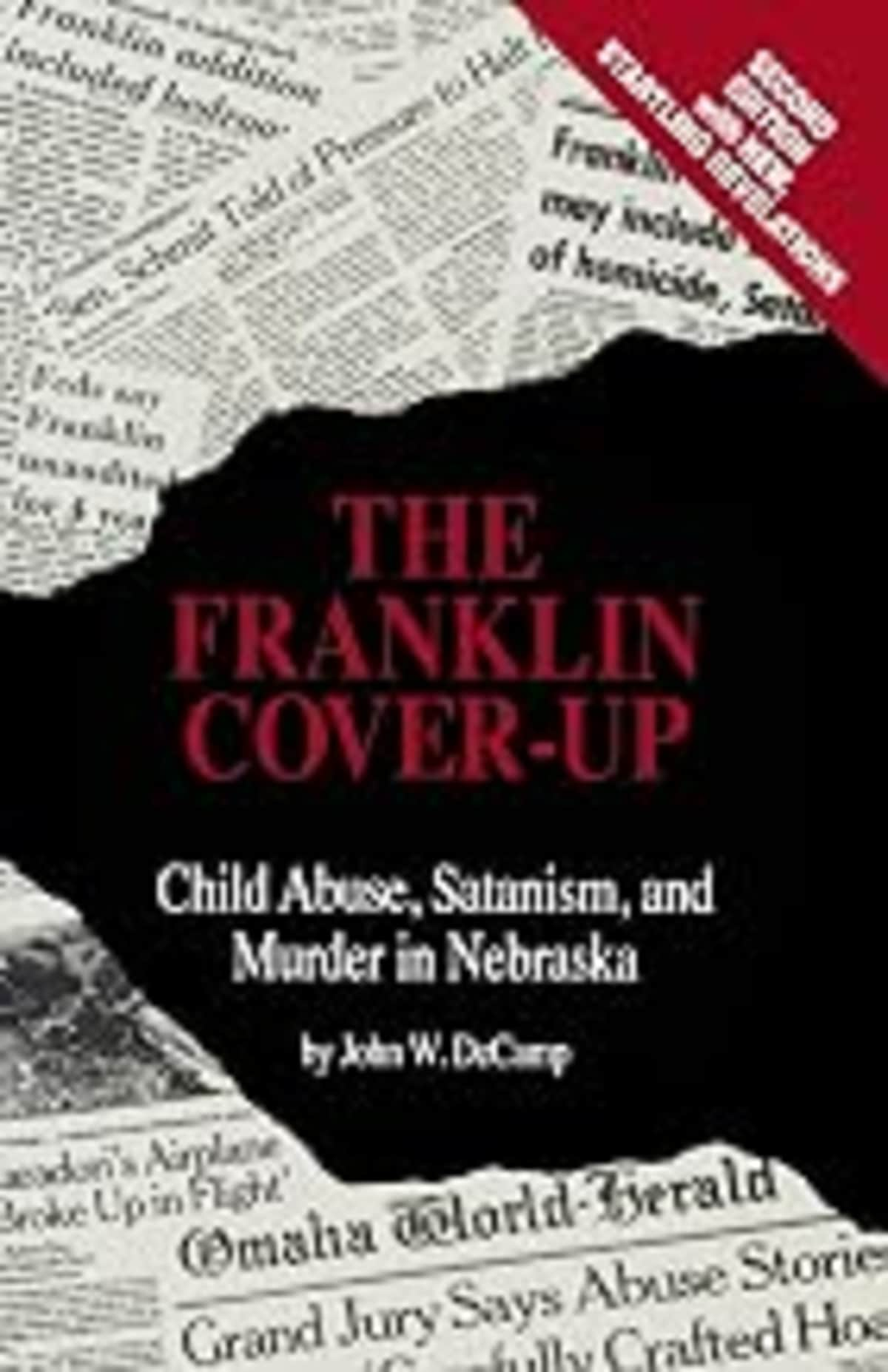
This post is a review of The Franklin Cover-Up: Child Abuse, Satanism, and Murder in Nebraska by John W. DeCamp (1992, 2004/2005 Edition). I must warn you, up front, that this review is quite lengthy because I had to first try to describe what was being covered up – and by whom.
Nick Bryant, in his book with a similar name, The Franklin Scandal (see my last blog post) referred often to John DeCamp and his book. I really didn’t want to read another “Franklin” book but since the Omaha Public Library had 12 copies, seven of which were available, I requested DeCamp’s book – with the idea of at least skimming it. I ended up reading “the whole thing” – finding DeCamp’s book to be as engrossing and disturbing as Bryants.
John W. DeCamp
First, a bit about the author. John W. DeCamp was a highly decorated Vietnam War veteran, rising to the rank of captain. While in Vietnam he was assigned to serve as an aide to former CIA director William Colby, then Deputy Ambassador to Vietnam (more later). DeCamp’s first campaign for the Nebraska Unicameral began while he was still serving in Vietnam. He won that election and eventually served as a Nebraska senator from 1971 to 1985. In 1975 he initiated Operation Baby Lift, which evacuated 2800 orphaned Vietnamese children.
He was a lawyer by profession and tenacious in virtually everything he did. In this book you will read about his active role in the Franklin Scandal, as the Franklin Committee chairman’s personal lawyer. In the 1990s he served as a lawyer for the Militia of Montana and in 1996 he ran for the U.S. Senate (from Nebraska) as a Libertarian. He is the author and self-publisher of this book, which has sold over 150,000 copies. I’m jealous.
Late in life, John suffered from Parkinson’s and Alzheimer’s diseases. He died in Norfolk, Nebraska on July 27, 2017, at age 75.
The Organization of the Book
DeCamp’s book was first printed in May 1992, a few months after the Franklin Scandal started to wind down – after the primary victim-witness (Alisha Owen) was sentenced to prison for perjury. The first edition (Part 1) consisted of an introduction, seventeen chapters (1-17), and two appendixes.
A “special 2004/2005 edition” included new material (Part 2), consisting of an introductory section entitled “2004/05 Updates and Developments …”, eight new chapters (18-25), and an epilogue.
As noted in my previous post, Nick Bryant relied on The Franklin Cover-Up and interviews with DeCamp when he first began to investigate – and later write The Franklin Scandal. Thus, both Bryant’s book and this book tend to tell the same story, but in different ways:
· Bryant’s book was more of a narrative, with the facts, statements, court transcripts, etc., woven into its six chapters – and with more of a third-person perspective (when he wasn’t writing about his own on-the-ground investigations).
· Decamp’s book had more of a first-person perspective. At different times he was the lawyer for three of the main characters in this book. At other times he was the public face for the Franklin Committee. When DeCamp writes about Larry King hosting a big political bash at Southfork Ranch, he was writing from the perspective of someone who was there in Dallas that day – someone in the front row.
But, given all the above, Bryant and Decamp wrote the same story. Bryant’s Franklin Scandal was basically the same as DeCamp’s Franklin Cover-Up; and as such I will not retell the story herein. I am not going to rehash the crimes, hearings, grand juries, and trials that I wrote about in my last post. Instead, I will try to zero in on the few things that are different about DeCamp’s book and a few perspectives that are unique to DeCamp.
One noticeable difference in DeCamp’s book is that he included many more word-for-word witness statements, interviews, and the like. Bryant wove some of those details into the story; DeCamp lays it out there for all to see – and much of what is shown is very disgusting and perverted.
Note: Throughout this review, page numbers from the book are included [in brackets], if you wish to review a quote in context or learn more about a particular topic.
DeCamp – Part of the Story
As I noted previously, John W. DeCamp was part of the story. He was a Nebraska state senator and active in the Republican Party during the early 1980s, when the Franklin misdeeds were starting to take place. “Larry King was a Democratic Party activist, and headed Black Democrats for McGovern in 1972, but after he shifted registration in 1981, King made his name in the GOP” [54].
In the introduction to his book DeCamp wrote, “I write about the unfolding of the Franklin case, its exposure and its cover-up, as not only an eyewitness, but a participant in these events. I knew how high Larry King’s reach went; … I was there, as the story of the Franklin Credit Union and the child abuse broke in Nebraska. I wrote the ‘DeCamp memo’ in 1990, which marked a new phase of the case. I will describe events in which I personally was involved” [xxii – xxiii].
DeCamp also noted that in 1984, while attending the Republican National Convention in Dallas, Texas, he first became aware of Larry King – as a rising black star in the GOP. During that convention, DeCamp attended the extravaganza that Larry King hosted at Southfork Ranch, the setting for the then popular CBS-TV show Dallas.
DeCamp wrote, “It was the most impressive party I have ever witnessed. The attendance by top politicians was remarkable; names and faces you only hear or see on television were there in number. At the center of the excitement was Larry King. Draped over him like a blanket throughout the evening was a heavyset woman, who I learned was Maureen Reagan, the president’s daughter” [55].
Seven years later, DeCamp learned that Paul Bonacci (one of the four Franklin victim-witnesses) was also at the Southfork Ranch party. “He [Bonacci] described it for me in exact detail …. He had been there for the purpose of providing sexual favors for people Larry King wanted to accommodate, satisfy, or compromise” [167].
John DeCamp was also a friend of (and personal attorney for) Loran Schmit, the chairman of the Nebraska legislature’s Franklin Subcommittee. Nick Bryant had written in The Franklin Scandal about a report addendum that Schmit wrote that caused three Franklin Committee members to resign. In The Frankling Cover-Up, DeCamp wrote that he had recommended the language that upset the resigning members. “I gave him the same advice then, that I would give now: ‘Accusations of child abuse are the worst accusations you can make against an individual. … make sure you have the smoking gun that establishes that is what actually occurred’” [62].
John DeCamp got so involved in the Franklin story that he moved his family to a small town south of Lincoln (Clatonia) for security [Author’s Note]. He got so involved in the Franklin story, that he was “supposed to be the ‘first hit,’ instead of Gary Caradori” [246].
The Cover-Up
The title of DeCamp’s book clearly denotes that he believed that a “cover-up” occurred. The chapter titles below identify the organizations (made up of people) who were involved in the cover-up.
· Chapter 4: Cover-Up Phase I: The Police
· Chapter 5: Just How Big is This Cover-Up?
· Chapter 11: Cover-Up Phase II: The Douglas County Grand Jury
· Chapter 14: Cover-Up Phase III: The FBI
The connection between Chapter 4 (The Omaha Police Department) and 14 (The FBI) was, in part, related to their leadership.
The Omaha Police Department was headed by one of the accused sexual abusers, Robert Wadman. DeCamp’s advice to the Franklin Committee chairman, was to, “Go to the highest authority you can, above the authority who is being accused” [85]. “I recommended to Senator Loran Schmit that he go directly to the FBI in Omaha to discuss the very serious allegations being made against Police Chief Robert Wadman by various individuals. … Senator Schmit insisted I go with him to this meeting, as his personal attorney” [85].
“In brutal language and with the most somber demeanor possible, Mr. O’Hara [the regional head of the FBI] made it clear that probably his closest friend in the world was Police Chief Robert Wadman, and that anyone who would dare to accuse Robert Wadman of impropriety had better realize that … they were effectively taking on Nick O’Hara and the FBI” [85-86]. Douglas County Sheriff, Dick Roth, who was sympathetic with the abuse victims’ case, later verified that, “Nick O’Hara of the FBI and Robert Wadman are closer than nineteen is to twenty” [88].
“In October 1983, the FBI announced it had investigated a male prostitution ring in Omaha. … U.S. Attorney Ron Lahners commented privately at the time, ‘This thing is so big and involves so many prominent people around the state.’ The investigation was expected to bring high-level indictments, but never did” [199]. What happened?
As to Chapter 11, Nebraska grand juries are heavily influenced by the county attorneys that present (or do not present) evidence to the jury. And, like the OPD/FBI situation noted above, one of the accused sexual abusers was Judge Theodore Carlson.
The Victim-Witness Stories
During Gary Caradori’s investigations, he zeroed in on four “star” witnesses. At various times he took sworn video statements from these witnesses. Caradori also made annotated transcripts of each of the recordings. DeCamp included lengthy excerpts from these annotated transcripts in his book, as noted below, in the order that they were gathered.
Alisha Owen [67-77]: Alisha turned out to be the strongest and most articulate of the witnesses. She persevered until the end – the end being four years in prison. I wrote about her story in my previous post.
Troy Boner [77-82]: Troy’s story vacillated wildly over time. When intimidated, or pressured (e.g., by the FBI), he would fold. DeCamp’s book is full of confessions, recantations, and recantations of recantations. Troy’s life and death were sad. I will write more about him later.
Danny King [82-83]: Danny was easily swayed like Troy. He was inclined to go with the flow and he didn’t make the best witness. As such, the state would tend to lead him through a series of yes/no questions – to back up Troy.
Paul Bonacci [102-105]: Paul Bonacci’s story was the most disturbing. Paul talked about ritual satanism and “snuff films.” Be advised, it is very hard to read. Two of the later sections in this review will address “Satanism” and “Paul Bonacci” in more detail.
The above documents are the heart of DeCamp’s book – the story of the Franklin abuse story. If you, as a member of a grand jury, believed the above statements, you most likely would indict the named abusers. If you didn’t believe the above statements, if these statements were later recanted or presented as lies, you might go a different direction.
“In order for the FBI to claim that all of the Franklin committee’s evidence was a hoax, they had to break one or more of the witnesses Caradori had taped. Troy Boner and Danny King recanted; what happened with Troy [pages 186-189] shows the hand of the FBI.” Alisha Owen and Paul Bonacci did not recant their confessions – and did not lie under oath. They were subsequently indicted for perjury.
Satanism
Nick Bryant wrote about Satanism in his book The Frankline Scandal, but I think the topic kind of got lost. John DeCamp put the word “Satanism” in his subtitle right between “Child Abuse” and “Murder,” – possibly in recognition of the typical order of events. DeCamp concentrated on the topic in the three chapters noted below:
Chapter 3: Pornography and Ritual Murder: “Loretta [Smith] described that they then cut the little girl’s head off …” [22]. “From three separate cases, involving pornography, child abuse, and ritual murder, children’s testimony and other evidence converged on Larry King” [24]. “When questioned about satanic cult activity, she [Alisha Owen] said that Troy Boner and Danny King were involved in this activity …” [74].
Chapter 15: Kathleen Sorenson’s Story: On pages 204-210 of his book, DeCamp prints a transcript of an interview that Kathleen Sorenson gave on television during 1989. If you read my previous post, you may remember that Kathleen, a foster parent, was one of the three ladies who first urged the state to investigate the child abuse linked to King. The interview, based on her experience with over 30 foster children, makes for a difficult read. Examples: “The children I have talked to have all had to murder before the age of two” [205]. “… we didn’t realize it at first, that they actually wanted to do it” [206].
“Kathleen Sorenson was aware that it was dangerous to tell the public what she did. She appealed to friends, ‘Pray for me.’ She died in a head-on car crash in October 1989” [210].
“Former FBI abuse specialist Ted Gunderson evaluated the accident in which Kathleen Sorenson was killed as a satanic contract suicide. The other driver didn’t die, but well could have; in satanic lore, a person who loses his life in such a contract murder/suicide will be reincarnated with more power, granted by Satan” [211]. DeCamp described the circumstances of the car crash, noting that, “Both the young woman driver and her husband had prior arrest records for cruelty to animals, a common marker for satanism” [211].
“One of the most potent weapons of the satanists is the inability of the average person to comprehend such hideous events as described by Kathleen Sorenson” [211].
Chapter 21: Drugs and the Monarch Project: “Tens of thousands of American children have been diagnosed MPDs [Multiple Personality Disorder]; virtually all of them are thought to have resulted from sexual abuse, of which perhaps 85 percent were cases of Satanic ritual abuse” [326]. “Multiple Personality Disorder is familiar to many people from Flora Rheta Schreiber’s book Sybil, … [who] first sought a psychiatrist’s help as a young woman in Omaha, Nebraska” [126].
Paul Bonacci
Only one of Franklin’s “star” witnesses deserved a chapter in DeCamp’s book – Paul Bonacci (Chapter 10). His story, as related in pages 102-104, is horrendous. After reading it, I hoped that Paul was lying but feared that he was not. I was tempted to provide a few quotes but decided that many were too horrendous to repeat.
As noted previously, Bonacci stuck with the initial story of depravity that he told Gary Caradori, repeated it before the grand jury, and then was indicted for perjury. If he had recanted, like Troy Boner and Danny King, he would not have been indicted.
One of the things that makes Bonacci so interesting is, no doubt, the twenty multiple personalities that he had – which were no doubt related to the early abuse that he experienced and the satanic rituals that he participated in over the years (as previously discussed).
“Bonacci spoke to Dr. Judianne Densen-Gerber about his activities as a member of four different satanic cults in Nebraska, some of which had 50 to 100 members” [204].
“The Franklin case was just one part of what [Bonacci] knew. The North American Man-Boy Love Association, or NAMBLA, figured prominently in what else Bonacci could recall. The motto of NAMBLA is ‘Sex before eight, or it’s too late.’ One of its leaders is named David Thorstadt. Two of Bonacci’s personalities, Sean and Christopher, have ‘Thorstadt’ as their last name” [228-9].
I suspect that the grand jury had a lot of trouble with Bonacci’s testimony. But, according to Dr. Densen-Gerber, who interviewed Bonacci in prison, because of his MPD, he was an excellent witness because:
1. He had an extraordinary memory for detail.
2. He did not lie.
3. He precisely described satanic rituals used by international cults which were impossible for him to have known, unless he participated in them [212].
Troy Boner
Troy Boner was the tragic victim of Franklin, as described in DeCamp’s book.
· He was one of the four “star” witnesses interviewed (and video-taped) by Gary Caradori [77-82].
· He later “recanted” that testimony before the Douglas County grand jury, during the Alisha Owen trial, and on the CBS program 48 Hours. “[Troy’s] recantation was crucial to the Douglas County Grand Jury’s findings of July 1990, that all the charges of child sexual abuse and related criminal activity was a ‘careful crafted hoax’” [305].
· He later “recanted his recantation” after Gary Caradori died in the plane crash [186-189], and via an affidavit recorded on October 27, 1993 [Chapter 20: Troy Boner Steps Forward]. That affidavit was divided into five sections, the fourth being, “My Contact with the F.B.I. and Why I Lied After That Contact.” In that section Troy stated, “I am completely certain in my own mind … that my brother Shawn was killed as a message to me … that they would do anything and kill anybody to keep the truth contained and to keep me lying for them; …” [313].
· During a court hearing in 1994 (held to get Alisha Owen a new trial), Troy Boner unexpectedly “took the Fifth.” Before he was called to testify at that hearing, a broken Troy Boner whispered to DeCamp, “Oh God, forgive me. They guaranteed if I talk here today, they will put me away for twenty years. … They told me I had to take the Fifth Amendment and refuse to testify. Otherwise, they promised I would be taken directly from court to jail” [391].
“In late 2003, Troy Boner walked into a hospital in New Mexico screaming, ‘they’re after me, they’re after me because of this book [The Franklin Cover-Up].’ … When nurses came to check on him early next morning, Boner was sitting in a chair, bleeding from the mouth and quite dead” [the opening line in the “2004/05 Updates …” introduction to the book].
Bob Kerry and Other Nebraskans
One very big difference between DeCamp’s The Franklin Cover-Up and Bryant’s The Franklin Scandal was DeCamp’s focus on Bob Kerry, the governor of Nebraska from 1983 to 1987. DeCamp took two big swipes at Kerry: in Chapter 6 (The Destruction of Commonwealth Saving, Model for Nebraska), and in Appendix B (Bobby and Me).
Decamp wrote, “It is impossible to understand the Franklin scandal and its cover-up, without knowing the environment created in Nebraska when Robert Kerry was governor, 1983 to 1987. It was an atmosphere of permissiveness for the rich and powerful, to do mostly as they pleased” [252]. “Bobby was riding as high as any governor ever had in Nebraska. Movie Star Debra Winger was now living in the mansion with him part time. All Nebraska was in love with Bobby and Debby” [265].
I remember those days, heck, I was also in love with the charismatic governor and his movie star live-in. It was Nebraska’s mini version of the Kennedy “Camelot” era. Other than the “permissiveness” mentioned above, DeCamp never connected Kerry to Franklin. DeCamp thought that Kerry was a hypocrite – and it just bugged him.
DeCamp was especially incensed about Kerry’s handling of a bank (Commonwealth Saving) insolvency – in comparison to another Nebraska bank owned by Kerry associates (Chapter 6), and Kerry’s blatant about-face on abortion to get elected [262]. But heck, many a Democrat flipped on abortion in those days. In any case, DeCamp seemed to have a lot of issues with Bob Kerry.
“JOHN DECAMP helped establish in 2001, 2002, 2003 that Lt. Bob Kerry was the officer in charge who ordered slaughter of 25 unarmed women & children at place called Thanh Phong in Vietnam, for which Kerry was decorated under claim that these had been armed Viet Cong soldiers” [“2004/05 Updates …” section of the book, as written].
When DeCamp updated the book (Second Edition), he seemed particularly concerned that then Senator Bob Kerry (1989-2001) might become the Democrat Party’s presidential candidate: “With his flip flops and prevarication, his personal aggrandizement, his manipulation by forces behind the scenes, and his protection by a controlled press, we are in for some very rough times, if Joseph Robert Kerry ever becomes President of the United States” [273].
DeCamp also took (in my opinion) an over-the-top swing at “The Omaha Business Community” (Chapter 12). In that chapter, he mentions a few names that were part of the story back then – but who never got caught up in the grand jury report or the Owen trial (e.g., Eugene Mahoney). DeCamp then drifted away from Franklin to discuss “Ak-Sar-Ben” (Nebraska spelled backwards – “a quasi-freemasonic social organization”), the leadership of the Union Pacific Railroad, and Warren Buffet (and the women in his life). Many of the assertions in this chapter seem to be rumors and speculations – rather than facts.
In my opinion, DeCamp heavy-handily roped some people into the “Franklin” discussion that should not have been mentioned. For example, after noting that the Franklin Credit Union “could not have functioned for a single day without the complicity of Nebraska’s largest bank, FirsTier …” [145], he listed the 34 names of the 1987 and 1988 board of directors of two FirsTier institutions [158-9]. While the bank might have been complicit, I doubt that those 34 named were – or should have been aware – of any complicity in the matter. I don’t believe those names should have been published.
Bill Coby – Friend and Mentor
Throughout the book, DeCamp would interject the name of William Colby.
In the later edition of his book, Decamp added Chapter 25: (In Memoriam: Bill Colby), which began, “On April 27, 1996, my dear friend and mentor, former Central Intelligence Agency director, William Colby, disappeared, supposedly while boating on the eastern shore of Maryland” [377].
As I mentioned at the start of this review, DeCamp, as a young soldier in Vietnam, was assigned to serve as an aide to Colby, who was then the Deputy Ambassador to Vietnam.
Per Wikipedia, “After the [Vietnam] war, Colby became Director of Central Intelligence (DCI) and, during his tenure, under intense pressure from the Congress and the media, adopted a policy of relative openness about U.S. Intelligence activities to the Senate Church Committee and the House Pike Committee.”
Per DeCamp, “(… as head of the Central Intelligence Agency (CIA), he took the CIA before the U.S. Congress, to reveal the Agency’s ‘family jewels’ and start the process of correcting the sins of the CIA. For this, President Gerald Ford fired Colby and replaced him with a man named George Bush” [379-80].
Colby became part of the Franklin story – as DeCamp’s confidant and mentor, as a candidate for the position of chief council for the Franklin Subcommittee, and as the person later hired by that subcommittee to investigate the plane crash of Gary Caradori.
“Bill Colby was one of the pivotal figures in unearthing the Franklin scandal. Without his persistent support and guidance, this book would have never been written” [377]. “To quote his exact words, ‘This case is so much bigger than you think. It goes to the very highest levels; we have to keep pulling the strings’” [378].
At the end of the chapter, DeCamp describes the circumstances of Colby’s death, which was officially labeled an “accident.” Decamp ends the chapter by writing, “I did not believe it then, and I do not believe it now. But I do believe what Bill said: ‘If it [an assassination] is done right, you will never know how it was done, or who did it’” [389].
What Was Franklin All About?
DeCamp asks and answers this question twice in his book.
In the first edition (Chapter 17), he asks the question on page 247 – “What is Franklin really all about? … Is it child abuse? Is it just a big ‘homosexual party,’ … Is it laundering money for Iran-Contra? Were there murders to protect rich and powerful people” [247]?
DeCamp later concluded, “Just as surely do I believe, that there was and is a cover-up. Just as surely do I fear, that nothing will be done about it. So, let me conclude my [sic] saying simply this: Bill Colby, you were right. It is too big. I am too small. … Yes, it is something that I should have abandoned long ago and faced up to the fact that good does not always triumph and that evil, with its many faces, does sometimes succeed. At least for a while” [248-9].
+++
In the second edition of the book, in the Epilogue, DeCamp adds to the above answer.
“I finally understood the true meaning of the Franklin case one night in early 1996. Watching television and skipping through the channels, I came upon the movie Billy Budd” [390]. DeCamp then noted that earlier, after Alisha Owen’s appeal for a new trial was rejected – after Troy Boner unexpectedly “took the Fifth;” Judge Enbody, in chamber, suggested that “If you want to understand the entire Franklin case … Go read ‘Billy Budd’” [392].
“To make a long story short, because of certain incriminating appearances in the case, the captain and his senior officers, although they knew Billy was innocent of all charges, nonetheless sentenced him to hang, a necessity – as they viewed it – to ‘save the system,’ not just on their own ship, but in the British fleet as a whole” [393].
“The ‘system’ is the only ultimate sacred cow – not a particular law or construction, but only ‘the system.’ Because, ultimately, it is the system which makes certain that the individuals functioning within it – from judges to lawyers, to prosecutors, to politicians, to businessmen – have their places and positions, and opportunities and pecking order, and future” [393].
“And, though it is unfortunate, that on occasion the protection of the ‘system’ requires the deliberate sacrifice of perfectly innocent people, that is hoped overall to be the exception rather than the rule” [393].
“But then I have one final, nagging question. How do I know when, or if, the ‘system’ itself has become so corrupted, that evil is the rule, rather than the exception? And when that occurs, what do I do about it” [393]?
Odds and Ends
Four Fighters Who Didn’t Quit: In Chapter 16, Decamp wrote about four fighters that wouldn’t quit:
· Paul Bonacci, A Christian Fighting for Life: … “Paul Bonacci is not just a victim. He is an intelligent young man, who has entered a process of redemption” [214-217];
· Alisha Owen, Persecuted for Righteousness’ Sake [217-219];
· Loran Schmit, Farmer, Senator, Man with Courage [219-221]; and
· Gary Caradori, Martyr [221-223].
+++
Suspicious Deaths Tied to the Franklin Case: Appendix A [250-1] starts with the following, “At least fifteen people who were close to the Franklin case have died under suspicious circumstances. Many of these deaths were violent, others were unexplained” [250]. Below that statement DeCamp lists the fifteen names with a few brief details (e.g., “Shawn Boner. Brother of victim-witness Troy Boner, he died of a gunshot wound from ‘Russian roulette”).
+++
Billy Budd: After reading DeCamp’s references to Billy Budd, the 1924 novella by Herman Melville and the 1962 movie directed by Peter Ustinow, I had to find out more. If you go to TCM.com you can view four clips from the movie that pertain to the lesson that DeCamp learned about Franklin.
The movie is set in the year 1797 on the British naval vessel HMS Avenger. Billy Budd, a new crewman pressed into service, attempts to befriend the brutal master-at-arms, who controls the crew through vicious flogging. Things happen; Budd accidently kills the evil master-at-arms, and the captain, “torn between morality and duty to his station,” sentences Budd to be hanged.
I previously noted John DeCamp’s quandary, “How do I know when, or if, the ‘system’ itself has become so corrupted, that evil is the rule, rather than the exception? And when that occurs, what do I do about it”?
In the story of Billy Budd, Billy lost – like Alisha Owen lost when she was convicted. In the story of Billy Budd, the British Navy won – flogging continued to flourish to discipline (fairly or unfairly) the crewmembers of the British navy ships – to, among other things, prevent mutinous thoughts and actions.
But as to “what to do about it” – in my book Sir Francis Burdett, I noted how Sir Francis Burdett, as a member of the English House of Commons in 1833, spoke against flogging and began the conversations in the British Parliament that eventually ended it. That is what you can do about it. You can fight to fix the system and right wrongs, recognizing that the task is not always easy. In effect, that is what John DeCamp did when he wrote his book.
Recommendation
The Franklin Cover-Up: Child Abuse, Satanism, and Murder in Nebraska was a very disturbing book – because of the child abuse, satanism, and murder that DeCamp wrote about. I found the book, especially Part 1, to be captivating.
Because DeCamp was part of the story, his first-person point-of-view provides a unique and inside perspective of the Franklin scandal – as it turned into a cover-up.
If you read the book, you will have to decide for yourself whether horrendous crimes were committed by important people – or whether what occurred was a “carefully crafted hoax.” You will have to decide whether DeCamp is pushing a conspiracy theory or whether a grave injustice was done to the victim-witnesses. There is very little middle ground.
As regards this book versus The Franklin Scandal (by Bryant), I liked the way that DeCamp quoted the words of others in his book – particularly Caradori’s excerpts of the Alisha Owen, Paul Bonacci, Troy Boner, and Danny King videotapes; and Kathleen Sorenson’s story (Chapter 15). While Bryant did a nice job of telling Alisha Owen’s story, I thought that DeCamp did a better job with the troubled lives of Paul Bonacci and Danny King.
My main criticism of DeCamp’s book involves his tangential chapters on Bob Kerry, the Omaha business community, the Oklahoma City bombing, and the Militia of Montana. I thought those topics detracted from the Franklin story – and frankly, gave the book more of a “conspiracy-theory” flavor.
In his book’s subtitle, DeCamp also documented the “Satanism” aspects of Franklin (as noted previously). As I read DeCamp’s book, I thought of Stanley Kubrick’s movie Eyes Wide Shut, which starred Tom Cruise and Nicole Kidman. In that 1999 movie the elites of New York City, wearing their masks and robes, participated in a ritual sacrifice (i.e., the woman who came to Cruise’s defense was killed – but not on screen).
Eyes Wide Shut has been fodder for many film critics, scholars, and sociologists. Per Wikipedia (11-09-26), “Scholar Arthur Versluis notes that Eyes Wide Shut represents a ‘political gnosis,’ which he describes as a ‘revelation that behind wealth and opulence of an American social elite is initiation into a corrupted and corrupting society or network.”
“Versluis believes the film’s title plays on the notion of ‘seeing what is in front of us (eyes wide open) and yet not seeing.’” In his book DeCamp suggests that Franklin is an example of “eyes wide shut.” Alisha Owen and Paul Bonacci described the crimes – the Satanism – for all to see, and yet the grand jury, the trial jury, and most of us cannot see it. Many of our eyes, for some reason, are “wide shut.” Franklin and “Epstein” are similar; they both have raised many serious allegations; many victim-witnesses have been forced to defend themselves; but very few perpetrators have been convicted (or even formally charged).