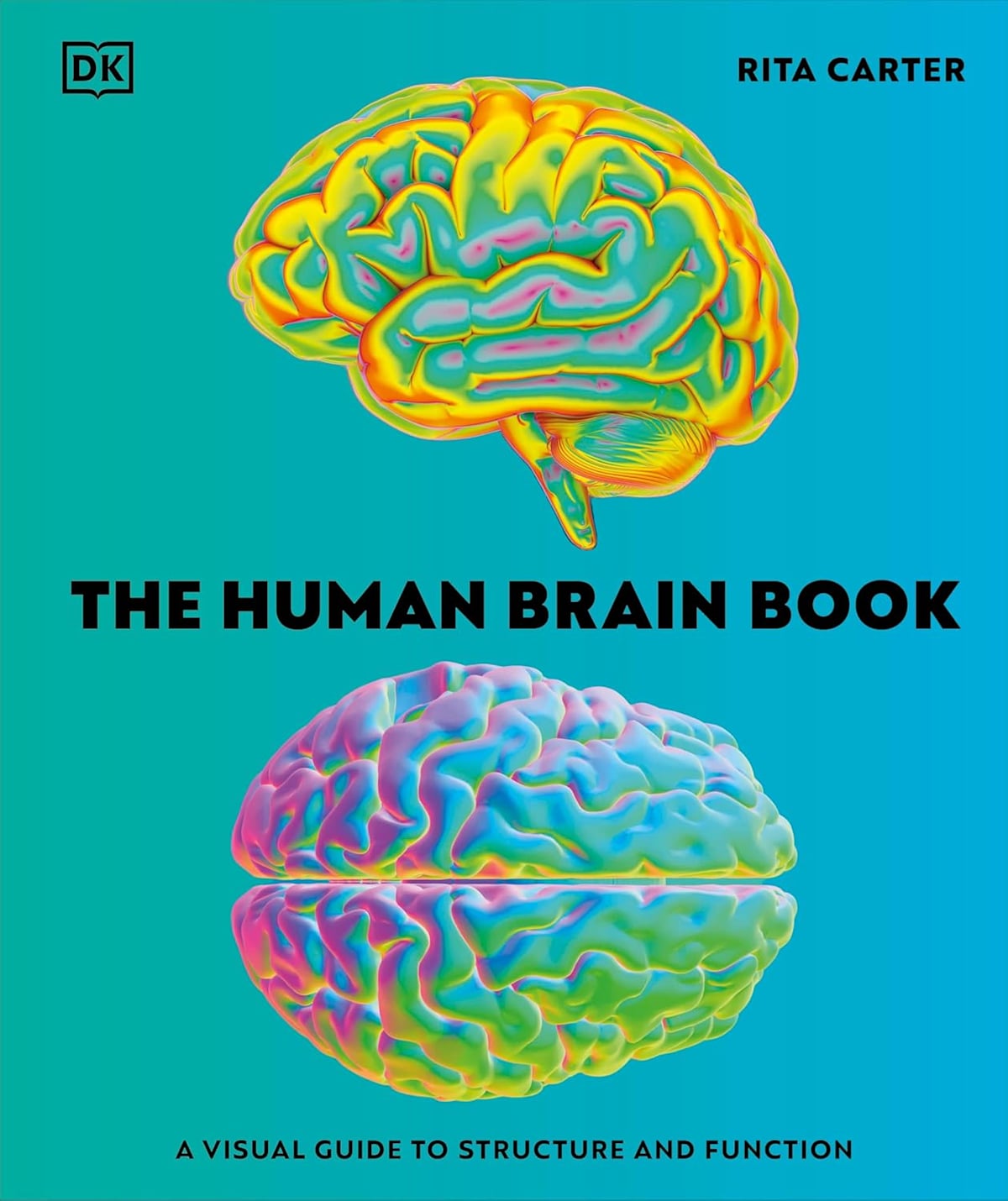
This is a review of The Human Brain Book: A Visual Guide to Structure and Function by Rita Carter (2026, fourth American Edition). Carter is a science and medical writer who has twice been awarded the Medical Journalists Association prize for outstanding contribution to medical journalism.
This book review is a bit different for me in that it is a review of a book that might best be categorized as a “coffee-table” book. It weighs 3.2 pounds, which coincidentally is the weight of an average adult brain. The book costs 80 cents per ounce, which is much more reasonable than my book The Polesworth Circle ($2.00/ounce). Carter’s book is also a bit out of my wheelhouse, as I am a bit of a hypochondriac and medical books can thus cause my brain to race. See the “Illnesses and Injuries” section later in this post.
Note: Throughout this review, page numbers from the book are included (in parenthesis), if you wish to review a quote in context or learn more about a particular topic.
What Makes the Book Great?
Two things (in combination) make this book great. They are:
Improvements to medical imaging techniques have led to a better understanding of neuroscience and how the brain functions. These techniques allow for measuring electrical activity (EEG), picking up magnetic fields created by electrical activity (MEG), and measuring metabolic side effects, such as alterations in glucose absorption (PET) and blood flow (fMRI). Other techniques include computed tomography (CT) and diffusion tensor imaging (DTI). Combining these technologies often provide even better understanding of how the brain works. On pages 15-23, Carter displays sixteen remarkable DTI images of the stringy nerve threads (axons) that carry electrical information from one brain cell (neuron) to the next.
The illustrator’s use of color brings all the images noted above (of the gray and white matter in the brain) to life. Almost every subsection of the book has one or more illustrations that use color to depict topics like brain functions (26-27), brain structures (40-43), the limbic system (52-53), … and brain mapping (218).
The Organization of the Book
The book is subdivided into 13 sections and 84 subsections as noted below. Two pages are reserved (with a few exceptions) for each of the subsections, which makes the book easy to read in a “coffee-table-book” manner.
As such, Carter accepted some self-imposed limits as to what she could include in the book. She adjusts the font sizes used to squeeze in considerable detail. But, a warning, bring your good reading glasses. In one instance (maybe a “brain test”) the printer/publisher even eliminated spaces to save space (Thepituitaryglandisapea-sizedstructurethathangsfromthebaseofthebrain,connectedbyastalkofnervefiberstothehypothalamusjustaboveit. …).
Sections (and number of subsections)
The Brain and the Body (5)
Brain Anatomy (9)
The Senses (16)
Movement and Control (6)
Emotions (8)
Language and Communication (5)
Memory (6)
Thinking (3)
Consciousness (9)
The Diverse Brain (6)
Development and Aging (4)
Changing the Brain (3)
Illness and Injury (4)
The Brain and the Senses
The first four sections of the book describe the physical properties of the brain and the rest of the central nervous system, including the brain stem, the spinal cord, and the 31 pairs of spinal nerves that provide pathways to the brain. These four sections provide the basic biology that the more nebulous sections of the book further explain (e.g., emotions and thinking).
“The primary task of the brain is to help maintain the whole body in an optimal state relative to the environment in order to maximize the chances of survival. The brain does this by registering stimuli, then responding by generating actions. In the process, it also generates subjective experience” (26).
My Favorite Section (Memory)
My favorite section of the book involved “Memory.” It contained the following six subsections: The Principles of Memory; The Memory Web; Laying Down a Memory; Recall and Recognition; Habits; and Unusual Memory.
In “The Principles of Memory” subsection, I learned that “Each time a memory is recalled, it is altered slightly to accommodate new information” (142).
In “The Memory Web” subsection, I learned that “Memories are stored in fragments throughout the brain” (144). As an example, Carter used a man’s pet dog – the “color” memory fragment in the visual cortex, “walking with him” in the motor area of the brain, and “the dog’s name” in the language area of the brain.
Laying Down a Memory: “Most experiences leave no permanent trace. A few, though, are so striking that they alter the structure of the brain by forging new connections between neurons. These changes make it possible for the neural activity that generated the initial experience to be reconstructed, or ‘recollected,’ at a later date” (146).
This subsection of the book has cool illustrations of five phases that occur when a long-term memory is formed.
· The first three phases (attention, emotion, and sensation) occur during the first half-second of the “experience.”
· The fourth phase occurs during the next ten minutes as the memory is “held in mind” – by repetition in the brains “working memory” (along with the six-digit passcode your bank may have just texted you). Lesser experiences, such as the six-digit-passcode, fade away after ten minutes.
· The more striking experiences advance to “Hippocampal processing,” during the fifth phase which lasts from 10 minutes to two years (i.e., until the memory is consolidated in the brain). This “consolidation” takes place largely during sleep, as a memory is transferred back and forth from the hippocampal to the cortex (to reinforce the circuit). Eventually, the memory will reside in the cortex, freeing the hippocampal for new information.
Recall and Recognition: “This experience of remembering ‘overwrites’ the memory, so each time an event is brought to mind, it really is a recollection of the last time we remembered it. Hence, memories gradually change over the years, until eventually they might bear very little resemblance to the original event. Many memories fade entirely in time. This is not a fault – the purpose of memory is to use past events to guide future actions, not keep a record of everything that has happened” (148).
In a past post (“Photo Albums,” August 12, 2025), I asked myself a question, “So, why do I continue to physically store my photographs in photo albums?” My final answer to that question is related to memories, recollection, and recognition. “The photographs reinforce memories and feelings. Someday someone might plunk one of these albums in front of me and say, “See, this was your mother,” or “This is you when you were young,” or “This is your daughter – the one who lives in Arizona.” The photographs and captions may help me stay in touch with my fleeting past – a little longer.”
Creativity – from an Author’s Perspective
My favorite subsection of the book involved creativity, from my perspective as a struggling writer, author, and playwright. Occasionally, when I finish a post, article, or book, I ask myself the question, “Where the hell did that come from.” This subsection of the book helped me answer that question.
Creativity and Humor: “Creativity is the ability to reconfigure what you know, often in the light of new information, and come up with an original concept or idea. In order to turn the idea into something that can be used, you have to switch to being critical, selective, and focused. … There are three main stages of creativity.
· First, creativity takes preparation. You brain needs to be rich in knowledge – not necessarily facts, but observations and questions such as ‘what if’ and ‘why.’ To get to this state, you only need to look, wonder, and watch. Your brain will automatically come up with its own questions, which will provide the seed for creative solutions.”
· “Incubation is the stage where your brain lets go of the problem and meanders, gathering information from different places. Much incubation happens unconsciously or even in sleep. This stage is associated with the resting state.
· “Illumination is the final “eureka” moment when you suddenly come up with a creative solution” (158).
The three stages, as described by Carter, seem to mimic my writing experiences. I prepare a lot – in that I observe and read a lot about a wide range of things. Many of my writing “problems” are resolved and “eureka” moments come between 5 and 7 AM, as I wake up. It is ironic that to “lay down a memory’ it helps to be laying down (resting).
Creativity and Madness: As an unsuccessful writer, I am blessed to be on the more “normal” side when it comes to “madness” (I think). On page 158 of the book, Carter provides the results of a “mental-disorder” study, which compared “successful” and “highly creative” writers to “patients with psychosis” (and an adult control group). Each of the four groups was scored on eight mental disorders such as depression, hysteria, paranoia, and schizophrenia.
The results: Successful writers are worse than "normal" (the control group) in all eight psychiatric categories. The scores of the highly creative writers were even worse, approaching the scores of the patients with psychosis. Of the eight categories rated, paranoia was the disorder where the gaps between the control group (score 35) and the others were the greatest. The paranoia scores for the writers were 58 (successful) and 62 (highly creative), while the patients with psychosis scored 80. These results are consistent with my personal experience.
Belief and Superstition: As regards writing, the subsection on “Belief and Superstition,” offered one more insight as to why I write. “Our brains are constantly trying to make sense of the world in order to guide our actions. One way of doing this is by creating explanatory stories or ideas into which we fit our experiences. Such frameworks are often useful, but they may not always be correct” (160).
Other Subsection Highlights
Listed below are a few highlights (for me) from some of the other subsections in the book and the types of information that Carter included in her book.
Making Sense of Sound (78-81) has a great two-page illustration of “how the brain hears” – from the outer ear to the primary auditory cortex.
The Sixth Sense (90-91) provides information on a sixth sense which is called proprioception – a sense of how our body is positioned and moving in space.
Unconscious Action (106-107) provides a series of illustrations on how the human mind attempts to return a tennis serve, given that the returner’s brain first becomes consciously aware of the ball 285 milliseconds after it comes off the server’s racket (and after it has already crossed the net) – giving the returner just 215 milliseconds to consciously act (return the ball). Needless to say, the returners brain must (via experience and memory) anticipate the serve to be successful.
Mirror Neurons (108-109) “unconsciously mimic the actions of others and thus share, to some extent, their experience.”
Empathy and Altruism (126-127) states that “People brought up in a ‘normal’ environment develop an instinctive sense of right and wrong that seems to be, at least in part, ‘hardwired’ into the brain.”
Recall and Recognition (148-149) describes the opposite of déjà vu. Carter writes briefly about jamais vu, “when one is in a situation that should be familiar but which seems strange … a glitch in recognition, whereby the emotional input that usually accompanies familiar experiences fails to occur.”
Sleep and Dreams (174-175) notes that, “No one is quite sure what it is about sleep that makes it so important. One theory is that it allows ‘downtime’ for the body to repair itself [or grow, in the case of a child]. One way it may do this is by draining away detritus – the broken -down molecules that accumulate in cerebrospinal fluid during cell activation. … A third is that the brain needs to switch off from the outside world in order to sort, process, and memorize information.”
Unusual Brains (196-197) described Einstein’s brain, noting that “part of a groove that normally runs through the parietal lobe was missing. The area affected is concerned with mathematics and spatial reasoning, and it is possible the missing groove allowed neurons there to communicate more easily, giving him his extraordinary talent for describing the universe mathematically.”
The Aging Brain (206-209) was especially interesting to me because my brain, at 77 years old, has aged. Carter notes in this section how my brain has lost neurons and my impulses are transmitted more slowly because of myelin decay. A series of MRI scans show how the basal ganglia, subarachnoid space, ventricles, and white-matter tracts change between the ages of 27 and 87. It is not a pretty picture. Carter does, however, provide some information on “Keeping the Brain Young.”
The Brain of the Future (214-217) notes that “Technologies for mind reading, thought control, and artificial intelligence are already with us and are becoming more sophisticated every day. … Rather than relying on neuroplasticity, where the brain is changed through learning, human brains may be enhanced by various biotechnologies that use machines, drugs, or genetic manipulation to rapidly alter our brain’s abilities.”
Illnesses and Injury
The last subsection of the book (228-249) contains a lengthy list (42 categories) of illnesses and injuries involving the brain. The list includes conditions caused by disease, genetics, and/or accidents.
Many of the categories have statements like, “The cause … is not known,” “The mechanism underlying is not known for certain,” and “often the cause is not identified.” The next edition of the book will hopefully have more answers. Neuroscientific investigation of the brain is very much a work in progress.
One of the categories listed was “Head Injuries.” In a blog post back on August 23, 2025, entitled “The Black Dog,” I wrote about the head injury that I received when I was hit by a car, while crossing a street. In that post, I quoted from Dr. Daniel G. Amen’s book The End of Mental Illness.
In that passage, the good doctor wrote, “When people ask me what the single most important lesson I’ve learned from looking at more than 170,000 brain scans is, I reply, ‘Mild traumatic brain injury is a major cause of psychiatric problems, and very few people know it.’ ... I’m constantly amazed at how many people think their injuries were too insignificant to mention.” That statement, my hypochondriac tendencies, and Carter’s book make me wonder.
Summary
The Human Brain Book by Rita Carter would look good on the coffee table at your house. Everybody picking it up would love the illustrations, the use of color, and the bite-sized (2 page) descriptions of the various aspects of the brain. It would make a much better addition to your décor than Colorful Birds of South America (for example).