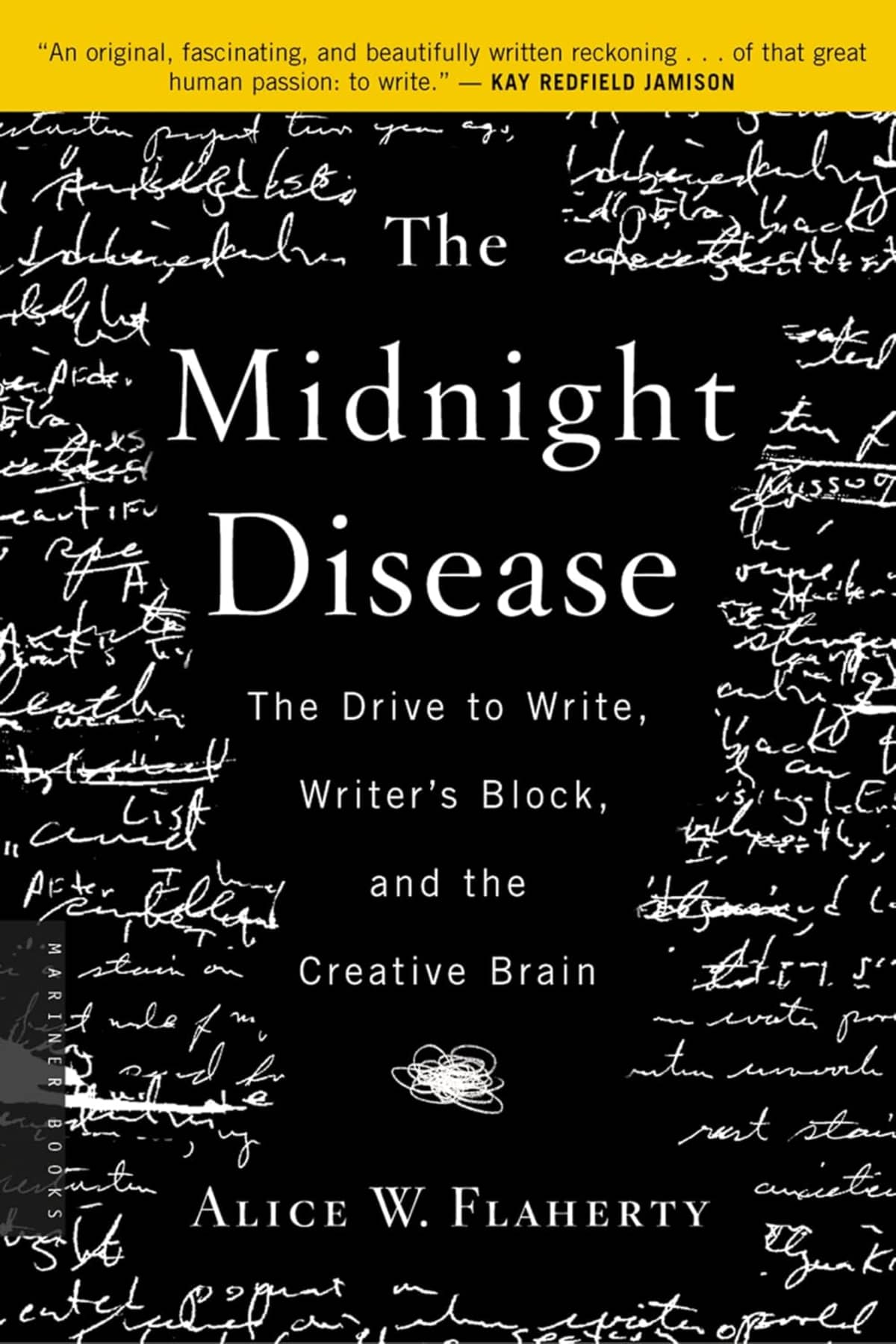
This post is a review of The Midnight Disease: The Drive to Write, Writer’s Block, and the Creative Brain, by Alice W. Flaherty (2004). I am not sure how the book arrived in my library queue a week or so ago. When I picked up the book at the library, I assumed that it had been a recent purchase – with a recent copyright date – reserved recently from my library’s list of new purchases (i.e., Wowbrary).
When I was almost through with the book, I noticed that the book had been written way back in 2004, leading me to believe that I may have reserved the book some time ago based on some sort of recommendation, which I can no longer recall.
In any case, the book was a great find, expanding on my recent post (May 10, 2026, The Human Brain Book) and helping me understand “Why I Write.” The latter question is of particular interest to me now because I am in the process of publishing my eleventh book, Bob’s 2026 Blog Book. In the introduction to that book, I attempted to answer the “Why I Write” question, so the arrival of Flaherty’s book was very timely and enlightening.
Notes: Throughout this review, page numbers from the book are included (in parenthesis), if you wish to review a quote in context or learn more about a particular topic. The title of the book was a phrase that Edgar Allen Poe oft used when he spoke about his sufferings as a writer.
Dr. Alice W. Flaherty
Dr. Alice W. Flaherty was (back in 2004) and is (today) a neurologist at Massachusetts General Hospital. Today she is also an associate professor of neurology and psychiatry at Harvard Medical School. Flaherty wrote The Midnight Disease from four perspectives; as a medical doctor, a neuroscientist, a writer, and a mental patient.
Medical Doctor: During much of her career, Flaherty worked as a doctor “with people.” She is currently the director of the Movement Disorders Fellowship at Mass General, which treats patients with movement and mood disorders.
Neuroscientist: In her book she notes that, “The Midnight Disease is shaped not only by my work as a doctor with people, but also by my work as a neuroscientist with brain imaging to study neural activity” (8). Among her accomplishments, she participated in a trial of the first successful genetic treatment of Parkinson's Disease.
Writer: Prior to writing The Midnight Disease, Flaherty wrote The Massachusetts General Hospital Handbook of Neurology, which subsequently received an award for its innovative approach. In chapters 3 and 4 of The Midnight Disease, she wrote “first person” accounts of her own “writer blocks.”
Mental Patient: Throughout the book, Flaherty writes about her own mental health issues. Early in the book, she wrote about the postpartum mood disorder and mania that began after her premature twin boys died at birth. Later in her book she wrote about, “my bewilderment at what wire in my brain snapped after the deaths of my first children. Whatever it was, it dragged me away from a happy career as a scientist toward an impractical compulsion to write” (204). In pages 33-37, she wrote about her hospitalization for depression, and the many patients she observed writing while she was hospitalized.
Introduction
The Midnight Disease begins with a wonderful introduction, followed by the six chapters reviewed herein.
Summary of Review: In my opinion, every writer should read the Introduction, Chapter 1, which defines Hypergraphia, and Chapter 6 (Why We Write: The Limbic System).
In the first paragraph of the Introduction, Flaherty describes writing as the supreme human achievement, which is “by turns exhilarating and arduous” (1). She quickly moved unto a medical term that I was not aware of – hypergraphia – “an overpowering desire to write” (2).
Before further describing hypergraphia, in Chapter 2, Flaherty describes the neuroscience involved in writing and the complex relationship between writing and emotion. From a neuroscience perspective, two parts of the brain are very much involved in writing:
· The Temporal Lobes (Chapter 5) are located in the cerebral cortex roughly behind the ears. “If the brain is shaped like a pair of boxing gloves, the temporal lobes are in the thumbs” (20). The temporal lobes are fundamental in that “they are necessary for understanding word meaning” (4). Very simply, from my layman’s point of view, the temporal lobes provide the “ability” to write “perceived facts.”
· The Limbic System (Chapter 6) is “surprisingly relevant to creative writing. … [It is] the seat of emotion and drive, and … some aspects of the feeling of being inspired” (5). The limbic system “gets its name from the fact that it forms a limbus, or ring, deep under the cortex” (5). Very simply, from my layman’s point of view, the limbic system provides the “drive” to write “metaphorically with emotion.”
In the remainder of this review, I will concentrate on the “writing” aspects of the book, versus the neuroscience associated with the writing.
Chapter 1: Hypergraphia: The Incurable Disease of Writing
“Temporal lobe epilepsy is the best-understood cause of hypergraphia” (18) – and this is important – “there is growing evidence that the temporal lobe is important for creativity in many driven writers without epilepsy” (20).
In The Midnight Disease, Flaherty, extrapolates the facts of hypergraphia, as observed in epileptics, to the “neurology of literary creativity” found in driven prolific writers from the past – and the not so driven writers of today, like me.
Flaherty starts by suggesting a 5-point “working definition” of hypergraphia (24-25):
1. Most obviously, hypergraphics write a great deal.
2. Hypergraphia comes from a strong, continuous, internal drive – say, pleasure – rather than from an external influence (e.g., boss, publisher).
3. The writing usually has themes that are highly meaningful for the author, often philosophical, religious, or autobiographical.
4. Apart from the loose constraint that writing be meaningful, at least to the author, the writing need not be any good.
Flaherty reserved a fifth point for “true clinical hypergraphia” (neurological or psychiatric patients with known or likely temporal lobe changes) before noting that, “otherwise-normal people who meet the first four criteria are similar enough that they are worth discussing together with the hypergraphics. In fact, they are the main reason for discussing hypergraphics at all” (25). Flaherty then goes on to discuss three topics that I, as a writer, found particularly interesting:
Manic-Depressives: “A surprising proportion of writers are manic-depressive” (30).
· “So many writers write about their depression that it has become a genre with its own anthologies … depressed people tend to be strongly introspective, a trait that may foster writing” (32).
· “Manics write because what they are writing about seems vitally important to them, worth preserving. Manics write because one topic reminds them of another … [that] when taken to a manic extreme psychiatrists call flight of ideas” (38).
Bloggers: “Thousands of authors simply write their diaries directly onto Web pages for the rest of the world to read. Why do people want to recount their lives? What could it mean to want to share one’s worldview with strangers (37)?
Graphomania: “Hypergraphia might reflect a manic distortion of that particularly Western desire to get published. Yet many hypergraphics clearly write for their own pleasure and are reluctant to show their writings to others” (39 and 217-218 for the term graphomania).
Chapter 2: Literary Creativity and Drive
Flaherty starts the chapter by stating that, “What makes hypergraphia worth studying is what it can tell about a much more meaningful phenomenon, creativity” (49). Flaherty notes that, “Just as creative work requires both novelty and value, the creative thinker who produces it requires both talent and drive” … [and that] … “drives are largely controlled by the limbic system” (52). In the rest of the chapter, Flaherty discusses several psychological explanations of creativity, the creative brain, and the effects of drugs on creativity. As regards writing, Flaherty notes that, “Memory and writing are intertwined. Writing tries to extend our memories infinitely” (61).
Chapters 3 and 4: Writer’s Block …
Chapters 3 and 4 both involve writers block (as “state of mind” and “Brain State”). Flaherty describes her own experiences with writer’s block, some involving her postpartum depression after the death of her twin boys at birth.
In this review, I am not going to spend much ink on the topic, because 1) it has never been a “big” problem for me, and 2) I am enough of a hypochondriac that I didn’t want to dwell on the topic to any extent – fearing that I might develop a “big” problem. I agree with the following observations that Flaherty made about avoiding, or dealing with, writer’s block:
· “Such times [writer blocks] may instead be fallow periods for the development of new ideas …” (82).
· “Often, author’s advice is practical: edit something you wrote the day before, always stop at an easy spot, start with an outline that gets more and more elaborate until it becomes your text, start with stream of consciousness writing, don’t edit too early …" (98).
· “Writers write every which way; the only ingredient their habits have in common is that having habits helps, …” (99).
Chapter 5: How We Write: The Cortex
As was noted before, writing skill is primarily the domain of the cerebral cortex, including the temporal lobes. In this chapter, Flaherty discusses writing skills, “speaking” versus “writing,” and the various factors that influence writing, reading, and speaking – such as dyslexia and orthographies. Flaherty notes that, “Writing, because it slows you down, makes you think” (166).
Chapter 6: Why We Write: The Limbic System
“If writing skill is primarily the domain of the cerebral cortex, the motivation to write is primarily the domain of the limbic system. … The limbic system controls the four F’s (fear, food, fighting, and … [another word for] sex), but also more upscale functions such as social bonding, learning, and memory, that are important for writing” (183-4).
Flaherty breaks Chapter 6 into three sections, the first being “The Brain’s Control of Emotion,” in which she starts by further describing the limbic system and its major components as noted below.
The Limbic System: “The limbic system is a slightly blurry category that includes different brain regions depending on which neuroscientist you ask. Most researchers would agree, however, that its primary components are the hypothalamus, deep in the midbrain, and several structures in the temporal lobe: the hippocampus and the amygdala” (184).
Hypothalamus: “The hypothalamus plays a role in primitive aspects of the mother-child bond, the joy of love and the grief of separation – two strong stimulants for writing … and many housekeeping and endocrine functions of the body: appetite, blood sugar level, temperature regulation” (184-5).
Hippocampus: “The hippocampus – Latin for seahorse because of the structure’s coiled shape – is necessary for encoding new memories” (185).
Amygdala: “The amygdala (the name means almond shaped) seems to flag emotionally what should be encoded into memory by the hippocampus, and to discard what is boring enough to forget” (186).
Temporal Cortex: “The rest of the temporal lobe, surrounding the amygdala and hippocampus, is primarily temporal cortex” (186).
The second section in Chapter 6 was entitled “The Motivation for Language and Writing.” In that section Flaherty notes that, “The urge to write is a secondary drive that grows out of a more fundamental drive, the drive to communicate” (195). On a lighter note, Flaherty quotes Lily Tomlin, “… man invented language to satisfy his deep need to complain” (201).
What Writer’s Desire
This section of my review was the third section (pages 213-223) of Chapter 6, which I chose to separate out because it addresses a question that I am very much interested in: Why do writer’s write. Flaherty with some help from George Orwell, lists five reasons (214 and 221):
· the desire for money,
· sheer egoism – the thrill of saying “I’m an author” to strangers at dinner parties,
· aesthetic enthusiasm (the desire to propagate beauty),
· historical impulse (the drive to discern true facts and store them for the use of posterity), and the
· political impulse (the desire to push the world in a particular direction).
Chapter 7: Metaphor, the Inner Voice, and the Muse
Metaphor: “Metaphor, broadly and prosaically defined as any use of a word for one thing to describe another thing, is nonetheless one of the most magical aspects of language” (224).
Per psychiatrist George Murray, “when a book describes waves crashing against a bulkhead as enraged, the writer is adding limbic music to the cortical drone” (230).
The Inner Voice: “Personifying inspiration as an external being is an attempt to say something about what inspiration actually feels like, about the way it seems to come from the outside just as the air you breathe does during respiratory inspiration” (236). “When we write, we feel as if we are setting down what our inner voice is saying” (239). Flaherty notes that sometimes the inner voice seems alien, maybe crossing the line into psychosis.
The Muse: As used by Flaherty, the term probably refers to “a person or spirit” that gives a writer inspiration – an external “inner voice,” as such. Flaherty goes onto note that, “outside of New Age spirituality, almost no one takes the poor muse seriously anymore” (236). Having said that, Flaherty devotes some time to mystical experiences. She notes that, “Theologians have argued that the predominant emotion in mystical experience is awe, or a mixture of joy and fear. … Thus the amygdala might be preeminent in activities intended to give life meaning, whether religious or artistic” (258).
My Midnight Disease
Flaherty’s book gave me the opportunity to examine “Why I Write.” Am I hypergraphic? I believe that the answer to that question is, “mildly” – but I fear that since I started my blog, my condition is worsening.
As to the four definitions of hypergraphia, I historically have not written “a great deal.” My writing has been sporadic over the years, somewhat seasonal (over the long Nebraska winters), and focused (genealogy and Catholicism). But since I started to blog, I find myself writing “a great deal” more, often on sunny days when I should be doing something else. What writing I do is for pleasure, certainly not money. The themes of my writing ARE highly meaningful to me – especially my books and blogs on Catholicism (AND I must admit that I wrote my autobiography in BS2). And lastly, my writing is meaningful to me. So, I meet some of the hypergraphia criteria.
As to the five reasons suggested for why writer’s write, I don’t think money is a factor, although “money” is the “points” that often defines success. Nor do I think that it involves sheer egoism, as I seldom tell strangers at dinner parties that I am an author. Although one of my interests is architecture, very few of my books or blog essays have been aesthetic in nature (propagating beauty).
On the other hand, two of the major things that drive me are “historical impulse” (the drive to discern true facts and store them for the use of posterity), and “political impulse” (the desire to push the world in a particular direction). In my case, the latter is “a desire to pull the world away from “woke” (and towards Catholicism).
As to graphomania (the desire to be published), after failing to find a true publisher, I have gone the “self-published” route (so people can buy my books if they so choose). In her book, Flaherty notes Kundera’s concern that “mass graphomania threatens the meaning of the written word because the resulting flood of words drowns out the chance for anyone to be heard” (218). I share Kundera’s concern and suggest that Artificial Intelligence is now making the situation even worse.
As to other, Flaherty suggest that the “chief cause” as to why people write prolifically is not illness (e.g., hypergraphia) “but … love, especially unhappy love” (43). She also notes that a primal desire for a writer is “for our words to mean something to someone else, somewhere” (223). I don’t know about her first point, but I suspect that the latter noted primal desire is indeed mine.