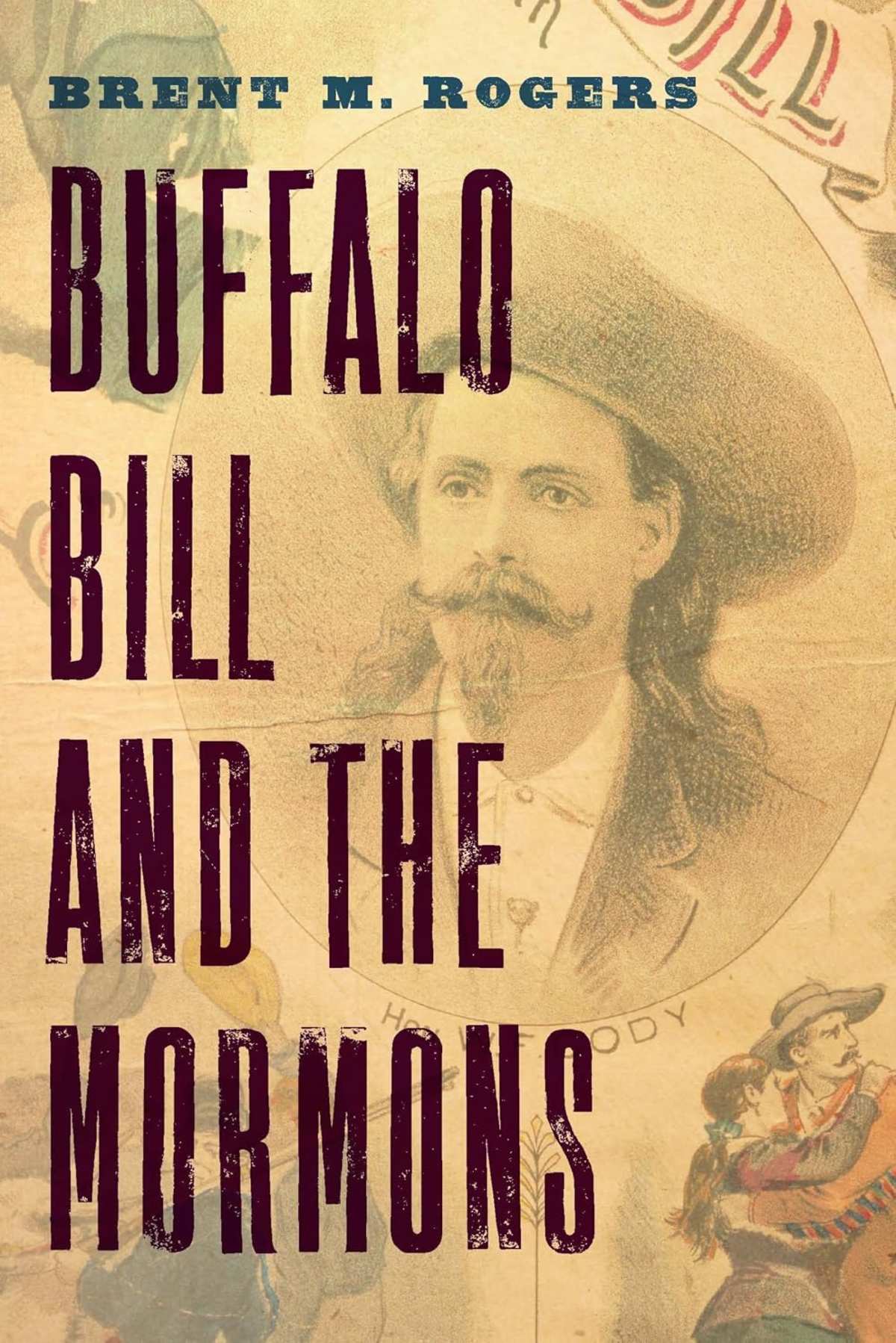
This is part one of a two-part book review of Buffalo Bill and the Mormons, by Brent M. Rogers (2024).
Rogers’ book caught my attention as I was wandering through my local library recently because the book’s title included two things that I was interested in, Buffalo Bill and Mormons.
As for “Buffalo Bill,” my wife and I were preparing for our 2026 road trip through buffalo country. We would be spending some time near Medora, North Dakota – where former president Theodore (Teddy) Roosevelt hunted buffalo. We were also spending a night in North Platte, Nebraska, the location of Buffalo Bill’s 4000-acre Scott’s Rest Ranch. I was trying to get into a “rough rider” mood before we hit the road.
As for “Mormons,” my father, grandfather (Burdett), and great-grandfathers (Burdett and Thomas) were Mormons. I wrote about their lives in BS: the Burdett Senger Chronicles. Their faith has always intrigued me, as did my great-grandfather Thomas’ heroic effort to reach and tame his “Zion” in Utah.
In Part 1, I will concentrate on Buffalo Bill and how he portrayed the Mormons via his acting and wild west show. In Part 2, I will examine the Mormon church and the anti-Mormonism that was rampant before, during, and immediately after the Civil War.
Note: Throughout this review, page numbers from Rogers’ book are included (in parenthesis), if you wish to review a quote in context or learn more about a particular topic.
Who Cares?
I enjoyed a line that Rogers wrote in the acknowledgements section of his book (xii). He noted that when he told a “senior scholar” about his intent to write this book, the scholar curtly queried, “Well, who the hell would care about that?” Rogers’ answer became “I care” – and I now join my voice to that response. Hopefully, you share enough interest in these topics to finish this book review.
I should also add that, after living my entire life on the Great Plains, I have become a little confused as to who did what historically. The likes of Buffalo Bill Cody, Wild Bill Hickock, Wyatt Erp, Doc Holiday, Billy the Kid, Jesse James, Bat Masterson, John Dillinger, and Bonnie and Clyde have all been mushed together in my brain. The previous statement is slightly exaggerated – but only slightly. I did need a “refresher” concerning what William F. (Buffalo Bill) Cody accomplished during his life.
Overview of the Book
In my mind, Rogers has combined two books into one, while emphasizing five major topics.
· He has written a biography of William F. (Buffalo Bill) Cody, with emphasis on, 1) Cody’s early frontier days as a herdsman, scout, and buffalo hunter; 2) his transition to an actor, storyteller, and showman; and 3) his career as a land developer.
· He has also written an abbreviated history of the early days of the Mormon church, with emphasis on 1) polygamy, and 2) irrigation (of all things).
It was the “actor, storyteller, and showman” element that Cody became best known for. Those careers were an outgrowth of his days as a “herdsman, scout, and buffalo hunter.” Very few people probably think of him as a “land developer.”
It was the “actor, storyteller, and showman” element of Cody’s life AND the “polygamy” element of the Mormon story that initially pitted Cody and the church against each other. It was the “land developer” and “irrigation” elements that eventually brought them together.
Herdsman, Scout, and Buffalo Hunter
I will not attempt to recreate the entirety of Cody’s life, but I think via the following quotes from Rogers’ book you will appreciate the “historic” life of Buffalo Bill Cody.
“Cody’s first job with the company was herding cattle. While corralling some cows in July 1857, the boy [then age 11] became engaged in a fight with an unnamed group of Native Americans on Plum Creek, … During the skirmish William shot and killed one of the Indians” (21).
“As an eleven-year-old boy, Cody claimed to have joined [as an extra hand or “herdboy”] the wagon train of Russell, Majors, and Waddell, the company supplying the U.S. Army traveling west to Utah in 1857 to suppress an alleged Mormon rebellion” (4-5).
“During the intervening time from his alleged travels to Utah, he had served in the Civil War, first as a scout for the paramilitary group the Red Legged Scouts and then as a soldier in the Seventh Kansas Volunteer Calvery” (36).
"[In July 1869] The U.S. soldiers attacked the camped Cheyennes in what would be known as the Battle of Summit Springs. During the fighting Cody shot a Cheyenne on horseback that he claimed was the chief, Tall Bull” … (42).
“Cody experienced life on the plains of Kansas and Nebraska as a U.S. Army scout (for which he earned a congressional Medal of Honor in 1872) and as a buffalo hunter [for the railroad]” (5). … It was those [railroad] laborers who initially bestowed on Cody ‘the very appropriate name of Buffalo Bill.’ … Buffalo Bill was a prolific hunter. Over a period of eighteen months, Cody claimed to have killed 4,280 buffaloes” (40).
During [the Battle of Warbonnet Creek in 1876] “… Buffalo Bill and a Cheyenne soldier named Yellow Hair engaged in an epic duel on the battlefield in northwestern Nebraska. Buffalo Bill opened fire on Yellow Hair, mortally wounding his opponent. Cody approached the fallen Cheyenne man, took out his bowie knife, and scalped the soldier. Cody grabbed the scalp and the attached fifteen inches of black hair and thrust it into the air. He triumphantly exclaimed, ‘The first scalp for Custer,’ in tribute to George A. Custer, who had led more than 250 American soldiers to their death against Lakota, Northen Cheyenne, and Arapaho forces at the Battle of Little Bighorn a month earlier” (58-59).
Actor, Storyteller, and Showman
Rogers describes how, shortly after the previously noted Battle of Summit Springs, in 1869, Buffalo Bill’s life and exploits attracted the attention of dime-novelist Ned Buntline, who introduced Cody to show business. After interviewing Cody, Buntline published Buffalo Bill, The King of Border Men, which “catapulted Cody to fame and made ‘Buffalo Bill’ the most recognizable name of his era” (42).
“Beginning on February 19, 1872, at the Bowery Theater in New York City, the story about Buffalo Bill played live onstage” (42). “William F. ‘Buffalo Bill’ Cody took the Nixon’s Amphitheatre stage in Chicago on December 16, 1872. He was not a trained actor, but he made his acting debut playing himself in Ned Buntline’s drama, The Scouts of the Prairie” (45).
“The Buffalo Bill Company premiered the play May Cody, or Lost and Won during the 1877 theatrical season” (57). That play was followed by The Red Right Hand, or Buffalo Bill’s First Scalp for Custer; The Knight of the Plains, or Buffalo Bill’s Best Trail; and The Prairie Waif: A Story of the Far West.
“Prairie Waif was Buffalo Bill’s third anti-Mormon blockbuster. Like its two predecessors, Prairie Waif was built on the foundation of decades of anti-Mormon thought, which was again in the crosshairs of American politics and culture when [John A.] Stevens penned the play” (74).
While it was his notoriety as an army scout who had scalped an Indian for Custer that initially catapulted Cody onto the stage, it was his “anti-Mormon” characters that kept him on the stage. Cody was being cheered while Mormon Ben (a character in The Scouts of the Prairie) was being jeered.
Buffalo Bill’s Wild West: William F. Cody, always the entrepreneur, made a big move in 1883 when he founded Buffalo Bill’s Wild West. It was a “variation on the circus and roundup genres of the era … [combining] … displays of horsemanship, exotic peoples, sharpshooting, roping, and events from white American frontier life” (83). The frontier events included reenactments of Custer’s Last Stand and the riding of the Pony Express. Headline performers included Annie Oakley, Calamity Jane, and several American Indians.
The name of the show was tweaked over the years. In 1893, Cody changed the title to Buffalo Bill’s Wild West and Congress of Rough Riders of the World. The new attraction was described as “an ‘assemblage of primitive horsemen’ from far distant countries, ‘differing in race, language, habits, customs, dress, as well as in skill, style and methods of horsemanship’” (112).
Buffalo Bill took his show to Europe eight times. During those trips Cody met the likes of King Edward VII, Queen Victoria, the future Kaiser William II, the future King George V, and Pope Leo XIII. “On May 11 [1887] Queen Victoria, the monarch of the United Kingdom, arrived for a performance … her first public appearance since the death of her consort, Prince Albert, from typhoid fever on December 14, 1861” (90).
Queen Victoria was so impressed that she “showered him with ‘compliments, deliberate, and unmeasured,’ before meeting others in the cast” (90). She later presented Cody with a cherrywood backbar for Cody’s Irma Hotel, which was opened during 1902 in Cody, Wyoming. The bar was built in France, shipped to New York by steamer, by rail to Red Lodge, Montana, and then by horse drawn freight wagon to Cody, Wyoming. The bar can still be found today at the Irma Hotel, in Cody.
Buffalo Bill’s Wild West successfully toured nationally and internationally for 30 years. Declining receipts and competition (e.g., silent movies) ended the show’s run in 1913.
Note: The first performance of the show was held at the Omaha Driving Park (at the intersection of 18th and Sprague Streets) on May 19, 1883. About 8000 people attended the inaugural performance. Cody brought his show back to Omaha for the 1898 Trans-Mississippi Exposition. His show was so popular at that time that it was performed near 20th and Paul Streets, to accommodate the crowds.
Land Developer
This is the part of Cody’s life that is probably the least known. Many of us are aware of a city named Cody in northwestern Wyoming, near the eastern entrance to Yellowstone Park, but not many are aware of that city’s history and connection to Buffalo Bill. But first:
Rome, Kansas: Cody’s first major attempt at land development occurred in May 1867, as the Kansas Pacific Railroad was being routed through central Kansas. “William Cody teamed with William Rose to establish the city of Rome, the first town founded in Ellis County. … For seven or eight months Rome howled with growth” (36-7).
To make a long story short, the federal government established Fort Hays a mile to the southeast, and the new town of Hays City popped up near the fort. On October 10, 1867, the railroad tracks reached Hays City. To make matters worse, the railroad “raised its approaches to the Big Creek Bridge, creating a plateau, cutting off Rome from Fort Hays, and ensuring that a railroad station could not be built off the high embankment. … By 1870 there was little left of Rome, save the ruins” (37-8).
The Big Horn Basin / Cody, Wyoming: “In the 1890s William F. Cody looked for new investment opportunities. Not even a year after his triumph at the Chicago World’s Fair, Cody was introduced to Wyoming’s majestic Big Horn Basin. On a topological map, the Big Horn Basin pops out of northwest Wyoming as a nearly perfect oval, cradled by the Big Horn Mountains on the east, the Owl Creek and Bridger Mountains on the south, and the Absaroka Mountains on the west. It is a stunning country of approximately twenty thousand square miles just east of Yellowstone National Park. Running through it is the Shoshone River, a major tributary of the magnificent Bighorn River. Cody believed in the superior potential of this basin” (130). “From Buffalo Bill’s vantage point, no physical feature of Europe could hold a candle to the Rocky Mountain region of western America, specifically the Big Horn Basin” (179).
Rogers spent much of his book documenting how Cody tried to bring settlers to the basin via his Shoshone Land and Irrigation Company. Cody believed that if the water of the Shoshone River could be used to irrigate the land (as the Mormons had done in Utah), the settlers would move to the basin, and the railroad would follow (to his town, Cody).
To make a long story short, Cody’s company struggled to irrigate the land. Cody came to believe that (as regards irrigation), the Mormons “provided a useful, alternative model to private capitalization” (137). Cody reached out to the Mormon Church for settlers and help, eventually relinquishing twenty-one thousand acres (and water rights) to the Mormon Church. By the end of May 1890, the first Mormon settlers arrived in the area and began to work on the irrigation canals and the Chicago, Burlington and Quincy railroad spur approaching Cody. The railroad reached Cody in November of 1891, and Cody completed the aforementioned Hotel Irma one year later.
Ralston, Wyoming: To make a long story short, President Theodore Roosevelt and the federal government figured out that they could solve the West’s water problems better than private capital (e.g., Cody) or the Mormon church. The Newlands Reclamation Act was signed by Roosevelt in 1902 and shortly thereafter Congress appropriated $2.25 million for the Shoshone Reclamation Project. Both Buffalo Bill and the Mormon church transferred their state water permits to the federal government and by 1910 the tallest dam in the world (at that time) was built on the Shoshone River. The dam was later renamed the Buffalo Bill Dam.
“Buffalo Bill Cody’s interests in the basin continued. He hoped to build another new town in the heart of the lands the federal government was in the process of reclaiming. Cody planned to name the town, which would be located thirty miles east of the town of Cody, Ralston” (212). But then things went downhill over issues regarding a “government town” that was going to be built near Ralston and (of course) water rights. According to Wikipedia, Ralston was platted in 1906 with lots for sale in 1907. Two hundred and eighty people lived there in 2010. According to Wikipedia, “the town was either named for a railroad worker or the bar owner in town.” Wikipedia did not mention Buffalo Bill Cody.
Part Two
Rogers did a good job of describing the many facets of Buffalo Bill’s life. He got me in a “rough rider” mood.
If all goes according to plan, my wife and I will be in Medora, North Dakota, later this week to visit the newly opened Theodore Roosevelt Presidential Library. We will be visiting the “Badlands” where that other buffalo hunter, “rough rider," and future president got his life back together after the deaths of his mother and wife (on the same day, in the same house). And next week, we will be heading down to North Plate, Nebraska to visit Buffalo Bill Cody’s Scout Rest Ranch.
In Part 2 of this review, I will discuss the Momon-side of the book’s title, before concluding the book review of Brent Rogers’ Buffalo Bill and the Mormons. I will also have more to say about some connections between Buffalo Bill and Teddy Roosevelt.