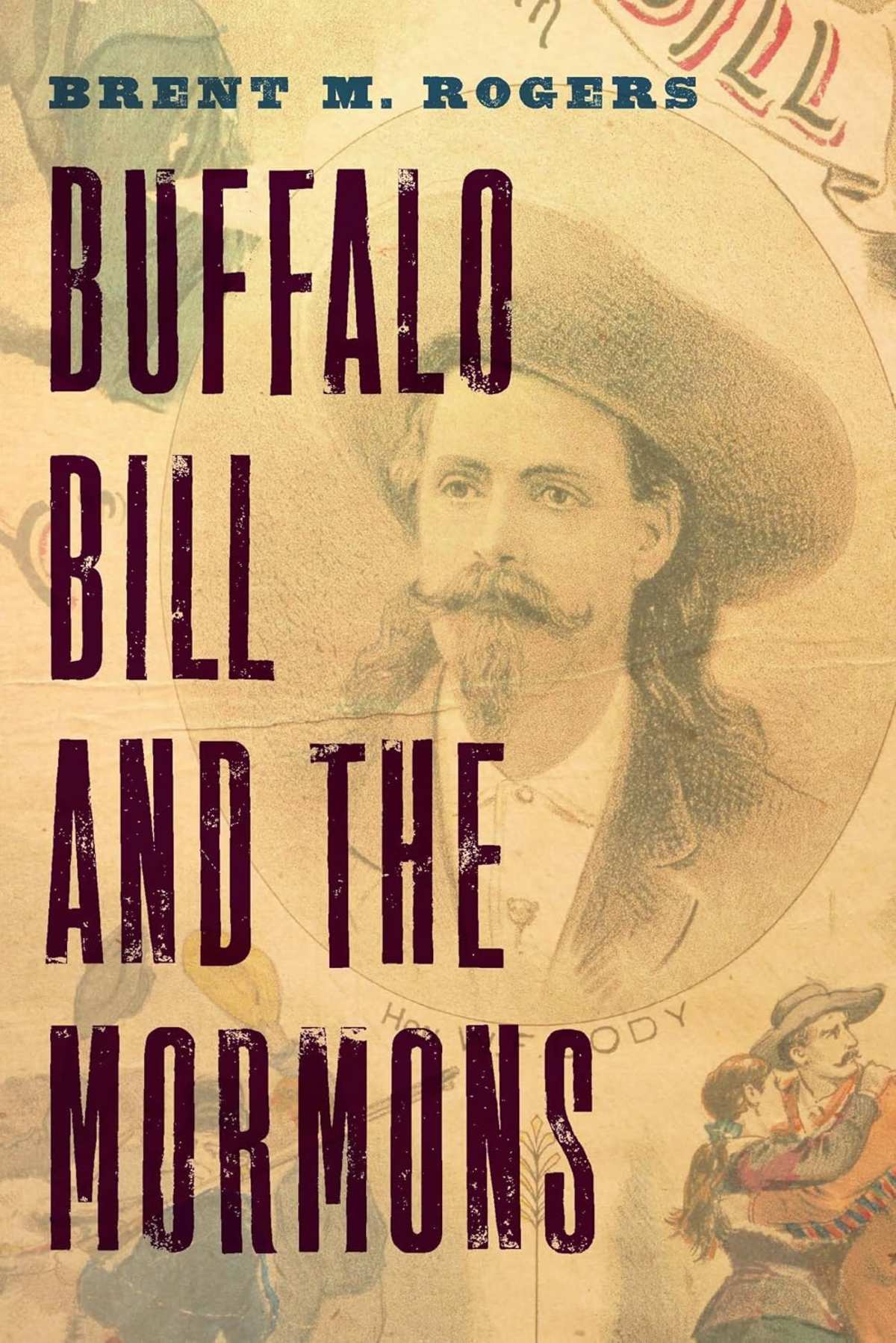
This is part two of a two-part book review of Buffalo Bill and the Mormons, by Brent M. Rogers (2024).
In Part 1, I concentrated on Rogers’ depiction of Buffalo Bill. In this part of the review, I will examine Rogers’ depiction of the Mormon church and the anti-Mormonism that was rampant during Buffalo Bill’s early years as an actor and impresario. I will then review how that anti-Mormonism was mollified after the polygamy issues with the federal government were resolved – as Cody’s interest expanded into land development.
This was the part of Rogers’ book that particularly interested me because it paralleled what I wrote in my book BS: The Burdett Senger Chronicles. In Chapter 2 of that book (pages 25-75), I wrote about Daniel Francis Thomas’ emigration from Wales to Utah, his years as a farmer and Mormon bishop, and his imprisonment for polygamy.
Note: Throughout this review, page numbers from Rogers’ book are included (in parenthesis), if you wish to review a quote in context or learn more about a particular topic. I have also included a few page numbers (in parenthesis, with a “BS” identifier) from my book (as noted above).
Cody Versus the Mormons (Polygamy)
The Church of Jesus Christ of Latter-day Saints (informally known as the LDS Church or Mormon Church) was founded by Joseph Smith in 1830. After Smith’s death and the resultant succession crisis, most of the church’s followers sided with Brigham Young who eventually led his followers to Utah in 1847.
“Polygamy has historically been troublesome for the Mormon Church. It was one of the practices that caused the church to relocate from Missouri to Illinois and from Illinois to the Great Salt Lake Valley. It was one of the main reasons that there was a Utah War. It was an obstacle for years to both Deseret and Utah becoming states” (BS65).
In When Mormons Call, Isaiah Bennett wrote, “For about 45 years, until 1890, the Mormon church taught its members to live the principle of ‘plural marriage.’ A man financially able was to take more than one wife and raise up the children from them. This was in direct obedience to a supposed revelation from God that Smith claimed he received in the 1830s. Smith himself practiced polygamy secretly for several years, while publicly denying it, before he made the doctrine public. ... The mandate for polygamy was first ‘revealed’ by God on July 12, 1843, but was not formally announced until 1852. The revelation was canonized as Doctrine and Covenant 132 in 1876 and voted on by the general membership in 1880.”
A critic of the faith might suggest that the doctrine started out to serve a specific need felt by Joseph Smith – more so than a revelation by God. As you might have expected, “a” Mrs. Joseph Smith (and later) “a” Mrs. Brigham Young took exception to the doctrine. If the “revelation from God” argument is true, it confirms (as we shall see) a verse from the Bible (Job 1:21), “the Lord gives and the Lord takes away.”
“Mormon polygamy in Utah was intertwined with slavery in Kansas during the presidential election of 1856, when the Republican Party introduced the proposition to outlaw in the territories the ‘Twin Relics of Barbarism: slavery and polygamy’” (20).
“Polygamy in Utah and slavery in the southern states, were linked by the Republicans to the theory of ‘popular sovereignty,’ the basis of the Compromise of 1850. Democrats, like Stephen A. Douglas, responded by denouncing Mormonism, in an attempt to delink polygamy from slavery and save the concept of popular sovereignty. As a result, both Republicans and Democrats were now speaking against polygamy and the Mormon government in Utah Territory” (BS50).
All the above resulted in the Utah War, beginning in 1857, which I will write about later. And then came the Civil War, which took the heat off the Mormons in the 1860s. But after the war ended, when slavery had apparently been taken care of, there remained polygamy in Utah and so began “a heightened anti-Mormonism in America” (44).
“In the climate of the late 1870s, Cody conveniently exploited this history and inserted himself into it to profit on national anti-Mormon sentiment” (30). Buffalo Bill Cody, the Indian killer and savior of the western pioneer settlers “emerged as the symbolic champion and defender of the proper monogamous American home and family” (6). He assumed this role on the stage in the three anti-Mormon blockbusters, like Prairie Waif, that I wrote about earlier.
“In a country and culture just removed from a brutal Civil War over slavery, the image of slavery, and that of enslaving white women, held immense power. … The American family needed saving from the sexual brutality of Mormons. … Buffalo Bill represented the ideal American man – one who protected white womanhood and who protected the home from barbarian threats” (48).
“The home was the cultural and political center of late nineteenth-century America, when the ideal American home was white, monogamous, and Christian” (50). “Of the period the historian Richard White has stated, ‘The home became the beating heart of an expansive political program that would create black homes, impose “proper” homes on Indian peoples, exclude Chinese … and expand the white home into the West.’ … In the case of Mormons, polygamy was the primary problem. … Plural marriage placed Latter-day Saint men alongside men of color, in particular Black and Native American men, as dangerous deviants and hypersexual beings that needed to be conquered or controlled” (51).
In his book, Rogers really gets into the above, as an example of “white supremacy.” In the books index you will find many references under the categories of, “family,” “gender,” “home(s): and Americanization of,” “immigration and masculinity,” “race,” “sex,” and “whites and whiteness.” Personally, I think Rogers overdoes it a bit, but you can decide for yourself. Some readers might be inclined to extend Rogers’ white supremacy comments to today’s immigration situation. As Rogers noted, “Captivity narratives such as these [as performed by Cody] typically presented a white woman being captured by a fierce opponent, often portrayed by a man or group of people considered outside the mainstream” (47).
To make and already long section shorter, the Mormon church faced a lot of pressure (e.g., the Morrill Anti-bigamy Act, the Edmunds-Tucker Act) to stop plural marriages. The latter act declared polygamy a felony. More than 1300 men were imprisoned under the terms of this act, including my great-grandfather, Daniel Francis Thomas. Over time, beginning in 1890, Mormon leadership backed away from plural marriages. In April of 1904, via what has become known as the “Second Manifesto,” the church leadership declared that “the laws of the land would be upheld and that those members who entered new plural marriages would be excommunicated from the church” (218).
Cody and the Mormons (Irrigation)
Things were very difficult for the Moman settlers after they first arrived in Utah. The initial challenge was to grow enough food to feed the ever-increasing population.
My great-grandfather, Daniel Francis Thomas, arrived in Utah just before Halloween in 1855, after a 99-day journey from Wales. He arrived in the Salt Lake Basin after a horrible insect-infested harvest in Utah, and just before a bitter cold winter that featured record snowfall. In total, about 5000 settlers arrived during 1855, the third-largest emigrating season to date.
“Because of a scarcity of food and the animal loss following the Hard Winter, many people survived 1856 by eating sego lilies (a bulbous perennial endemic to the West) and redroot pigweed (the greens and radish-like root” (BS48).
Given the above and the looming war with the government of the United States, Brigham Young had to find a way to grow more food on the arid desert land. He had two things working for him.
· The first thing was the rich alluvial soil – the soil that washed off the Wasatch Mountains since they were first formed. All that was needed was water.
· The second thing that Young had working for him, via his religious and political position, was an ever-increasing supply of workers that could be marshaled to build the canals that would distribute the mountain waters to the alluvial soil.
“The Mormon church of the nineteenth century provided a case study on socialism. In 1855, five thousand new settlers arrived in the Great Salt Lake Valley, and Brigham Young ‘placed them.’ When Brigham Young decided to build up Ogden at the expense of Bingham Fort, people moved” (BS74). And when Brigham Young said build canals to irrigate the land and feed our people – canals were built.
“The hierarchical nature of the church, with grassroots stakes, wards, bishops and counselors; controlled the community and implemented the plan created by the religious elites. And before the Utah War, when Utah equaled Mormon, it was a form of state socialism. If you believe what my grandfather wrote, even polygamy was socialistic (versus sexual) – it was a way to take care of people. A rigorous tithing system took from those who had” (BS74).
Brigham Young was able to do what capitalists like Buffalo Bill could not afford to do, and what the federal government had not yet decided to do (until 1902). Buffalo Bill noted the Mormon’s success in Utah (making the Salt Lake Valley “blossom as the rose”). That is why Cody worked hard to recruit Mormons to The Bighorn Basin. “They provided a useful, alternative model to private capitalization” (137). Buffalo Bill labeled the Mormons as “the greatest irrigators on earth” (9).
That is where my great-grandfather, Daniel Francis Thomas, eventually ended up – on the north side of 2nd street, along the North Branch of Mill Creek, in Lynne, Utah (just to the north of Ogden). Years earlier, the first settlers had dug the irrigation ditches to redirect some of that creek’s water. In his journals (1874, 1882, and 1883) Daniel noted when he worked to maintain those ditches. “Cultivating the sod was the same to a Latter-day Saint as cultivating the soul” (175).
Miscellaneous
The Utah War: In 1857 and 1858, the government of the United States fought a quasi-war against the Mormon settlers in Utah Territory that were led by Brigham Young. That war is also sometimes referred to as, “The Mormon War,” “The Utah Expedition,” “The First Civil War,” or “Buchanan’s Blunder.”
“Let me set the stage first. When the first Mormon pioneers settled in the Great Salt Lake Valley in 1847, the land technically belonged to Mexico. The United States had gained control of the valley in 1846, during the early stages of the Mexican American War, but legal transfer did not occur until the Treaty of Guadalupe Hidalgo was signed in 1848” (BS49).
From the perspective of the U.S. government in Washington, DC, there were two major problems. In addition to the polygamy problem noted before (and its political linkage to slavery), “President Buchanan was alarmed by the theocratic nature of many of Governor Young’s appointments and how administrative and ecclesiastical roles coincided, including that of probate judges. Mormon church leaders were counseling their members to use ecclesiastical arbitration to resolve disputes instead of the more explicit governmental legal system. There were also concerns about the power of a Mormon paramilitary organization called the Danites” (BS50).
In 1857, orders went out for the U.S. Army to take control of Utah. Luckily (thus buying time), the initial deployment was haphazard and delayed. U.S. Army troops did not reach the area until late in the year. By that time Brigham Young had deployed his militia (i.e., the reactivated Nauvoo Legion that had been created during previous conflicts in Illinois). That militia was ordered to defend the canyon passes that the U.S. Army would prefer to use. The militia was also ordered to harass federal troops by burning their food supplies, stampeding their animals, and blockading roads by felling trees.
“In early October, the Legion burned down Fort Bridger, lest it fall into federal hands. A few days later, three Army supply trains were burned by Mormon calvary. Army horses and cattle were ‘liberated’ and taken west. Few shots were fired but prisoners were taken by both sides. The U.S. Army’s response was limited by lack of calvary troops. The Nauvoo Legion continued to fortify the canyon passes” (BS52).
And then, luckily (buying more time) winter came. “The winter lull provided an opportunity for negotiations. As early as August 1857, Young had requested help from Thomas L. Kane of Pennsylvania. In December, Kane had contacted President Buchanan and offered to mediate” (BS52). Buchanan, under pressure from Congress to end the crisis before it became a true war, granted Kane unofficial permission to attempt mediation.
Kane successfully convinced Young to accept Buchanan’s appointment of Cumming as the new Territorial governor (replacing Young), and he persuaded the new governor to travel to Salt Lake City without his military escort. In April 1858, President Buchanan sent an official delegation to Utah offering terms like those that Kane had negotiated with Young, including permitting Johnston’s Army into the Territory. The commissioners further assured Young that the government would not interfere with their religion. Polygamy became a non-issue for the time being. Young accepted the terms and the war was over before it had gotten real nasty.
“At the end of June 1858, army troops under General Johnston entered the Salt Lake Valley unhindered. A full pardon was granted to all Mormons, except those involved in the Mountain Meadows Massacre” (BS53).
“In early July, the Mormons from the northern settlements began to return to their homes. The Mormons had lost control of the executive branch and the federal district courts but maintained political authority in the Territorial Legislature and the powerful probate courts. Polygamists had gotten a pass (for now)” (BS53).
“President Lincoln [later] gave Brigham Young tacit permission to ignore the Morrill Anti-Bigamy Act, in exchange for not becoming involved in the Civil War. The residents of Utah Territory were not involved in the Civil War, except to protect the telegraph lines crossing their territory” (BS54).
Rough Riders: The term “rough riders” is normally associated with Theodore Roosevelt and the 1st Calvery Brigade that he led in Cuba during the Spanish-American War during 1898. The term “rough riders” actually existed before that war broke out. As noted previously, in 1893, Cody changed the official title of his show to Buffalo Bill’s Wild West and Congress of Rough Riders of the World. As such, Roosevelt and his brigade borrowed the term.
Buffalo Bill, never one to overlook an opportunity, added members of that volunteer regiment to his show in 1899, after the war, who reenacted the Battle of San Juan Hill. “In addition, Buffalo Bill started publishing a new periodical, the Rough Rider magazine, in 1899, to capitalize on the widespread admiration of his own and Roosevelt’s Rough Riders” (144-5).
Scout’s Rest Ranch: In his book, Rogers did not write very much about Buffalo Bill’s ranch near North Platte, Nebraska. The ranch was built for Buffalo Bill in 1886. “His estate featured a large, marvelous Victorian-style home and barn on some four thousand acres to support cattle, horses, and fields with irrigation agriculture near North Platte, Nebraska, a thriving cattle town” (85). The ranch was also his shows “HQ” when they were not on the road. Some of his entertainers rehearsed at the ranch. His wife refused to live there, preferring to reside in a stately home in North Platte or faraway in Rochester, New York (“much of the 1870s). See “Mr. Buffalo Bill” below. As time went on, Cody’s interest moved on to Cody, Wyoming. The Scouts Rest Ranch today is a Nebraska state historical park.
Mr. Buffalo Bill: “Though he played the hero, Buffalo Bill was perhaps not the monogamist that he claimed to be. He was accused of being a womanizer …” (75). By all accounts he was a good-looking guy, and he was on the road a lot, with Buffalo Bill’s Wild West (during the summer and fall) and with his touring theater troop (during the “off-season”).
“He and [his wife] Louisa fought over money and property and the time that William spent on his show business” (85). His marriage may also have also been impacted by the deaths of two of his children (his only son, Kit Carson, at age five from scarlet fever; and eleven-year-old daughter, Orra, in 1883 from causes unknown).
“Buffalo Bill made his first attempt to divorce Louisa in 1883” (76). “He accused Louisa of trying to poison him” and she countered that he was “immoral with any woman that he met.” … The divorce was not granted, leaving Louisa and William married but still at odds” (222). It should be noted in the years following the bankruptcy of his show, Buffalo Bill “reluctantly joined the Sells-Floto Circus and returned to the grind of touring, this time with his wife, Louisa, with whom he had finally reconciled, by his side” (225).
Cody and Religion: While Buffalo Bill (and his persona as an actor) appeared to be anti-Mormon, it may have been more “persona” than real. Per Rogers’ account, he didn’t seem to have any animosity towards the Mormons when he visited the state, interacted with their leaders, or when he tried to entice them to move to the Big Horn Basin. I never got the feeling that he was a hypocrite during his later dealings with that faith. In contrast, he seemed to appreciate the Mormons and the ways they conducted their lives.
“On January 9, 1917, the day before he died, Cody was in Denver, Colorado, at the home of his sister, Mary …. They were visited by Father Christopher Walsh, a Catholic priest from the city. Cody told Walsh that he had always believed in God and that he wanted to die in the Catholic faith. Walsh … baptized him that day. … The next day Buffalo Bill passed away from kidney failure and ‘entered his promised land’” (229).
Connections
One of the things I love to write about is the connections I discover that link people. In Rogers’ book I found several such connections between my great-grandfather, Daniel Francis Thomas (1826-1890), Buffalo Bill Cody (1846-1917) and Theodore (Teddy) Roosevelt (1858-1919). They were contemporaries for several decades during the development of the West.
The Utah War (Cody and Thomas): Earlier in this review I wrote about the Utah War, noting that early in that war three U.S. Army supply trains were burned by Mormon calvary. In his biography (disputed by some, including Rogers), Cody wrote that, as a young eleven-year-old boy, he had hired on as and “extra hand” or “herdboy” on the Simpson-led wagon train. In his autobiography Cody described “herding beef cattle alongside the wagon train” (28). Early in his life he had recounted these stories to his wife, and later in life he elaborated on the details with some of the Mormon contingents visiting the Big Horn Basin.
In my book BS: The Burdett Senger Chronicles, I wrote about my great-grandfather Daniel Francis Thomas, who was, at that time, a young man, new to Utah, and most likely a member of the Nauvoo Legion that burned Cody’s supply train. My great-grandfather and Cody may have been very close to each other on that day - possibly shooting at each other.
On the other hand, as Rogers speculates in his book, “Cody may have heard and unapologetically borrowed [John Y.] Nelson’s account to construct his own memory of the event” (29). “Perhaps he [Cody] had embraced the story so long that it had become part of his persona, and therefore it had become a constructed memory “(160). Maybe Cody wasn't even there on that day.
The situation must have boggled my great-grandfather’s mind – having worked so hard to get from Wales to Utah – to get from the famine and riots in his home county, to America and freedom. It must have boggled his mind, that after that grueling 99-day journey, he found himself fighting the U.S. Army.
Ralston, Wyoming (Cody and Roosevelt)
Earlier in this review, in the “Land Developer” section, I wrote about Cody’s attempt to create the town of Ralston, Wyoming, and the “government town” and “water rights” issues that developed at that time. Attempting to resolve these issues in his favor, Cody “penned a letter directly to the president of the United States, his friend Theodore Roosevelt” (212). Cody also wrote to the director of the U.S. Reclamation Service. “Neither the director of the Reclamation Service nor the president gave Buffalo Bill the assurances he sought on this land” (213). As the title suggests, Jeremy M. Johnston, Ph.D., in his thesis entitled Two Rough Riders: Buffalo Bill and Theodore Roosevelt’s Enigmatic Relationship, further discusses these two larger than life personalities.
Summary and Conclusion
If all goes well, my wife and I will be visiting Buffalo Bill’s Scout’s Rest Ranch in North Platte, Nebraska in a couple of days. Back in 1855, my great-grandfather, Daniel Francis Thomas, passed along the Platte River as he emigrated to Utah.
The Platte River played an important role in the western expansion of the county. Several emigrant trails passed nearby, including the Bozeman, California, Mormon, Oregon, and Pioneer. North Platte (the city), where the North Platte and South Platte Rivers merge, was plotted in 1866 by the Union Pacific Railroad. That railroad is still the biggest employer in the city of 24,000 souls. Buffalo Bill moved to the area in the 1880s.
“William F. ‘Buffalo Bill’ Cody was a storyteller. Onstage and in the arena, he re-created the West and its history for audiences all over the world” (231). “In England alone the company gave three hundred performances to more than 2.5 million people” (92).
“Buffalo Bill was a storyteller, and the Mormons were part of his story. He told the story of stereotypes, of prejudice, and of hate toward the religious group. He listened to their stories and shared experiences with the faith group. … Together they ultimately told a story of friendship and admiration (234).
Likewise, Brent M. Rogers is a storyteller, and he has told a story that many readers of history "will care about."
Cody was very much an entrepreneur. That is the mentality that took him from herdsboy, to herdsman, to scout, to actor, to showman, to land developer. Through his show and land development in Nebraska and Wyoming he impacted the lives of many others – and he knew it. He once said, of his legacy, “when I die people will say, ‘Here lies Bill Cody, who made a million dollars in the show business and distributed it among his friends’” (165).