John William Carson (John to his friends, Johnny to his audiences) died 21 years ago on this date, at age 79. He was, for 30 years (1962-1992), the king of late-night television, a title that died with him. I hesitate to use his name today – in the same sentence – with the likes of Jimmy and Steven.
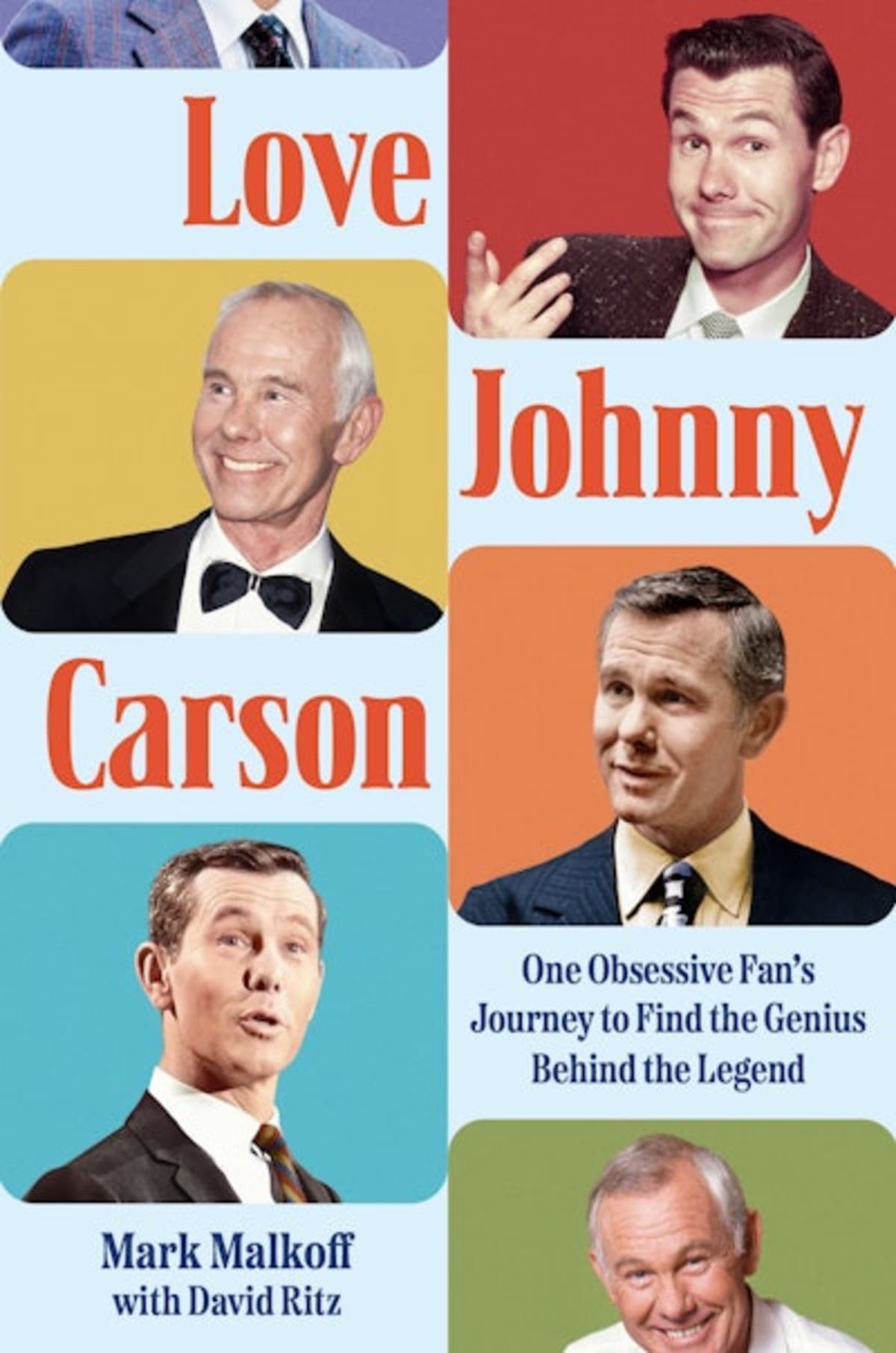
Over the past year, I have read three biographies on Johnny, the last being Love Johnny Carson: One Obsessive Fan’s Journey to Find the Genius Behind the Legend (2025, by Mark Malkoff with David Ritz). I will briefly review that book and the other two in a bit.
After acknowledging that I have read three books on Johnny Carson over the last year, I must also acknowledge that I too seem to be a bit obsessive, as regards Johnny. Why?
My Obsession with Johnny Carson – TV
I think my obsession goes back to the 1960s, when we both got into the TV game; Johnny, as the host of The Tonight Show, in New York City, in 1962; and me as the Friday night “controlman” at KFYR-TV in Bismarck, North Dakota, in 1968. In my book BS2: An autobiography, I write about my brief career in the television industry.
In that book, I noted that the toughest part of my work week (as the controlman) was Friday evenings during the 6 PM and 10 PM news/weather/sports segments. Those segments were live, somewhat helter-skelter, and prone to trouble. Adrenaline usually got me through relatively unscathed, but it was close at times.
Every Friday night at 10:30:00 PM (or slightly after) I would switch to The Tonight Show and take a deep breath. In a sense, Johnny Carson was my savior in those days. And then, Johnny and I could kind of settle in and enjoy a few laughs together. The rest of the staff would quickly depart, leaving us alone, and by the end of the show at midnight, it was just Johnny and me. We could then say good night and sign off together. His show had a calming effect on me.
The Tonight Show had a kind of pace; the last half hour was usually the most relaxing. There were no “late-late” shows in those days. At the end of The Tonight Show it was time to signoff the station – time to play the National Anthem – time to go home to bed. There were no other TV or cable stations to watch. The day was over; the television screens in Bismarck went dark.
My Obsession with Johnny Carson – Nebraska
My obsession with Johnny Carson continued when I moved to Nebraska in 1970. While Johnny had been born in Iowa, he moved to Norfolk, Nebraska early in his life. That is where he started his showbiz career, first as a young magician. One of the books that I read stated that as he practiced his craft, he performed in a chicken hatchery in nearby Wahoo. Some of you may remember that Wahoo was, for a while, the “home office” of David Letterman.
His next stop in Nebraska was the capital city of Lincoln, where he graduated from the University of Nebraska in three years, majoring in radio and speech and minoring in physics.
He then moved on to Omaha where he worked for WOW-AM and WOW-TV. In some ways, his morning television talk show, The Squirrel’s Nest, was very similar to The Tonight Show. One of his early bits was interviewing the pigeons on the Douglas County Courthouse. Routines like that attracted considerable attention within the community.
All this to say that in 1970, when I moved to Nebraska, he was something of a local hero, a local boy who had made the big time. Yet, he was unlike many, in that he maintained his connections with the state and the friends he left behind. He maintained that connection with the state of Nebraska for the rest of his life.
And lastly, when this homesick lad from North Dakota went home to his lonely apartment in Omaha during 1970, there was Johnny on The Tonight Show, making the day a little brighter.
Love Johnny Carson
Love Johnny Carson: One Obsessive Fan’s Journey to Find the Genius Behind the Legend, copyright 2025, by Mark Malkoff (with David Ritz), was the most complete book on Carson that I read. Malkoff, a comedian, writer, and podcast host was the obsessive fan. The book was divided into three parts, chronologically by decade:
New York, 1962-72: with chapters on “Beginnings,” “Guests from Hollywood and Broadway,” “Bits and Skits,” “Colleagues and Guest Hosts,” “Comedians,” “Music and Musical Guests,” “Politics and Social Issues,” “Johnny the Businessman,” and “Life as a Star.”
Burbank, 1972-82: with chapters on “Beautiful Downtown Burbank,” “Actors, Musicians, and Comedians of the Seventies,” and “Bumps in the Road and Bans from the Show.”
Burbank, 1982-92: with chapters on “Impressions and Spoofs,” “Stand-Up Sensations in the Eighties,” “John, Dave, and Jay,” “Joy, Grief, and Loss, “The Last Days of the Show,” and “Retirement.”
The three parts were quite detailed. I could recall many of the episodes (guests, skits, jokes) as I read through the book. The authors wrote a lot on the behind-the-scenes happenings, about the various staff members and guest hosts, about who was in (scheduled) and who was out (banned) at any given time. The book got into Johnny’s wives and his problems with alcohol. The book was a walk down memory lane. I chose the cover of this book, with its five portraits of Johnny taken over the years, to accompany this essay.
Carson The Magnificent
Carson The Magnificent, copyright 2024, by Bill Zehne (with Mike Thomas) was a bit unusual in that Bill Zehme died on March 26, 2023, at age sixty-four, with about three-quarters of his manuscript complete. After Zehne’s death, Mike Thomas completed the book before shipping off Zehne’s research materials to the Elkhorn Valley Historical Society, in Carson’s “hometown” in Nebraska.
The book was similar to Love Johnny Carson, in that it covered many of the same people, places, and things. It did, however, go into more detail on Johnny’s early life in Nebraska and his first marriage to Joan Morrill Wilcott, in North Platte, Nebraska. Joan, besides being the mother of Johnny’s three sons, was also his magic assistant for a while. The book also provided more details on Johnny’s three divorces (when, why, and how much).
My Friend Johnny
My Friend Johnny, copyright 2025, by Howard Smith (with Eli Gonzalez), is exactly what the title suggests – a story by Howard Smith, a Malibu neighbor, tennis buddy, and friend of John Carson. On page 5 of the book, Smith stated, “I wrote this book to bless you, as I was blessed by knowing John Carson.” That statement set the tone for the rest of the book.
My Friend Johnny, after a foreword by Jay Leno, was also subdivided into three parts: the first part on John Carson. Chapter 3 (Our Kind-Hearted Midwesterner) contains information on some of the causes that John supported, including the millions of dollars that he gave to shelter and feed homeless veterans. Parts 2 (My Forrest Gump Life and What I’ve Learned About Celebrities) and 3 (Malibu Memories …) were of lesser interest to me. They had more to do with Howard Smith than John Carson.
My Favorite Jokes
An essay on Johnny Carson would not be complete without a couple of jokes. Below are two jokes from the above cited books – the first joke delivered by Johnny, the second joke about him.
Joke 1: In Love Johnny Carson, Malkoff wrote (cf. pages 54 and 261) about one of Carson’s characters, Carnac the Magnificent.
The classic formula, beginning in May 1964, was simple: Ed McMahon would introduce Carnac the Magnificent, a soothsayer oracle from the East. Dressed in a feathered turban and a black cape with red velvet lining, Carson would make his grand appearance, tripping on the stage step before sitting behind the desk.
In a booming voice, Ed would say, “I hold in my hands envelopes which have been hermetically sealed. They have been kept in a mayonnaise jar on Funk and Wagnalls’ porch since noon today.” With that, he would hand Carnac an envelope, which the oracle would put to his forehead, using his mystic powers to divine answers to questions he had yet to see. My favorite answer/question revolved around a popular cheerleading chant.
“Sis-Boom-Bah,” Carnac said.
“Sis-Boom-Bah,” Ed repeated.
Carnac then paused, tore open the envelope, blew into it, and pulled out the card with the question, which he then read, “Describe the sound made when a sheep explodes.”
Joke 2: In Carson the Magnificent (page 186), Zehme and Thomas pass on a joke about Johnny and his many marriages to women with names beginning with the letters “Jo.”
The joke goes like this: “Johnny’s first wife was named Joan; his second wife was Joanne; his present wife is Joanna. The man just won’t go for new towels.” Johnny got the last laugh when he married his fourth and last wife, Alexis Maas, on June 20, 1987.
Who is Johnny Carson?
So, after reading the three biographies, what new things did I find out? Who was the real Johnny Carson? What was he really like?
The biographers were all challenged by that question. In a sense, there were many Johnny Carsons (e.g., the public Carson and the private Carson, the sober Carson and the inebriated Carson, …). In general, there seemed to be many more positive quotes than negative ones. He appeared to be somewhat shy, sensitive, and easily hurt. And when someone hurt him, he tended to walk away. They no longer existed; he never took revenge; but, on the other hand, they might never be booked again on The Tonight Show. He acknowledged that at times in his life he had issues with alcohol, which for the most part he controlled. He could also hold a grudge and appeared to have some unresolved “mother” issues that affected his interactions with the female sex (per some quotes from the female sex).
Johnny was a political person. He had many political views that I would disagree with, but you would be hard pressed to know what they were from his show. He never tried to jam them down your throat. He did help rehabilitate (after a poorly received speech) and humanize Bill Clinton, by inviting the then presidential candidate to play his saxophone on The Tonight Show on July 28, 1988 (Gershwin’s “Summertime”).
Johnny was always quite generous when he was alive and after his death. The John W. Carson Foundation has donated over $156 million to a variety of institutions and causes.
According to Malkoff, “Carson writer Marshall Brickman said, “He was a barefoot boy from Nebraska … He had a moral sense. He was a decent human being and a good boss.”
According to Zehne, Comedian Tom Dreesen said, “He was a little boy from Nebraska when he walked through that curtain [at the beginning of The Tonight Show].”
The Johnny Carson Tennis Center and Museum
As previously noted, Johnny was very generous with his money, in general, and generous to the people of Nebraska. He gave millions of dollars to support the Department of Theater Arts at the University of Nebraska in Lincoln, which created the Johnny Carson School of Theater and Film. Carson also donated to causes in his adopted hometown of Norfolk, including the Carson Cancer Center at Faith Regional Health Services, the Elkhorn Valley Museum, and the Johnny Carson Theater at Norfolk Senior High School.
Unfortunately, little of Johnny’s money found its way to Omaha, and Omaha has no public memorials or museums to recognize the early days of Carson on WOW-AM and WOW-TV.
Back in the mid-1990s, shortly after Johnny retired, I had an idea on how to rectify the above situation. At that time, my son was playing high school tennis, and I was shagging balls for him during some of his practice sessions. Also, at that time, Omaha was building a major tennis complex in the northwest part of the city, at Tranquility Park. Recognizing Carson’s love for both Nebraska and tennis, I thought that the city should approach Carson about the project.
I envisioned expanding the tennis clubhouse to include a small museum wing, with displays on Carson’s time in Omaha. I envisioned naming some of the courts after Carson’s characters (e.g., Carnac the Magnificent, Art Fern, Aunt Blabby, El Mouldo). I envisioned signage on the grounds, by the courts, to commemorate those characters and some of the other elements of The Tonight Show. I envisioned a grandstand court that, with Johnny’s assistance, might hold some sort of pro/celebrity tennis tournament.
I shared my idea with a few members of the Omaha tennis community but never pushed it very hard. Today, I wish that I had been more aggressive with my pitch. Today, the complex, which has 31 hard courts (numbered 1-31 – BORING!) is named the Koch Family Tennis Center; and Omaha still does not commemorate Carson’s early-TV days in the city.
Home Again
Last year, the University of Nebraska released a television spot called “Home Again”. The spot features the timeless voice of Johnny Carson. When I first heard the spot, I suspected that Carson’s voice had been AI-generated, but I found out later that the audio had come from his 1982 NBC special “Johnny Goes Home.” Johnny’s voice reinforces the foundational links between the university that he graduated from and the state that he loved.
In the spot, Johnny is heard saying, “A term you hear used frequently is “the Midwestern ethic.” I’m not exactly sure what that means but, there still exists out here in this country a openness and a honesty and a sense of warmth that you feel inside. Thomas Wolfe once wrote, “You can’t go home again.” Well, that’s probably true if you expect to find things as they were, but, in a sense, we carry our home with us wherever we go.
John William Carson, RIP!