Well, I finally got around to it. In my December 19, 2025 “Happy Holidays” post, I noted my plan to publish a series of essays in mid-January, regarding my planned funeral. I then hemmed and hawed as I attempted to write out those plans – going instead with a few book reviews to kill some time as I got my act together. So, here we are, in mid-February.
This is the first of a (planned) eleven-part story on my upcoming (date unknown) funeral. Note that this series is “Draft One.” The plans may change as time goes on (if time goes on).
My wife, a non-Catholic, has been bugging me for years to “write down” what kind of Catholic funeral I want. While acknowledging the reasonableness of her request, I had chosen to defer the matter (until now) for several sound reasons like:
· I am, at age 77, still relatively healthy. – [True, but irrelevant.]
· I don’t know what kind of funeral I want. – [True, but I probably should figure it out.]
· I prefer not to think about my demise. – [True, but a lazy and poor excuse.]
· I might be vaporized during a nuclear attack. – [Sadly true, but hopefully not.]
· I’ve got better things to do with my time. [Probably false.]
Her “bugging” usually picks up after someone younger than me dies, as was the case in November of last year, when my cousin and goddaughter, Salina Plaff, died at age 60. Salina’s death caused me to pause – and my wife to start bugging me again.
And to be honest, my wife was not the only one bugging me. Over the years, the priests at my parish (first Father Tom Bauwens, and now Father Mike Eckley) have been bugging me (and the rest of their parishioners) to fill out a “Funeral Guide” (for the parish files). St. Wenceslaus is a mega-parish. Many of the parishioners who are not very active (like me) are barely known to the staff. When my time comes, and my non-Catholic wife calls the parish on the phone, it would be nice for them to have something on file to start with.
And lastly, as a reason to write out my funeral plans, I am always searching for some things to write about in this blog. So, given all the above, here we go.
Background
First, a little background. In Chapter 1 (A Catholic …) of my book A Catholic Prays Scripture: and tips for how you can too, I describe my Catholicism. For good or bad, I am cerebral in nature; I think Catholic; I don’t necessarily emote Catholic. I am not suggesting, nor do I believe, that this is good; I am just noting it.
I have been a member of St. Wenceslaus for decades, since it relocated to west Omaha in the early 1980s. I have never been very active in my parish, except for attending weekend Masses and “doing” an hour of adoration in the chapel on Monday evenings, the latter usually a solitary event – just me and God.
My non-Catholic wife and I did join the previous pastor of the parish (Father Bauwens) for international tours of Ireland, Italy, and the Holy Land. Those were somewhat bonding trips, a chance to meet a hundred or so other members of the parish. My wife, Terry, has also been part of a women’s “Bible study” at St. Wenceslaus, off-an-on for years. Being sociable, she probably knows more people than I do at MY parish. Her “friends/hour” ratio is much higher than mine.
In the past, Father Tom would occasionally greet ME with a friendly “Hi Terry,” after Mass. He sometimes caught himself and tried to correct his error as I was walking on. I always found this humorous; it says a lot about my wife’s personality (and my lack of it).
The Funeral Guide
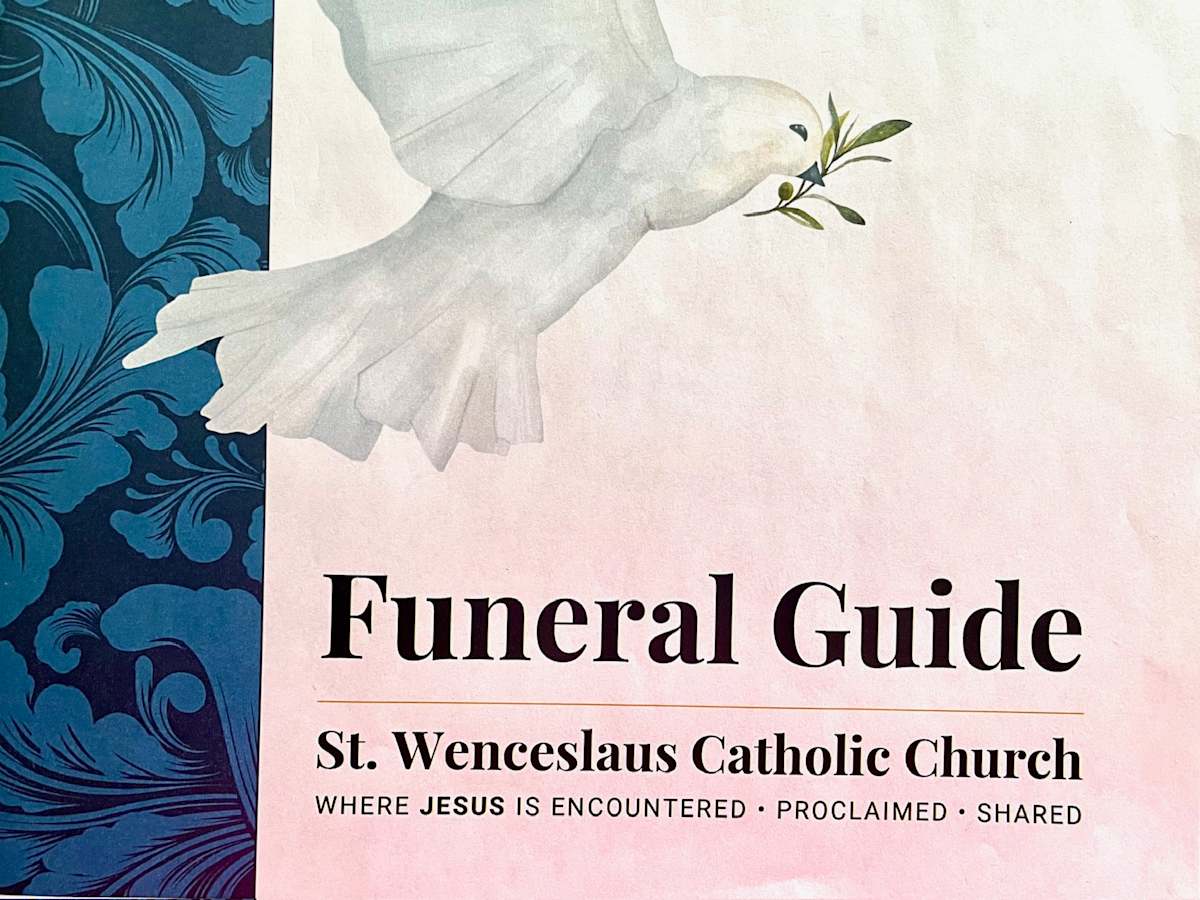
St. Wenceslaus has developed a thirty-page guide to help the future deceased communicate what kind of wake, funeral, burial, and even lunch that they want. The guide offers a way to communicate desired readings and hymns, even “homily ideas.” Among the various staff members listed in the guide was “the Funeral Coordinator,” a position that I never knew existed.
So that is where I started, an email to Brian, with a brief outline of my intentions and a few questions. His quick response was, “I’m going to call you as there are a lot of questions there and I feel like I can help you better on the phone. I am happy to help you out and look forward to chatting.” As I am not a great chatter, I was discouraged by the need for a call but otherwise enthused about Brian’s willingness to help.
As it turned out Brian was the “Parish Pastoral Ministry Office, Director.” So, “the Funeral Coordinator” wasn’t so much a position, as a part of pastoral ministry; made sense. As I mentioned, St. Wenceslaus is “mega” – also having directors for parish children’s faith formation, parish development, parish evangelization, parish finance, parish liturgy, parish music, parish operations, and parish youth/young adults. Brian called later, as promised, and we determined that the rough outline that I had furnished him was doable. In a pastoral manner, Brian answered, via that call and subsequent emails, all my questions.
A Funeral is for the Living
As I recall, years ago, while I was waiting for my wedding to start – in the sacristy of Dowd Chapel at Boys Town – I asked Pastor Bruce Laverman a question, something like, “How do you get through funerals?”
Pastor Laverman, then the senior pastor of Westwood Community Church, a part of the Reformed Church of America (RCA), was one of the co-celebrants at our September 18, 1981, wedding, along with Father Paul Ortmeir. Anyway, we had a little time to kill, and the discussion turned to church services – weddings and funerals. I noted that I suspected that I would have a tough time presiding at a funeral – getting all teary-eyed, choked up, and unable to speak – as I thought about the life and death of the deceased.
Pastor Laverman then said something that stuck with me, something about remembering that “the funeral is for the living.” Pastor Laverman focused his mind on the people in the pews, their spiritual needs on that day. That helped him during such occasions.
So that is my main point here: My funeral is for you, where “you” is mainly my wife. As such, I hereby give you permission to do what you want – to ignore whatever I write herein, to have a service that you are comfortable with – after all, you are living and this funeral is for the living. Maybe, Pastor Dave could conduct a small service at the funeral home?
That being said, the “Anointing of the Sick” (the former “Extreme Unction”) is a Catholic sacrament and I hope that those around me, when I am dying or dead, can see that that sacrament is administered in a timely manner. See Chapter 7 (Anointing of the Sick) in my book A Catholic Prays Scripture (Volume 2): concerning the sacraments.
I realize that funerals can be taxing, even under favorable circumstances. I also realize that funerals can be more taxing when the deceased and his survivors do not share beliefs regarding their faiths and the hereafter.
Another Option
I am reminded of one of my favorite television shows of long ago – a show called The Untouchables, with Robert Stack playing the role of Eliot Ness, an agent of the Bureau of Prohibition – known for its efforts to bring down Al Capone. One of the stock pieces of film that that show ran from time to time, to depict the violence of the underworld, was that of a 1930’s era automobile rounding a corner at a high rate of speed, sometimes with machine guns blasting away. And then, as the car passed by the camera, a door would open, and a body would fly out as the vehicle sped away – machine guns still firing.
I thought about those scenes as I thought about my funeral. My church, before the most recent expansion, had the coolest circular drive out front. The drive is still there but it is no longer the church’s main entrance. Anyway, I could picture one of my cars squealing around that drive (with no machine guns), the door opening, and my body tumbling out by the stairs leading up to the church.
On my body, maybe in a “toe bag,” would be a note and $10,000. The note would read, “Please see to it that this Catholic body is cremated. Keep the change.” I will admit that this thought is somewhat macabre and probably illegal, but it would certainly be simpler than planning my funeral has been.
Note: If I decide in the future to pursue the above option, I will revisit the $10,000 amount, as I am beginning to believe that $10,000 might be insufficient. There might not be any change for the church to keep.
Part 2 Tomorrow = The Memorial Service