In the last part of this series I wrote that “for a variety of reasons, I have decided to be cremated and have a memorial service (without a Mass).” I intended to leave it at that and moved on to my obituary. When I was pretty much finished with my (then) nine-part series, I decided I needed to add another part to explain (to myself and possibly others) “why” I decided on a cremation with no vigil, and a memorial service with no Mass.
Cremation Pros
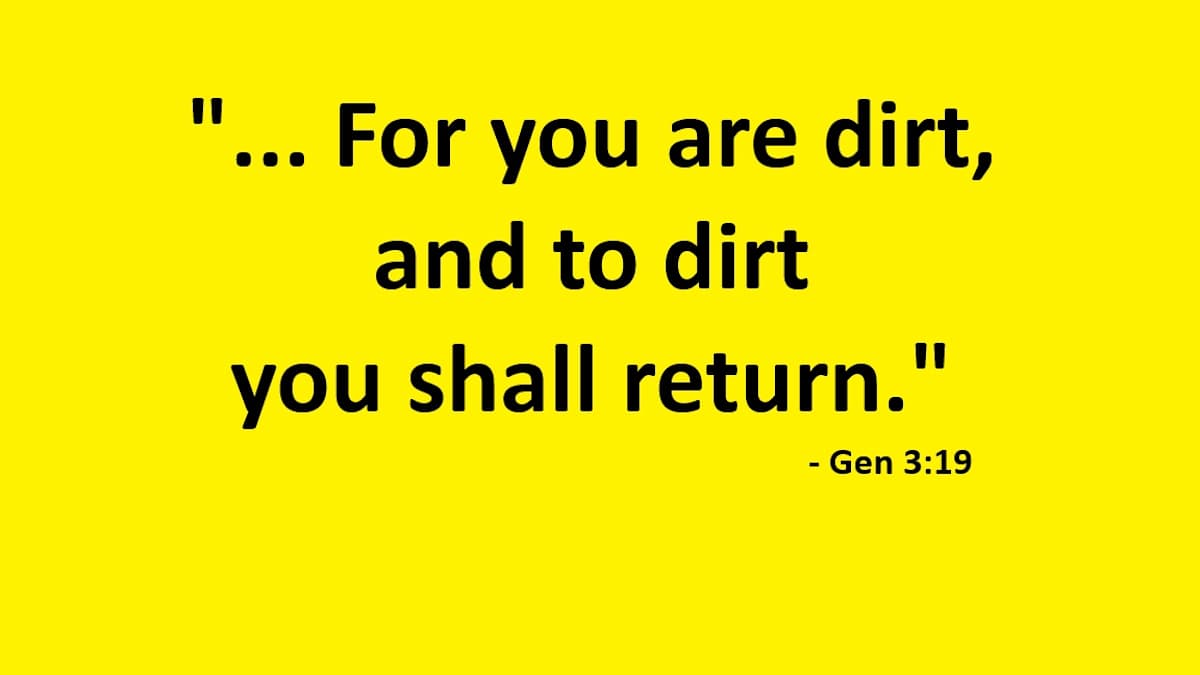
This is the easy part. Cremation eliminates (or at least reduces) a lot of expenses for the family, including the costs associated with the vault, casket, and monument. In terms of land utilization (going forward), it frees up more space for food and housing. It also eliminates the “pall bearer” issue (that has always haunted me). Lastly, note the visual that accompanies this post, which is especially appropriate today (Ash Wednesday) – “For you are dirt, and to dirt you shall return.” If nothing else, cremation hastens this biblical process.
Cremation Cons
First, the Catholic Church, until recently, has “frowned upon” cremations and I suspect that some Catholics and Catholic clergy still do (it’s a big tent). My wife has told me of a friend of hers who left the Catholic Church because of “cremation” issues. Brian, the funeral coordinator, helped me work through this – noting some cremations that had taken place within his own family. See the “Cremation Notes” below.
Second, and this was the bigger issue for me, was what I will term “closure.” I have read, and it makes sense to me, that viewing a body in a casket facilitates closure. There is something about seeing a body in a casket that tells the deepest part of your brain – yes, he is dead, time to move on. This closure and moving-on is important. And this issue is especially difficult for the “little ones” to process – where did grandpa go? As the “littles” get older, this is less of an issue. Alas, I am going to leave that issue for my survivors to deal with; but please be cognizant of the little ones and try to help them to healthily process my death (and other deaths).
Cremation Notes
The Catholic Church’s position is that during life, the human body was a temple of the Holy Spirit and should be treated with the same dignity and respect, after death, whether in full body form or cremated remains. Therefore, one wouldn’t do anything with cremated remains that one wouldn’t do with a full body — no scattering, no long-term storage in the home, no separation, no combining of ashes, and each person should have a dignified final resting place within a cemetery.
The remains are to be placed in a worthy vessel, transported with the same care as a casket and placed in a final resting place where throughout the years family and friends may return to visit and pray for their loved one. Just as in burying a casket, a plaque or gravestone recording the name and dates of a loved one is appropriate, the same approach is appropriate for the cremated remains.
No Mass
The great majority of my family, and the ones most likely to be at my funeral, are not Catholics. This no doubt says something about me – the leadership I provided my family, and my effectiveness as an apologist and author. In any case, the Catholic Mass is somewhat foreign and uncomfortable for them. The flow of the Mass, the ups and downs (i.e., the standing, sitting, and kneeling), the responses to prayers, and especially the communion service are confusing.
During my life, I have attended various Catholic and Protestant services, including funerals, where a mix of Catholics and Protestants are in attendance. I have come to HATE communion time on such occasions – the clash of the “literal” interpretation of Catholics and the more cavalier “memorialization” by Protestants, not to mention the unbelief of the unbelievers.
When my wife joins me occasionally at a Mass, she remains behind during communion. When I occasionally attend her church’s less frequent communion services, I remain behind or otherwise pass on the crackers and grape juice. Protestants are “nicely” told they can’t come up “to eat flesh” and I am told, by my church, that I should not participate in a nonsacramental “memorialization” of Jesus’ last supper.
Part of me thinks, why can’t we participate in the other’s ritual – to the extent that we believe. I can “memorialize” the Last Supper at my wife’s church – a worthy and noble endeavor. My wife can do the same at my church even if she does not believe that the host is Jesus’ body. Afterall, statistics suggest that most self-described “Catholics” do not believe that any form of transubstantiation takes place during the Mass.
BUT, as I have noted before, and as I will note later in this series, the sacrament of the Eucharist is a major component of Catholicism (its dogmas and doctrines) and something that Jesus seemed to take seriously as his followers drifted away from the Sea of Galilee (as recorded in John 6).
SO, in any case, to avoid this uncomfortable situation for my loved ones, and any non-Christians, agnostics, atheists, and “nones” that might show up for my funeral, I believe that a memorial service is, if not preferable, at least more palatable and comforting. Besides, it gives more time for the homily.
No Vigil
One of the three major reasons to have a vigil, in my opinion, is to provide time for the friends and acquaintances of the deceased to offer their condolences and possibly share stories that might bring comfort to the family. This service is especially helpful for those who can’t or choose not to attend the funeral. A second reason to have a vigil is for the “closure” issue previously noted, especially if the casket is open. And lastly, the vigil provides an opportunity for more prayer.
I decided to pass on the vigil for two reasons already noted. A vase and a picture don’t help much with the “closure” matter. The prayers, litanies, and rosaries are of little comfort to my survivors. That just leaves “fellowship and condolences,” and I am hoping that the memorial service will suffice, in conjunction with the brief visitation opportunities before the service and during the luncheon.
Anyway, those are my thoughts. Part 4 Tomorrow = The Obituary