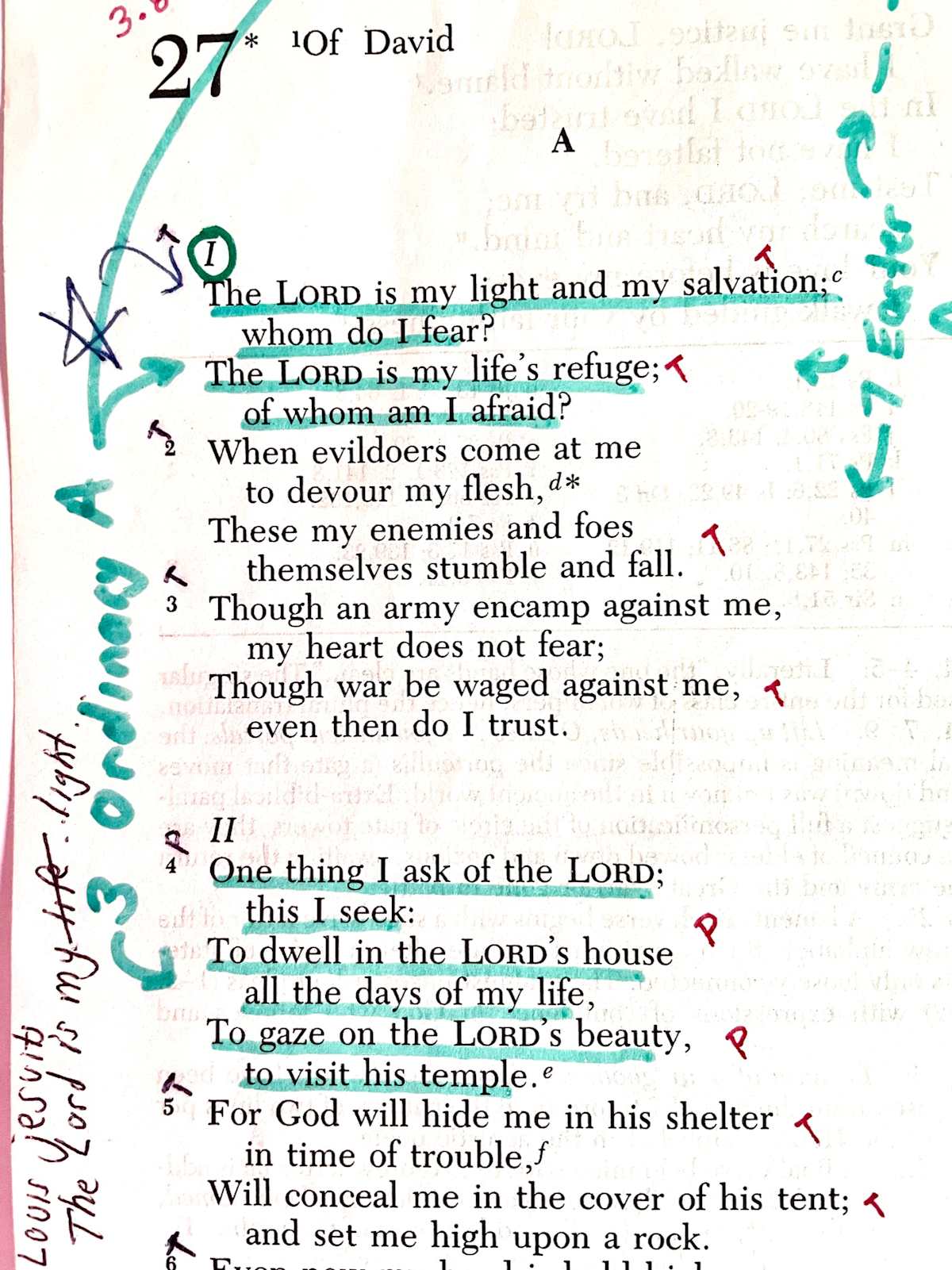
A “Responsorial Psalm” is read or sung between the first (usually Old Testament) and second (always New Testament) readings. The funeral guide provided ten options. I almost went with the first option, Psalm 23 (The Lord is my shepherd; there is nothing I shall want) but after some more reflection, I selected the third option (P-3) from Psalm 27, as I believe it describes God’s loving care for his people.
The seven verses from Psalm 27 (1, 4, 7-9, 13-14) that make up this responsorial psalm are listed below. The seven verses include thanksgivings [T], wisdom [W], and petitions [P] – as noted by the bracketed letters and the explanation that follows.
+++
Presider: The Lord is my light and my salvation.
Response: The Lord is my light and my salvation.
1: The Lord is my light and my salvation; whom should I fear?
The Lord is my life’s refuge; of whom should I be afraid? [T]
Response: The Lord is my light and my salvation.
4: One thing I ask of the Lord; this I seek:
to dwell in the house of the Lord all the days of my life,
that I may gaze on the loveliness of the Lord and contemplate his temple. [P]
Response: The Lord is my light and my salvation.
7: Hear, O Lord, the sound of my call; have pity on me, and answer me. [P]
8: Your presence, O Lord, I seek. [P]
9: Hide not your face from me. [P]
Response: The Lord is my light and my salvation.
13: I believe that I shall see the bounty of the Lord in the land of the living. [T]
14: Wait for the Lord with courage; be stouthearted, and wait for the Lord. [W]
Response: The Lord is my light and my salvation.
+++
Earlier in my life I feared that my prayers were unbalanced – heavy with petitions, light with adoration. It occurred to me when I was writing my book – A Catholic Prays Scripture (Volume 4) concerning God’s “word” and the “future” – that The Book of Psalms (Psalms) might be a good place to look for help, as the psalms are prayers.
In Chapter 2 (A Prayer of Adoration) in my book, I wrote about the psalms. I was interested in what kinds of prayers were in the Psalms in terms of Peter Kreeft’s “A TRIP” model (Prayer is A TRIP to heaven). Like our prayers, the psalms contain a mixture of Adoration, Thanksgiving, Repentance, Intercession, and Petition.
To answer my question, I analyzed the 2521 verses in the 150 psalms and categorized them per the “A TRIP” model. I found that 1347 of the 2521 verses fit the “A TRIP” model, with Thanksgiving (449), Petition (419), and Adoration (416) being the most prominent. Even in Psalms adoration was relatively rare. As to the other 1174 verses in Psalms, I categorized them as verses of “Wisdom” (711), “Lamentations” (365), or “Other” (98).
Wisdom verses in a sense were Thanksgiving verses (e.g., I am thankful that I understand and can proclaim this); and Lamentations were implied Petitions (e.g., woe is me – rescue me or at least help me understand my predicament). The infrequent Other verses were often found at the starts of the psalms (e.g., introducing the music, acknowledging David).
Psalm 27, in addition to its beautiful imagery, is balanced with verses of Thanksgiving (2), Wisdom (1), and Petition (4). The verses of Petition seek God’s presence. In addition to funerals, the Church prays from Psalm 27 on the third Sunday of Ordinary time (A cycle), the second Sunday of Lent (C cycle), and the seventh Sunday of Easter (A cycle).
In addition to being prayers, psalms are often poems and always songs. The psalms were written to be sung. Many of the psalms are introduced with a reference to music (e.g., #8 – upon the gittith). Indeed, the words psalm and psalter are English renderings of the Greek word psalterion, which means “stringed instrument.” It is possible (depending on the musicians) that my funeral psalm might be sung. But alas, we have lost the original melodies.
Catholics are blessed, in that the psalms, this wonderful collection of poems, songs, and prayers are included in each Mass – as the readings transition – from the Old Testament – to the New Testament – to the Gospels (the good news).
Note 1: My “A Trip” categorization was not rigorous. Some verses change from start to finish; some verses had to be categorized “in context.” My book discusses these issues. If I went through the process again today, I am sure that the results would be slightly different but similar.
Note 2: The photograph that accompanies this post shows how Psalm 27 looks in my well-worn family Bible. The little black letters by the verse numbers are my “A TRIP” classifications. The green ink (underlines and arrows) identifies when these verses are read during the Church’s three-year liturgical cycle.
PETITIONS (Universal Prayers)
Shortly after the homily, the presider will invite those in attendance to join in a prayer for the deceased, his family and friends, and for all others “who have fallen asleep in the hope of rising again.”
The funeral guide provided two “petition” options that could be used during the service. The guide also stated that “petitions may also be composed by the family,” but the petitions listed in the petition below (Form 2) seems to be sufficient. I would like the presider (priest/deacon) to read these petitions.
+++
Universal Petition Form 2
Note: The response to each of the petitions is, “Lord, hear our prayer.”
For Robert, who in baptism was given the pledge of eternal life, that he may now be admitted to the company of the saints. We pray to the Lord.
For our brother who ate the body of Christ, the bread of life, that he may be raised up on the last day. We pray to the Lord.
For our deceased relatives and friends and for all who have helped us, that they may have the reward of their goodness. We pray to the Lord.
For those who have fallen asleep in the hope of rising again, that they may see God face to face. We pray to the Lord.
For the family and friends of our brother Robert, that they may be consoled in their grief by the Lord, who wept at the death of his friend Lazarus. We pray to the Lord.
For all of us assembled here to worship in faith, that we may be gathered together again in God’s kingdom. We pray to the Lord.
+++
Part 7 Tomorrow = The Homily (The Deceased)