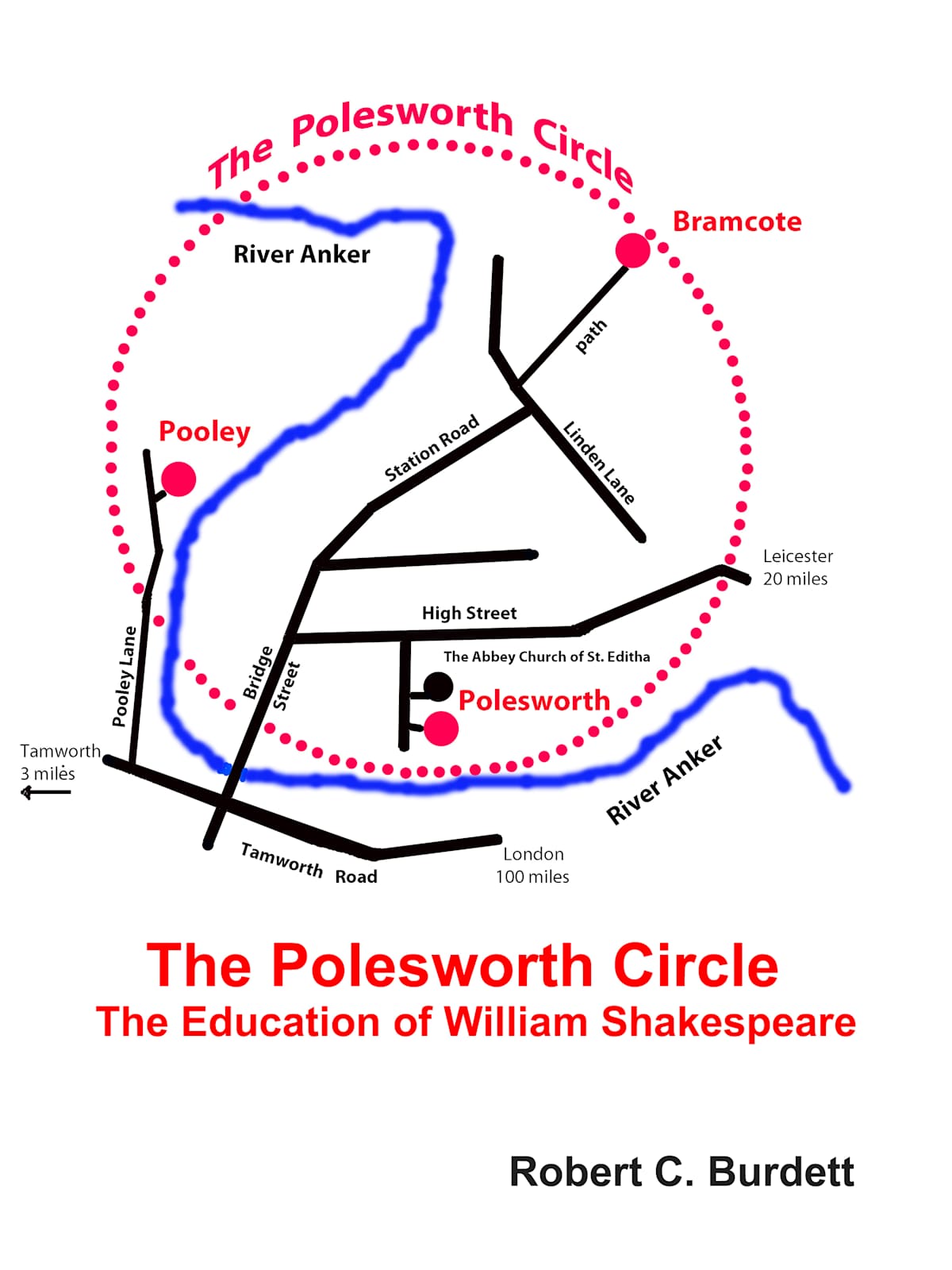
When I first wrote my play “The Polesworth Circle,” as an appendix to my book BS3: Etcetera, I also wrote a review of the play (pages 69-70 in BS3). That review – of an imaginative performance of the play – is presented below. As far as I know, no other “humans” have reviewed the play or the book.
In my next post, I will print a “non-human” review of the book, that was written by CoPilot, Microsoft’s AI-powered assistant. I think that you will find the similarities (few) and differences (many) between the two reviews interesting.
+++ Start of My Review in BS3: Etcetera
Where to start? Last night I saw the world premiere of Robert C. Burdett’s The Polesworth Circle: The Education of William Shakespeare. It is currently playing at the Globe Theatre downtown, in what will most likely be a very limited engagement. The gist of the play, which claims to be “historical,” centers around the premise that William Shakespeare was tutored by an ancient chronicler named Raphael Holinshed, in a village called Polesworth, Warwickshire, England. This obviously conflicts with the “facts” known by every serious theatregoer, such as me, that Shakespeare was educated in Stratford-upon-Avon. Thus, the premise of the play gets us off to a rocky start. Historical plays are tricky. In this case, I found it difficult to determine what was real and what was fluff. In that sense, the author proved successful.
This play is the first for Burdett, and for the most part it shows. To start with, it is way too long. Even with intermissions, it poses a challenge for anyone with a weak bladder. When I say that it is Burdett’s first play, I should note that it contains two more plays (within the play). Trying to manage a play within a play is a bold move for an experienced playwright. Trying to include two plays – by a novice playwright – is just plain stupid; and Burdett made several mistakes:
First, he included way too many characters, including a windy narrator that he called the Chorus, a sister-saint-ghost named Editha, and various villains such as the lamely named Murderer 1 and Murderer 2. Burdett kept throwing out the characters, hoping that something might stick. Shakespeare would be spinning in his grave – in Stratford-upon-Avon (not Polesworth).
Second, Burdett created the “love triangle” of Drayton, Shakespeare, and Anne Goodyer. He tried to add a fourth – a character who coincidently shared the same name as the author. Then, after all that effort, he dropped the ball and never followed up with any hot and juicy action – action that might have paid off at the box office.
Third, Burdett could never settle in on a dialect for the play – mixing in Old English sounding words, the English of today, dated expressions such as “the man,” and crude expressions such as “pissed off.” Come on, pick a tone, and stick with it – man!
Fourth, it became obvious over time that Burdett was trying to glorify the pasts of his ancestors. He used way too many words describing their past escapades, ignoring other relationships – such as the “love triangle” just mentioned.
Fifth, one of criticisms of Shakespeare, then and now, was that he “borrowed” freely from the work of others. Burdett kept making that point, while at the same time “borrowing” from virtually everybody who ever wrote of Shakespeare and the Elizabethan era – kind of like the pot calling the kettle black.
But not to be overly critical, the staging, lighting, acting, and music (yes, it was a bit of a musical) were all superb.
It can be difficult to find young actors – 15 to 25 years of age – to play such demanding roles. I found the two actors and one actress that were cast as Holinshed’s “kids” to be exceptional, especially Jayson Watts as Shakespeare. His soliloquy in the epilogue was exceptional – the high point of the play for me. Likewise, the brother-sister tandem of Jake and Isabella Valicea (as Michael Drayton and Anne Goodyer) were wonderful. It is always hard for a sister to kiss her brother, maybe even more so on the stage.
The scenery was for the most part simple and inexpensive – especially when considering that there were three plays to stage. I liked the screen projections in the prologue and epilogue – they helped break up the nauseously long speeches by the Chorus.
So, what scenes did I especially enjoy and/or dislike?
I liked the Pye and the Fawcon – the magpie and falcon birds – in the first scene. They proved to be a fun way to introduce the “kids” as students, while taking on a topic of great importance today – misogyny. Speaking of “borrowing,” the references to the magpie named Pye, is suspiciously close to the Magpie Murders series, a play within a play, currently airing on PBS. Coincidence?
I loved the harp music and the ballads sung in Act 1, Scene 4. The ballads were very much of the era and provided a bit of comic relief when it was dearly needed. The harp solos provided a good excuse for adding the “asides” required to advance the play. Once again Burdett borrowed one of the stage techniques that Shakespeare was noted for.
I liked Drayton’s play, The Murder of Thomas Cokayne, and how the playwright chose to write about dueling – such a strange concept in this modern era – like doctors draining blood in the old days to make the patient healthier. Seems so quaint and illogical today.
I liked the way that Shakespeare in his play, The Beheading of Thomas Burdet, intertwined the lives of Thomas Burdet, the duke of Clarence, and the duke of Gloucester (for he was always there) into Shakespeare’s script from Richard III. Again, I found it difficult to determine what was real and what was fiction.
I hated the last scene in the play – the last scene before the epilogue. I didn’t care for Saint Editha in that scene. The scene was way too preachy for the modern ear. Given the play was already too long, that scene and Saint Editha should be eliminated.
So, all and all, not a bad effort for a first-time playwright. Sadly, if such a play needed to be written, it should have been thirty years ago when people still cared about Shakespeare and the history of the white man’s Western Civilization. Today’s theatregoer is searching for equity and plays depicting the real cultural issues of the day. If this play were ever produced in another venue, it would be difficult to cast with people of color, or trans actors.
So, bottom-line, unless you are into conspiracy stories, a Shakespeare nut lost somewhere in the white man’s Western Civilization, or logical; I suggest you save your money and forgo The Polesworth Circle: The Education of William Shakespeare.