This is the third in a series of three posts on Nebraska government and politics. The first post (June 21, 2026) concerned Nebraska’s unicameral legislature. The second post concerned a Nebraska political phenomenon known as the “blue dot.” This post will concern how the blue dot impacted the May 12, 2026, primary election in Nebraska.
My Favorite Primary Ad
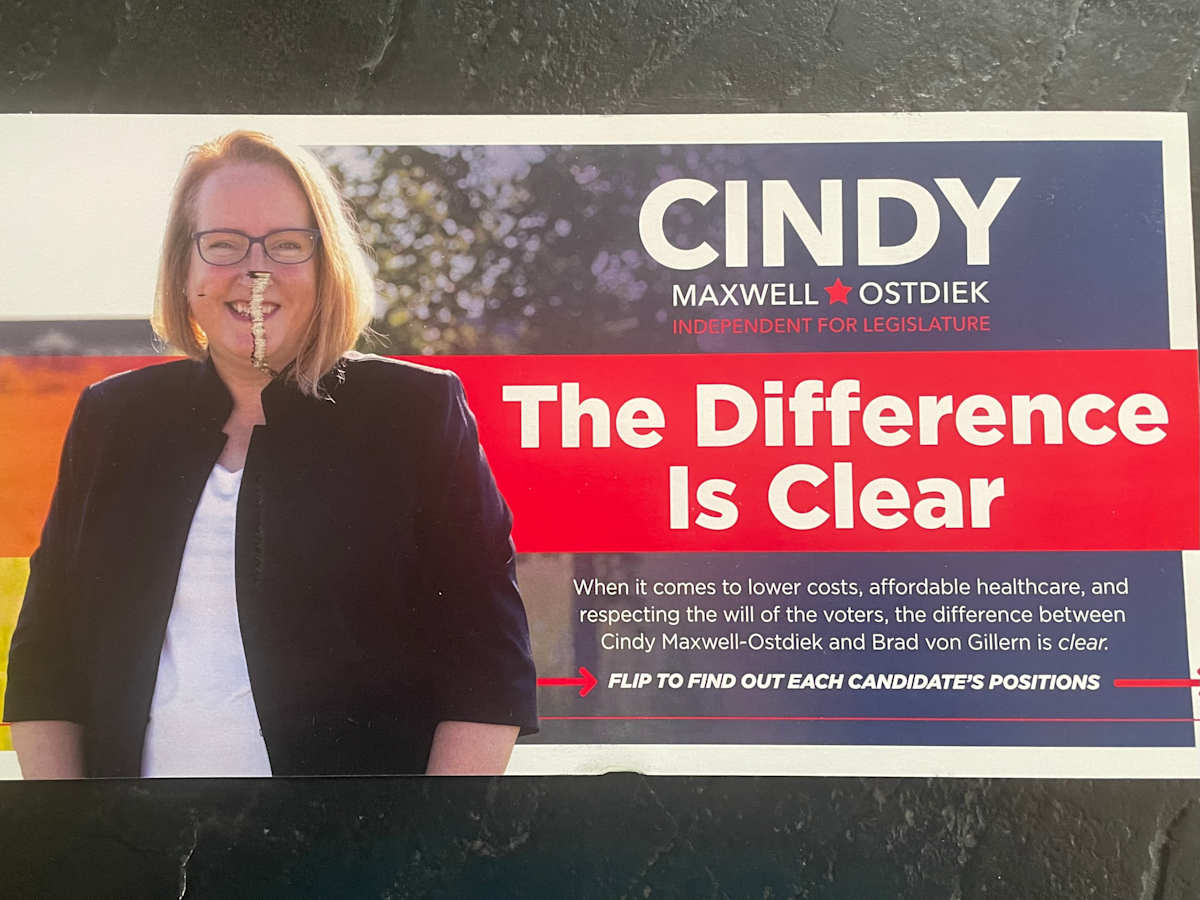
The political ad that ultimately prompted this post caught my attention when I pulled it out of my mailbox. I DID see a clear difference between that ad and the many others that I had received leading up to the May 12th primary election. In this case, the independent (which normally means not-Republican) candidate for Nebraska’s 4th legislative district seemed to have a serious “snot” issue.
I swear that I did not in any way alter the picture. I don’t know if it was the only mailing that got messed up, or if it was one of thousands. In any case, I suggest that Cindy Maxwell Ostdiek consider hiring a new printer – or congratulate her team for coming up with an attention-getting ad that a voter (like me) might have otherwise quicky trashed.
Nebraska’s Unicameral District 04
The ad must have been somewhat successful, as Cindy Maxwell Ostdiek collected more votes (5204) in the “nonpartisan” election for the fourth district – then the incumbent Republican, Brad von Gillern (4553), who I voted for. As such, according to the law, both candidates now advance to the November general election.
Nebraska’s Congressional District 02
The above results may have been a bit skewed, as the big political race this year was for Nebraska’s 2nd District congressional seat – an election to replace Don Bacon, our current Republican congressman, who chose not to seek reelection.
Anyway, in this year’s “congressional” primary election the Republican candidate (Brinker Harding) ran unopposed, while five candidates sought the Democratic spot on the November ballot. This was the race that drew the most voters (i.e., Democrat voters) to the primary election. The final totals indicated that 57,404 voters voted on the Democratic side (for one of the five Democratic congressional candidates), versus only 39,533 who voted for Harding, the uncontested Republican candidate.
Back to Unicameral District 04
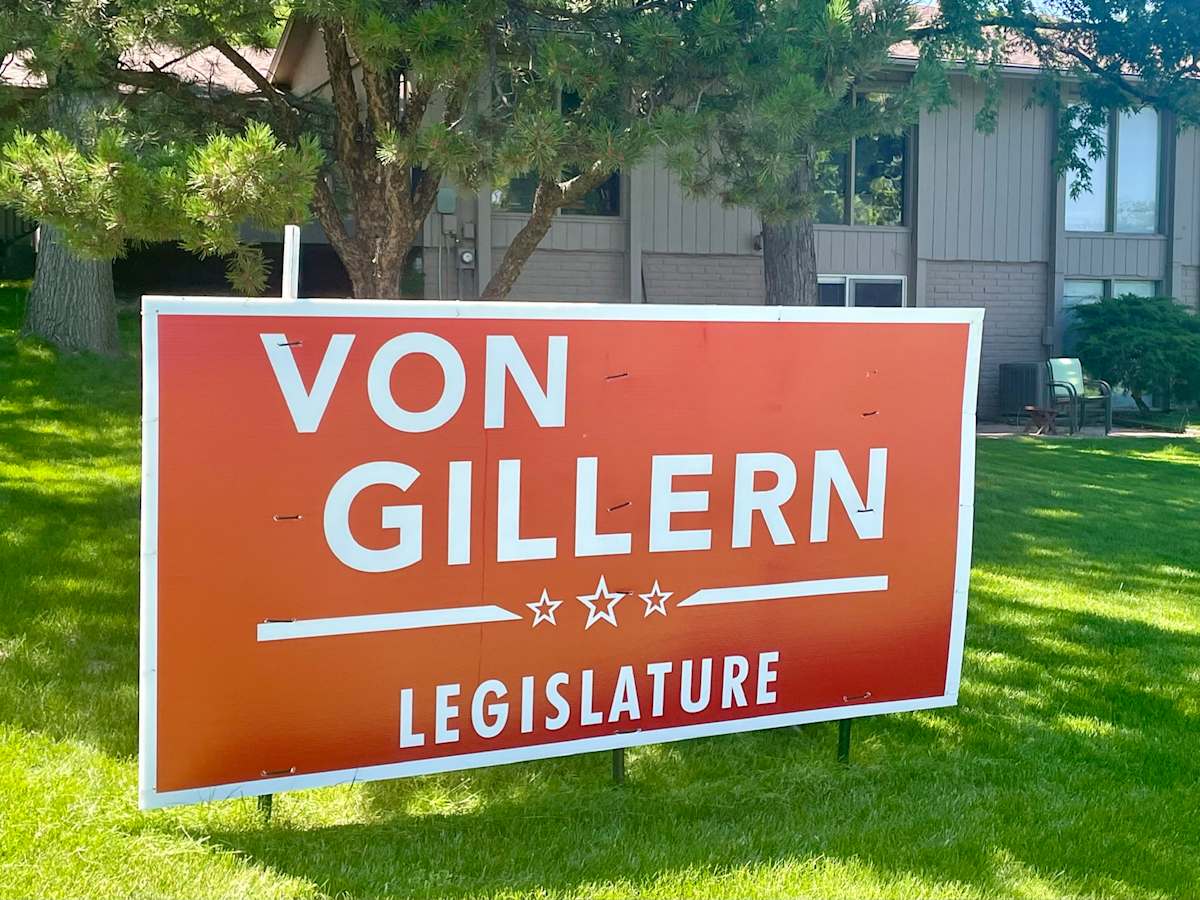
So doing a little “speculative” math (57,404/39,583 = 1.45 x 4553) leads me to believe that Brad von Gillern would have received like 6600 votes if an equivalent number of Republican voters had showed up on May 12, suggesting that he will most likely be reelected this fall. But he apparently still has some work to do and I will keep his “big” campaign sign (below) in my back yard – aimed at the voters driving north and south on 144th Street – until he wins or loses in the November general election.
Back to Congressional District 02
This year’s Democrat primary, for the second congressional district, was interesting and filled with intrigue. As noted previously, five candidates vied for the Democrat votes. The shoo-in candidate to me was John Cavanaugh, one of the 15 (really 16) Democrats in the non-partisan Nebraska unicameral (more later). His main opponent, who showed up early and often (via television ads), was Denise Powell.
John Cavanaugh would have been my pick, if I had to vote for a Democrat. I watched him represent his district in the Nebraska unicameral and he appeared to be articulate, logical (for a Democrat), and effective. He is a good-looking guy and familiar to Omaha voters. His father represented the 2nd District in Congress from 1977 to 1981. His sister, Machaela, is also a member of Nebraska’s unicameral. I noted her (“the most outlandish, silly at times”) in my first post in this series, when I discussed the “progressives” in the unicameral.
Denise Powell on the other hand, came out of nowhere, reeking “activist” and “anti-Trump.” In one of her ads. she declared that she carried her passport with her, in case ICE tried to sweep her off the streets of Omaha (and back to one of her parent’s homelands). ICE, abortion, and “anti-Trump” seemed to be her platform. Prior to running for election, she co-founded an organization called Women Who Run Nebraska. Her campaign tag was “Be Brave” and she oft noted in her ads and speeches that she was “a pissed off mom.”
As noted previously, Denise was on TV early and often. She obviously tapped into a lot of cash. After I saw her ads for the tenth or so times, I reached for the mute button as fast as I could. In addition to the “Be Brave” ads, there were several other ads on TV (by various vague PACs or other groups) that were stressing a “Nebraska-weird angle,” involving the blue dot (which I discussed in my last post).
Powell’s “supporters,” via their ads, were suggesting that, if Cavanaugh won the primary election, the 33 Republican – 16 “other” balance in the Nebraska Unicameral would be screwed up (because Nebraska’s Republican governor would appoint a conservative Republican to replace Cavanaugh). Powell’s ads suggested that a larger Republican majority in the Unicameral would then ravage the state (e.g., abortion, transgender rights, and eliminating the “blue dot” itself).
Cavanaugh’s ads in response, tried to downplay the above argument, referred to Powell as “Dark Money Denise” (which I enjoyed), and suggested that many of Powell’s financial “supporters” were Republicans in disguise – trying to defeat Cavanaugh (who would be more difficult to defeat in the general election). The latter argument sounded logical to me.
Results: When the primary votes were tallied, Dark Money Denise won (22,270 to 20,923). The three other Democratic candidates, who seemed somewhat attractive, shared the other 14,211 votes. Their TV time was sparce; they were largely nonfactors.
Denise’s Republican opponent in the fall election, as noted earlier, will be Brinker Harding, who collected 39,533 votes (unopposed) in the primary election. Brinker is an Omaha city councilman who is not well known outside of Republican circles. He appears to be rather bland when compared to Denise, who I would describe as shrill but brave.
The general election in the fall should be interesting. I fear that Brinker’s personality will be no match for Denise’s spunk. That, and a general “Trump-fatigue,” will bring out more Democrats than Republicans in November (or whenever the hell we start voting). But time will tell.
Congressman Don Bacon
I first met Don Bacon when he knocked on my front door in 2016 and asked for my vote, during his first run for congress. At the time, I thanked him for running and promised him my vote. I also voted for Bacon in the 2018, 2020, 2022, and 2024 elections. How could you not vote for bacon?
Before running for Congress, Bacon had a successful career in the USAF, commanding wings in Ramstein, Germany and at Offutt Air Force Base, near Omaha. He retired from the military in 2014, as a brigadier general.
As one might expect, he promoted a strong military and could be classified as a neocon. When I first voted for him, I most likely was a neocon myself. He at times, especially after he announced his retirement, was a vocal critic of Donald Trump. Bacon was one of the 35 Republicans who supported the committee to investigate the January 6th attack of the capitol. If he hadn’t retired, Trump would most likely have tried to “primary him out of office.”
I never had the need to contact Bacon or his office for assistance, but he seemed to represent his district effectively. I trust that he will now have more time to spend with his grandchildren, as desired. I wish him God’s speed as he moves on. It will be interesting to see who wins the blue dot.