Politically speaking, we are between seasons in Nebraska. The May 10th primary election has been held and the November general election is several months away. So, I thought I would spend a little time now writing about Nebraska government and politics. This is the first of three planned posts on these topics.
Nebraska is traditionally a Republican state. The current governor (Jim Pillen), two senators (Pete Ricketts and Deb Fischer), and three congressmen (Mike Flood, Don Bacon, and Adam Smith) are all Republicans. Occasionally, a charismatic Democrat (like Bob Kerry) will sneak out a victory.
Nebraska has a unique legislature. All the other states pattern themselves after the federal government, with two legislative bodies similar to the house of representatives and the senate. These two legislative bodies work at the state level like the federal legislative system, with affirmative votes in both bodies required to advance legislation.
Nebraska’s Legislature (aka the “Unicameral”)
Nebraska adopted its “one house” unicameral structure in 1937, during the worst part of the Great Depression. The unicameral is also unique in that it is officially nonpartisan. Consisting of only 49 members, it is also the smallest state legislature in the nation. The majority is thus 25, but 33 votes are required to overcome a filibuster. Members are elected for four-year terms; 24 districts will vote in 2026, 23 in 2028. Since 2000, the members (called senators) are limited to two consecutive four-year terms.
According to Wikipedia, for their efforts, each senator receives $12,000 a year plus per diem. The unicameral meets early each year (before planting season) for 60 or 90 days, or when the governor calls. The unicameral meets in one of the two legislative chambers in the Nebraska State Capitol (more later). In general, I like the simplicity of the system.
The 2026 Nebraska Unicameral
The 2026 group of senators is interesting. The party breakdown (for the “nonpartisan” unicameral) is 33 Republicans, 15 Democrats, and 1 Independent. The one independent senator (Megan Hunt) is for all practical purposes a Democrat – and has been so-registered in the recent past. Theoretically, the 33 Republicans have enough votes to overcome a filibuster, but one Republican member tends to side from time to time with the minority – so overcoming filibusters is often easier said than done.
NPM: Nebraska Public Media (NPM/PBS), as a “service to the state,” televises the legislative sessions live. During the past session, I watched many of the televised sessions. I found that I could write and watch at the same time because the legislature moves slowly and somewhat predictably. I didn’t have to concentrate on the action.
Opening: I found the daily opening routine interesting. The “speaker” would first call the session to order. Then a prayer would be offered, by a senator, or more often by a clergy member (per a senator’s invitation). The prayer would be followed by The Pledge of Allegiance. THEN a rollcall was conducted to see if enough senators were present to take on the day’s agenda.
Rollcall: NPM would have a camera pointed at the “tally board” as the senators (via a switch and green light) acknowledged their presence in the chamber. After an initial flurry, additional green lights would dribble in over the next 5-10 minutes, as more senators (who apparently didn’t pray or pledge) showed up. I kept my eye on some of my “favorite” Democrats, as they slowly got around to “lighting up” – demonstrating their perceived importance or their contempt for the body as a whole (or so it seemed to me). The unofficial filibuster had begun.
Alliances: As noted previously, the unicameral is nonpartisan, but a person didn’t have to watch very much of the NPM coverage to note some alliances. Everyone seemed to know the plan. The majority Republicans would try to pass as much of their legislative agenda as possible. The Democrats would go along with the “apple pie” (not necessarily “motherhood”) legislation. The Democrats would (via rules and amendments) try to make it impossible (or at least very difficult) to pass anything they opposed.
Dynamics: As such two dynamics were in play. The Democrats (progressives, if you prefer) wanted to slow things down. The Republicans wanted to move things along. The Democrats wanted to talk a lot about the shortcomings of a bill or the governor’s asinine and cruel budget. The Republicans, since they wanted to move things along, didn’t talk very much about anything – as it slowed the “move along” goal. As a result, the Democrats tended to hog the mike.
Progressives: Thus, if you listened to NPM, you would hear repetitive ramblings from the same progressive senators – namely (in order of verboseness) – Danielle Conrad, Machaela Cavanaugh, George Dungan III, John Cavanaugh, Megan Hunt, Terrell Mckinney, and Ashlei Spivey. Machaela Cavanaugh was often the most outlandish, bordering on silly at times. I would tend to perk up whenever she or Megan Hunt would begin to speak, as they were often entertaining.
Brad von Gillern: A post like this would not be complete without a shoutout to my Legislative District 04 senator, Brad von Gillern. Brad, a Republican, was normally one of the first to flip his green light on each day. He is the chairman of the revenue committee, which was an especially big deal during the past session – as Nebraska’s revenue forecasts are down (in a challenging farm economy). In an earlier life, Brad was the CEO of a successful Omaha construction firm. I know him a bit via my wife’s church. I even played a round of golf with him one day, if you use the term loosely. Brad is a decent stick. My game was so bad and frustrating that day that I forewent the last couple of holes.
Balanced Budget: By law, the Nebraska state budget must be balanced at the end of each session, and the Republican-Democrat dance (cut waste – tax the rich) was tough. It was hard to find a willing partner at times.
Gallery: The legislature has a nice tradition. The public galleries in the balcony are relatively small, but during a typical session, individuals and groups (e.g., the Future Farmers from Cherry County) will stop by for a visit – to see their legislature in action. And so, from time to time, the speaker will interrupt the legislative process to recognize someone or some group in the balcony. Even during moments of contentious debate, the senators as a body will rise in union and applaud those being recognized – a nice “Nebraska-nice” tradition.
The Penis of the Plains
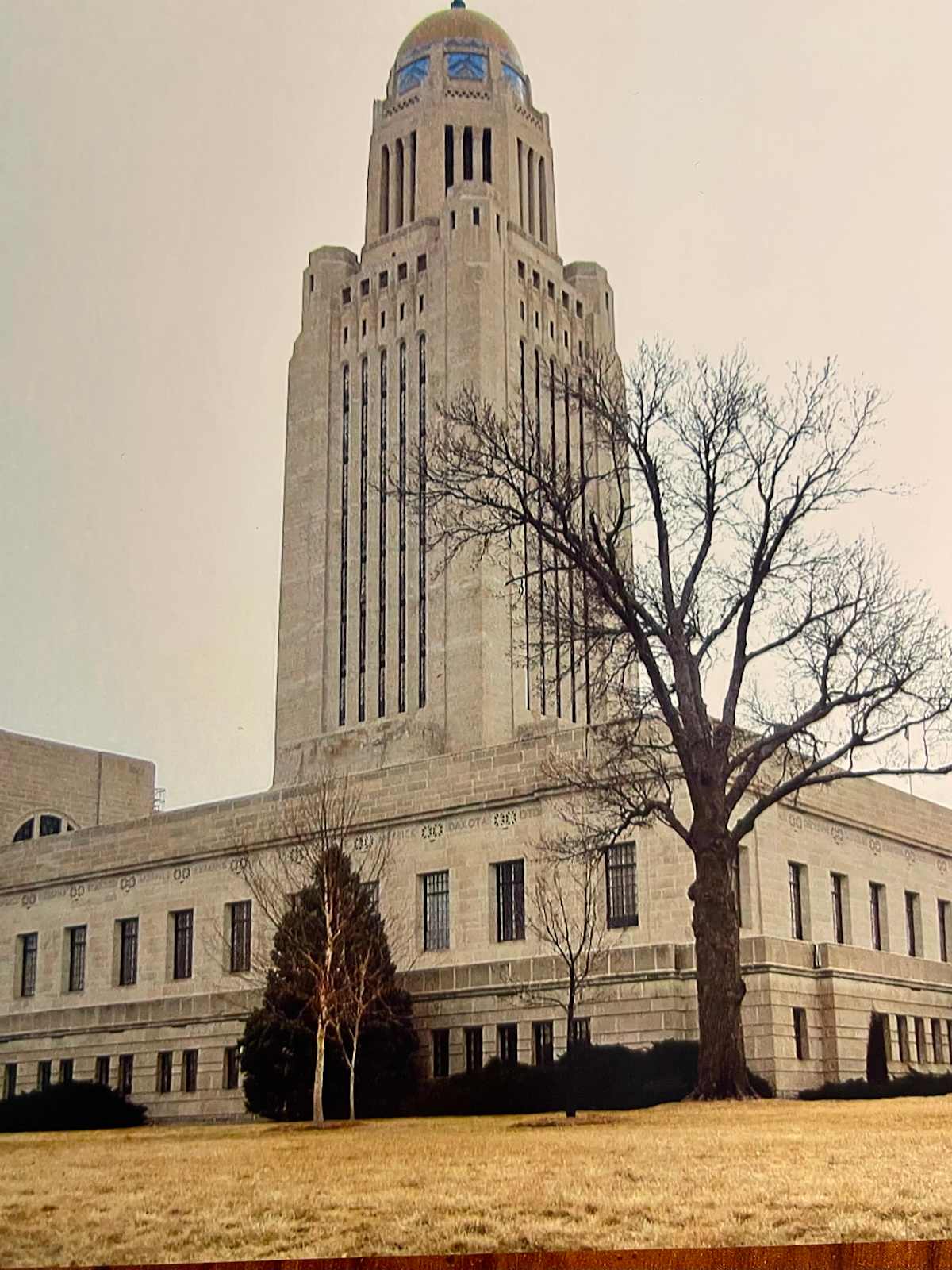
The unicameral meets each year in the Nebraska State Capitol building, which is in downtown Lincoln. The building was designed by New York architect Bertram Grosvenor Goodhue in 1920; it was constructed of Indiana limestone between 1922 and 1932 (around the start of the Great Depression). The capitol building houses all three branches of Nebraska’s government. From an architectural perspective, it features three styles: Art Deco, Neo-Byzantine, and Gothic Revival.
When the capitol building was designed, two legislative chambers were planned. The unicameral now meets in the George W. Norris (West) Chamber. The Warner (East) Chamber is now used as a public-gathering space. The capitol building, both inside and outside, features many beautiful works of art that capture the history of the state.
The architectural design is significantly different than that of the national capitol and many of the similar-looking state capitol buildings. The large base, 14-story shaft, and rounded dome have led some to refer to the capitol affectionally as “The Penis of the Plains” (or something similar). It probably did not help when a 20-foot-high finial called “The Sower” was placed atop the dome – spreading seeds.
Photo: The photograph of the capitol was taken by the author in 2014, when my wife and I visited the building during that year’s legislative session (thus the brown lawn).