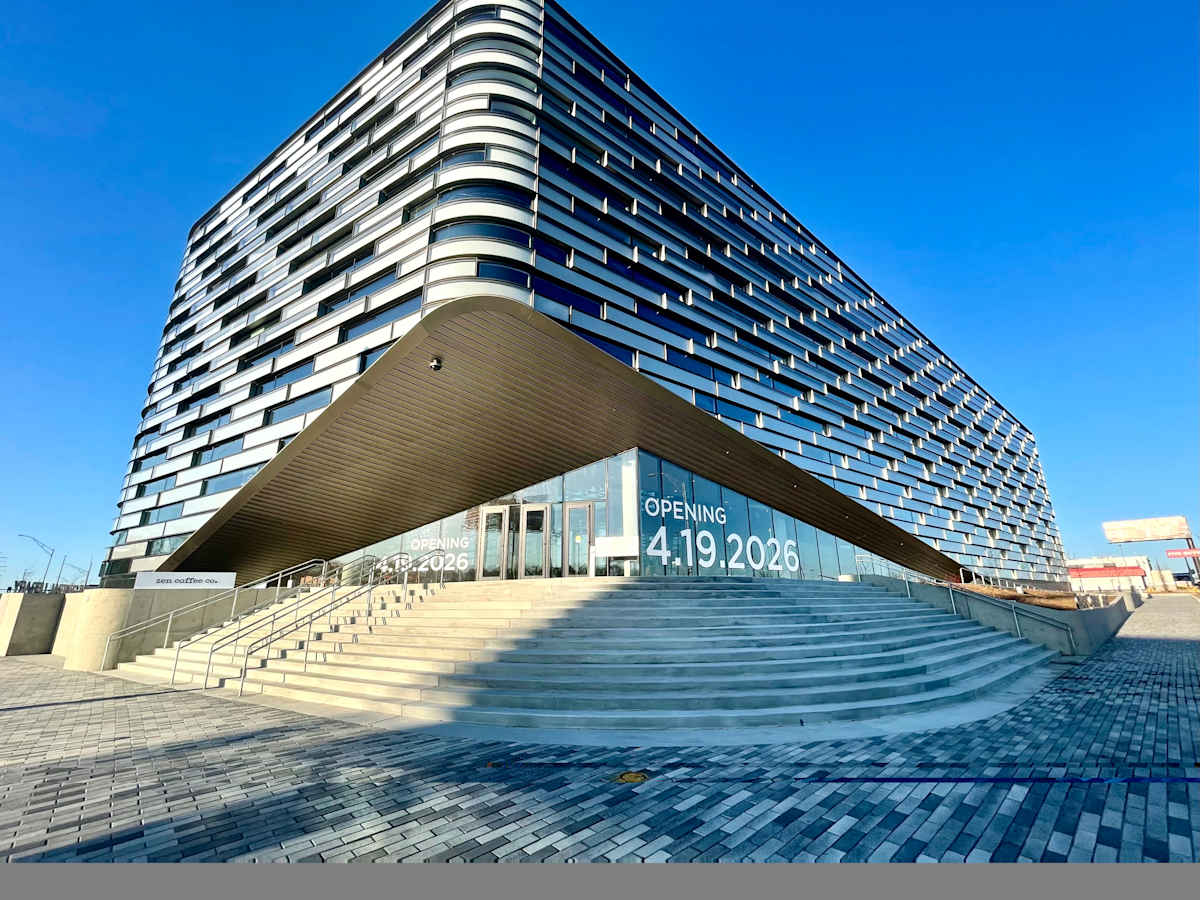
Omaha’s new Central Public Library opens to the public later today. It is conveniently located in the “Crossroads” area of Omaha, at the intersections of 72nd and Dodge Streets. The ribbon-cutting ceremony is scheduled for 12:30 p.m. The new building at 96,000 to 102,000 square-feet (sources vary) was built at a cost of around $158 million, $20 million from the city, and the rest from the private sector, including Heritage Omaha (the “city fathers,” including some early and fortunate “Warren Buffet” investors). The city fathers have been very good to Omaha over the years.
The W. Dale Clark Library
The new Omaha Central Public Library replaces the W. Dale Clark “main” Library (WDC), which was located downtown on a square block bounded by Dodge, Farnam, 14th, and 15th streets. The WDC opened to the public in 1977, replacing Omaha’s first “dedicated” library building, which was opened in 1894. Omaha does not build many new “main” libraries. This is a big deal.
The W. Dale Clark Library was an example of the brutalist school of architecture; it was a concrete behemoth that was quite functional when it was built – but it was built before the age of laptop computers, internet search engines, wi-fi, and e-books. I would occasionally visit the WDC after it first opened, but my visits declined over the years as Omaha’s branch library system developed. Today, Omaha operates thirteen libraries. The four closest branch libraries to my house are 2.8, 3.1, 4.5, and 5.1 miles away – all very convenient. The new Omaha Central Public Library is also convenient – just 6.7 miles away.
Because of its location, the WDC became something of a refuge for Omaha’s homeless community, as the building aged and society changed. It was demolished in 2022 to make way for the new Mutual of Omaha Headquarters Tower (a 677-foot high, 44-floor skyscraper). The city, after a cursory study, felt the land swap and other economics associated with the overall development to be favorable. A controversial new streetcar line, which was part of the deal, is proving to be quite expensive and disruptive to downtown businesses (e.g., street closures, utility restorations, new bridges) – which most likely contributed to the then mayor’s reelection defeat.
Note: The new streetcar line has yet to be named. I have proposed OMA-hop (pronounced “Oh-mah-hop”) in recognition of Omaha’s airport designation (OMA) and the “hop” already used by the Milwaukee’s streetcar system.
Location Pros
As noted previously, the new “Central” library is indeed centrally located at the intersection of 72nd and Dodge Streets, easily accessible by automobile and the city’s Metropolitan Area Transportation (MAT) buses, including the new crosstown “OBRT” (pronounced “Orbit”) busses, which pass by in both directions every ten minutes – from the Westroads Mall (100th and Dodge) to downtown (8th and Farnam).
Omaha has a great north/south, east/west grid system with “primary” streets roughly every mile (12 blocks) and “really important” streets every six miles (e.g., 72nd Street, 144th Street). Dodge Street (US Highway 6) is the major east/west street in Omaha. Thus, the new library is at the intersection of one of the busiest intersections in the city.
Omaha was one of the first cities in the country (in 2015) to expand the concept of a library to include technology and innovation (e.g., 3D printing, laser cutting and engraving) – via a stand-alone “technology library” (named “Do Space”) that was built at 72nd and Dodge Streets. Does that location sound familiar? Locating that new “technology library” in the center of town, in the center of commerce, made a lot of sense back in 2015.
So, when the city started searching for a new location for the “main” library, the centrality and relative availability of the “Do Space” location was noted. The former and relatively new “Do Space” building was subsequently demolished in 2023 to make room for the new library. So, via its new location, Omaha’s main library (its Central Library) is now very central, accessible, visible, and imbedded in the life of the city.
Note: The “Do Space” concept was located offsite during construction but has returned to the 72nd and Dodge intersection (on the second floor of the new Omaha Central Library).
Location Cons
On the negative side, the new “Central Library” is also located at Omaha’s favorite location for public protests (e.g., “no kings,” Trump, ICE); celebrations (e.g., increasingly rare national NCAA football championships); and riots – not necessarily a great place to build a glass building containing flammable paper.
Thankfully riots are not common or frequent in Omaha. The last riots of note occurred in the closing days of May and the early days of June in 2020, after the killing of George Floyd, in Minneapolis, by police officers. The initial protests then were centered on the intersection of 72nd and Dodge. Subsequent protests and riots spread east to the Old Market area downtown where one of the protesters (videotaped earlier trespassing and vandalizing) was shot and killed by an Omaha bar owner (who subsequently committed suicide). An all-around sad situation.
In addition to being Omaha’s first choice for protests, the intersection is also ugly. I hesitate to use the word ugly because it is a relative term and probably not accurate. But it reflects my opinion that the new library deserved a prettier setting. I will get into the exterior design of the building shortly. Let me just say for now – the new design deserved a better space.
On the opposite side of the intersection, you will find a Petco. To the north, all that remains of the demolished Crossroads Mall is the mall’s sign in a Target parking lot – still displaying unreadable messages to those traveling through the intersection. The messages are unreadable because many of the light bulbs have burnt out or the sign's processor has had a nervous breakdown. I’m not sure if anybody even knows who owns the sign., although someone seems to be paying the electric bills. Maybe the library should buy the sign, rehabilitate it, and use if to promote what is happening at the library.
To the east, across 72nd Street, lies a coffee kiosk sharing a parking lot with a gas station. And to the west and south of the library run a seemingly endless series of fast-food restaurants, commercial buildings, and strip malls – leading west to Children’s Hospital and south to the legendary Nebraska Furniture Mart.
In my opinion, the new library deserved better – possibly a spot in the middle of a nicely landscaped section of the now vacant Crossroads property across the street – the long-delayed re-development project from hell.
Exterior Architecture
The exterior of the building is beautiful. It was designed by two Omaha architectural firms, HDR and Alley Poyner Macchietto Architecture.
The north and east sides of the building (pictured) are curved, and the northeast entrance to the building is lifted “to mimic the opening of a book.” The exterior walls on these sides (and on the southeast corner) feature hundreds of horizontal windows with a three-dimensional look. The southwest side of the building has the traditional “boxy” look of a modern glass-walled office building. As you walk around the building, it is sometimes difficult to believe that you are looking at the same building, depending on your location – north, east, south, or west.
The building wraps around a semi-enclosed courtyard, leading to, or a part of, what is described as the “City Garden.” Most of the unique narrow glass windows face out towards heavily traveled 72nd and Dodge Streets. The parking is hidden in the back – on the south and west sides of the building.
Interior Architecture
While I have been driving by the exterior of the building for months (during construction), I must admit that I have yet to be inside the building. I did peek inside the Sunday morning that I took the exterior photograph, and I look forward to getting inside soon, as the crowds subside. I have, however, seen many renderings of the interior and pictures of the local artwork recently installed in the building.
The renderings and pictures depict an architecture that is open, flexible, and ready for the changes that will come with time and technologies. Including the mezzanine and ground levels, the building has essentially five floors. One of the websites that I visited proclaimed that “from browsable collections and interactive learning zones to a café, podcasting room, and makerspace, the library is designed to be as dynamic as the city it serves.” The building also features community event spaces, places for kids to play, a 3D printing lab, a genealogy research hub, and sixteen meeting rooms. The interior design features high ceilings and generous floor openings.
As to actual “books,” they are shelved in three ways, via traditional shelving, display shelving, and ASRS – the Automated Storage and Retrieval System. The traditional shelving provides library patrons with hands-on-access to the ever-changing browsable collection. The display shelving attractively showscases highly visible “discovery points” (e.g., by topic, era, author). The ASRS allows fast access to the “deep” collection – of up to 600,000 items.
The Automated Storage and Retrieval System is three-stories high, secure, and climate-controlled. From the library’s main level, floor-to-ceiling windows allow library patrons to view the system in action. The Omaha Central Library’s ARSS (“book robot”) is believed to be the first such system installed in a public library in the United States.
The Omaha Library System – What I Like
I use the Omaha library system quite a bit. My online “borrowing history” stands at 1423 items as I type this – the great majority of which were non-fiction books that I read (and wrote book reports/reviews about). I am glad that my borrowing history is private because I wouldn’t want the world to know that among my eclectic list of borrowed books are Tits up by Sarah Thornton and The Penis Book by Aaron Spitz (both of which I would recommend).
Listed below are a few things that I especially like about the Omaha library system.
· I like the systems website and my ability to track the books that are checked out or on hold. Today I have 24 books on hold. I am #2 in line for Pope Leo XIV by Paul Kengor. The other 23 book are “on order.”
· I like my branch library, just 2.8 miles down the road. Saddlebrook is unique in the Omaha system, in that it shares facilities (e.g., entrances, parking lots, building) with an elementary school and a community recreation center. During parts of the school day, a few bookcases are repositioned to turn the kid’s section of the city library into the school library. Saddlebrook is relatively new, bright, clean, and busy. It is truly a neighborhood library.
· I like the online ordering system. I can have any book in the Omaha catalogue (and the broader interlibrary system) delivered to Saddlebrook for (usually) next-day pickup.
· I like their “Wowbrary” emails. Once a week, the library sends out an email showing what books (or other media) are new to the catalogue or on order. The items are categorized (e.g., “Non-Fiction, History), so it is easy to get to the books that I am interested in. Most of the 1423 books that I have borrowed over the years came via “Wowbrary” (or its predecessor).
· Occasionally we take the grandkids to “story time” or some other such event. I have never stumbled upon any drag queen readings, for which I am very grateful.
· In the COVID days, the library worked hard to service their patrons – the staff would deliver books to the parking lot for pickup – even when the weather was not very accommodating.
The Omaha Library System – What I Dislike
I can think of only one thing that I dislike about the Omaha Library System. That is the way that it treats local authors – like me. The system pays good “lip service” to the topic, but I have not seen the words translate into much action – at least not for me. The library’s 2022-2026 “Goals and Objectives,” include the following two objectives:
· Build a community-based collection that preserves and promotes local content.
· Increase programming that encourages reading and celebrating authors.
Writing, publishing, and marketing books is a trying experience. Sometimes it seems like it is you against the world – and any help getting a book “out there” is appreciated. Most self-published authors rely on “word-of mouth” to promote their books. When people ask me about a particular book, I find it helpful when I can say, “the library has a copy of the book, check it out.” That seems like a win-win-win to me.
In the rest of this section, I will describe my efforts to get the Omaha Public Library to include my books in their catalogue. I will document my efforts in terms of a 3-round amateur boxing match, in which I won the first round before losing the next two – thus losing the fight (but still getting some weird sort of consolation prize at the end).
Caveat: Not every book by a local author deserves to be or should be added to the Omaha Library catalogue. On the other hand, because of their “local” status, I believe that such books should be given a fair shot (e.g., a cursory review and assessment), especially if the books are being offered to the library system free of charge. And, yes, I know, there are costs involved in accepting a book in addition to the cost of the book (e.g., cataloging, storage, handling). I know that because the library has repeatedly told me that.
Round 1: My first book was copyright in 2015. It was entitled Families 1450, 4506 and 4711: before, during, and after Manzanar. The book told the story of how my wife’s parents (the Oshimas) and their extended families (the Gendas and Shiroyamas) were caught up in the Japanese internment process during World War II. The book also featured more general sections on the overall internment process and the newspaper that the internees published at Manzanar (inappropriately named The Manzanar Free Press).
Because this topic has touched the public at large in many ways, because books on Manzanar have proved interesting to the reading community (e.g., Farewell to Manzanar), and because of the unique section in my book on The Manzanar Free Press, I thought the book might be a good fit for the Omaha library system (worth space on the shelf).
Accordingly, I dropped off two “free” copies of the book at the front desk at Saddlebrook, and low and behold, the books appeared in the Omaha catalogue within a couple of weeks – one book on the shelf at the Millard branch, the other at my Saddlebrook Branch. I won the first round!
Round 2: Because the first round went so well, I probably “dropped my guard” (a boxing term). I am a little vague as to the circumstances – a bit groggy (as I took a punch or two) – but I think Round #2 occurred between 2021 (BS: The Burdett Senger Chronicles) and 2014 (A Catholic Prays Scripture …). In any case, I started as I had during the previous round by dropping off a couple of “free” books at Saddlebrook (same librarian).
This time I waited and waited and waited (for months) – for the books to pop up on the website. I spoke with my Saddlebrook librarian and called the acquisitions department at the main library several times (waiting for the adult-acquisitions librarian to return from an overseas vacation). To make a long story short, for whatever reason (I never fully understood), the latest books were not deemed catalogue worthy, and they were disposed of (via a used book sale). I never saw them again. I lost the second round.
Round 3: Per input from the library, I used the “Suggest a Purchase” feature on the library’s website to submit (in my opinion) my most library-worthy book, The Polesworth Circle: The Education of William Shakespeare. On May 3, 2024, I filled out the online form complete with the ISBN. Sometime later I checked the website and read “Not Approved – We are sorry to inform you that we will not be purchasing the item you suggested because we are unable to obtain it from our regular suppliers.” That message remains on the website today.
That was it, no indication that they would ask their “regular suppliers” to source the book. Heck, if they had called, I would have been happy to bring down some “free” copies, cutting out the middleman. I lost the third round and the fight.
And let’s be real, the above “regular suppliers” response is more of an excuse than an answer. Virtually everyone in the world knows how to buy a book from Amazon; certainly, the Omaha Library can figure it out (if it wants to). I am not attuned to all the infighting that goes on within the publishing world – between Amazon, legacy publishers, legacy distributors, and innocent libraries; but it would be nice if the local libraries could help their local self-published authors navigate through this morass.
My Consolation Prize: Time has moved on. My “Families” book has been removed from the Saddlebrook and Millard shelves; it now is a “GENREF” in Central Storage (maybe two of the 600,000 items accessible via the ARSS “book robot”).
What I don’t understand is how the Omaha Library got ahold of my book BS2: an Autobiography. It has been on the shelf at the Milton R. Abrahams branch for years. I have no idea how it got there or how it has survived the “standard weeding procedures” all these years. I doubt that the library’s “regular suppliers” ever stocked it. It is a book that I literally wrote for my grandchildren. I hope the library didn’t pay for it – but I will accept the situation gracefully – as a consolation prize for my 3-round loss.
Conclusion
After I wrote the above, I wondered if my 3-round boxing match was a good analogy. When I concluded that I had lost the bout, it implied that the library had won. Was that true? If the Omaha library really believed the “local” and “authors” objectives that I previously noted, then the Omaha library also lost. Thus, it was something of a lose-lose situation but not a draw (in a boxing sense).
Omaha has a beautiful new central library. It is poised for the future. I hope that Omaha’s local authors are also part of that future.