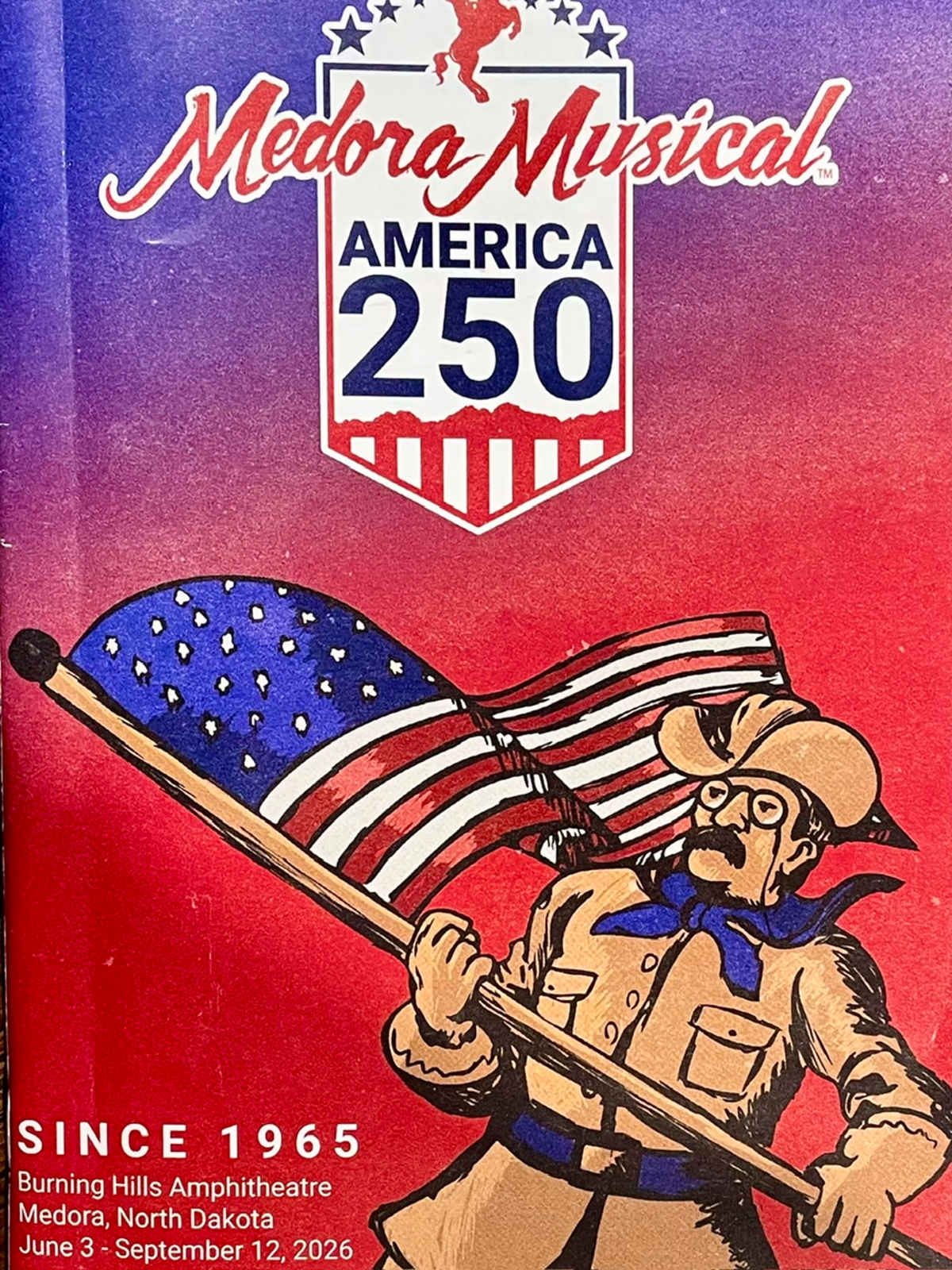
The three main goals of this year’s “road trip” to North Dakota were to visit the Theodore Roosevelt Presidential Library (which I wrote about in my previous post), to attend my 60th and “last” high school reunion (which I will write about in my next post), and to visit relatives (my two living aunts, some cousins, and my sister – who would be also be visiting Bismarck from her home in Las Vegas, Nevada).
The trip's itinerary was very fluid and changed often during the early weeks of planning. Sadly, one of my aunts (Irene Senger) died before we made the trip. The trip's schedule revolved around the dates of my high school reunion (July 31 and August 1); we had to be in Bismarck on those dates. My sister and her husband were also thinking about driving to North Dakota. If they did, we would meet up somewhere in North Dakota, most likely Bismarck or Medora.
During the early planning stages, we talked about increasing the size of our own little “reunion within a reunion” by inviting my sister’s BFF to join us (and her sister – who was also a graduate of the BHS class of 1966). At or about that time, to entice my sister and others to join us on the Medora portion of the trip, I suggested that we add an outdoor performance of the Medora Musical to the itinerary.
I also suggested to my sister that she invite her brother-in-law, and his wife, to join us at the Medora Musical because her brother-in-law (Reinhardt) had performed in that play back in the 1960s. I remembered that Reinhardt had ridden a horse in the show and I speculated that he might have played the role of Roosevelt because (at least to me) they looked alike (e.g., facial similarities). Regardless, I thought that Reinhardt might also want to join our little “reunion within a reunion” and re-live his time on the stage in Medora. The more the merrier!
To make a long story short, my sister was enticed by the Medora agenda, and she went about inviting the others to join us. But, for a variety of reasons, nobody else did. My sister and her husband eventually decided that a road trip was too long; she alone would fly to Bismarck. Our “potential” group of ten was back down to three – my wife, my sister, and me.
BUT (in the process) the Medora Musical had been firmly planted in the itinerary. You can read more on this matter at the end of this post in a section titled “CORRECTION!”
History of the Medora Musical – The Walsh Years
Note: Some of the information and all the quotes below were obtained from a transcript of an interview with Dr. Frederick G. Walsh, which was recorded on February 23, 1988, for the Heritage Education Commission.
The history of the Medora Musical goes back to 1958, when Dr. Frederick G. Walsh, the head of the theatre department at my alma mater (North Dakota State University), met with the Board of Directors of the Theodore Roosevelt Park and Badlands Association to consider developing a pageant to commemorate the 100th anniversary of the birth of Theodore Roosevelt. At that meeting they agreed, with a budget of $50,000, to create “something that would run 20 years.”
On February 22, 1958, Walsh and three others visited Medora and (“like Brigham Young”) found the site to build the Burning Hills Amphitheatre. Walsh then quickly designed and built the 2000-seat theatre, with the help of volunteer labor – including young boys from the nearby Home on the Range at Sentinel Butte. The first production of Old Four Eyes (Roosevelt’s nickname) was held on June 29, 1958. During the first year, Old Four Eyes sold out 32 (of 33) times.
Walsh was amazed at the show’s draw and popularity back then, saying later that when “you realize where this is – 40 miles from a town of 2,000 [Dickinson then], a hundred and forty miles from a town of 20,000 [Bismarck then] … And yet, night after night, it was fascinating to watch that long string of cars leaving after the performance, seeing that string of red taillights disappearing off into the Badlands ….”
Walsh cast and directed the show during its first three years before moving on, saying later; “I consider [Old Four Eyes] kind of the zenith of [my] career and also the nadir because it both was a fascination and a joy and an accomplishment of something I’d longed dreamed of. It also turned out to be a bitter kind of experience because … I found myself wanting to leave the show and get away from it; and I’m a little disappointed that Medora has been changed from the magnificent cow town, the one remaining honest-to-goodness cattle town, into a honky-tonk tourist trap; but that’s history; that’s the way things happen.”
Old Four Eyes ran for three more years after Walsh left. I will write more about Dr. Walsh towards the end of this post.
History of the Medora Musical – The Harold Schafer Years
Walsh’s “honky-tonk” tourist trap view of Medora differed considerably from that of the man who is now credited with saving Medora. The quotes below are from the Medora Musical “America 250” program – on a page with the heading “About Our Founders.”
“In the early 1960s Harold Schafer, head of the Gold Seal Company of Bismarck, was pouring funds into the restoration of the town of Medora. Harold, an unabashed patriot with a strong interest in Theodore Roosevelt, loved the Badlands. This made him a natural fit to serve as President of the Theodore Roosevelt National Memorial Park and Badlands Association. In March of 1965, when the association decided to discontinue their outdoor drama, Harold purchased the equipment and property where the amphitheatre was built.”
“Sheila Schafer, Harold’s wife, had a background in theatre. The two of them felt that family entertainment in Medora was necessary. … The first year of the new show [1965] proved to be winner, as they hoped it would. Harold’s instincts told him that the type of show would build in popularity each year as long as exciting changes and improvements were made.”
Thus, the Medora Musical replaced Old Four Eyes – a musical replaced a drama and an honest-to-goodness cow town transitioned to a corporate-run tourist trap destination.
Note: The Gold Seal Company, founded in 1942, was a Bismarck-based international distributor of household products, most notably Glass Wax (1945), Snowy Bleach (1950s), and Mr. Bubble (1961). Gold Seal was sold to Airwick Industries in 1986. In that year, Shaefer donated his Medora property to the Theodore Roosevelt Medora Foundation (which he had previously established).
Note: Mr. Bubble (the brand), is still available today in a variety of forms (bubble bath, foam soap, bath potions, bath bombs, bath paints; and products with names like “Magic Bath Crackles,” “Baby Bubble,” and “Calm & Sleep.” The Amazon ad that I read began, “Making memories for 65 years! From his signature bubble-gum scented bubbles to his extra gentle and dye-free formula, Mr. Bubble has the best hypoallergenic bubble bath for kids of all ages!” The Amazon ad almost made me want to run out and buy a bottle – for old times’ sake.
Note: Harold Schafer was also a graduate of Bismarck High School and North Dakota State University. One of his sons (Ed) was the governor of North Dakota between 1992 and 2000. One of his daughters (Pam) was in my class (1966) at Bismarck High School.
Medora from 1883-1886
A lot happened in Medora between 1883 and 1886. Those were the years that Theodore Roosevelt lived in North Dakota. At the start of 1883, Medora was a military cantonment called Little Missouri, located in the Badlands of North Dakota, on the mainline of the Northern Pacific (transcontinental) Railroad.
In 1883, another interesting gentleman moved into the area, a French aristocrat and entrepreneur who was named/titled the Marquis de Mores. The Marquis came to the area to establish a new kind of cattle operation – not for the bison and solace that Roosevelt sought. The Marquis’ plan was to slaughter and cold pack cattle in Medora before shipping the beef back east on refrigerated railcars.
The Marquis built his factory (slaughterhouse) in the cantonment, which he soon renamed Medora, after his wife Medora Marie Von Hoffman. The Marquis built other structures in Medora for his employees, including St. Mary’s Catholic Church, and a beautiful hunting lodge/summer home for his guests and family, which was called the Chateau de Mores.
For three years Medora (the town) bustled. And then a drought, competition from the meatpackers back east, and the Marquis’ own business ineptitude combined to end the venture. The plant was abandoned (except for the smokestack that still stands) and the chateau was left empty, except for occasional visits, until it was finally given to the state of North Dakota in 1936.
Theodore Roosevelt and the Marquis de Mores knew each other, but their relationship was complex. At one time they were friends, visiting each other’s homes. The friendship soured when de Mores attempted to take over Rosevelt’s ranch. At one point a duel was almost arranged to resolve the disagreement. Roosevelt and de Mores left North Dakota about the same time – Roosevelt in 1886.
Medora in the 1960s
I experienced a little bit of Medora during the 1960s, during our summer vacation treks to Idaho and Utah. Those years were transition years in many ways – one being in the way people traveled.
When people visited Medora in the early 1960s, it was a small town on the Northern Pacific Railroad. The first visitors to Old Four Eyes wound their way into town on the old highway (US-10). In those days visitors might also visit the adjacent national park, the smokestack (where the de Mores slaughterhouse once was), the Chateau de Mores (a North Dakota state historical site), and the “honky-tonk tourist traps” downtown.
As the 1960s ended, it became easier to get to Medora. The last section of Interstate-94 in North Dakota (from the Montana State Line to Medora) was completed in 1968. Building the interstate through the Badlands had been a challenge – blending the road into the landscape of the Badlands. In 1967, the North Dakota Highway Department won a national contest for that work.
In any case, during that time, I would find myself (with my parents and sister) passing through Medora occasionally – viewing the Badlands, visiting the Chateau de Mores, rummaging through honky-tonk tourist shops, but never once watching Old Four Eyes or the Medora Musical. We never seemed to have either the time or the money.
Before the Show
Tickets: We got our tickets for the July 31, 2026, performance of the Medora Musical well in advance. Our desire for “good seats” outweighed our concern about any sort of weather-related cancelation.
The Medora Ticketed Event Policies (for an outdoor event) are not buyer friendly. “All tickets are non-refundable, but we’re happy to exchange your tickets to any future date in the same season ….” Not what you want to read if you live hundreds of miles away and are only in town for a day. But we took our chances, deciding that the chance of cancellation was low. The tickets for the event were a little pricey – not small change at $73.45 (some seats higher, others lower).
The show was scheduled to begin at 7:30 PM. At 5:30 PM the light rain that had started dropping from the sky in the early afternoon was still falling – but there was no lightning and the radar on my iPhone indicated that the rains were moving to the east. Sure enough, the rain stopped shortly thereafter, and the show went forward as scheduled.
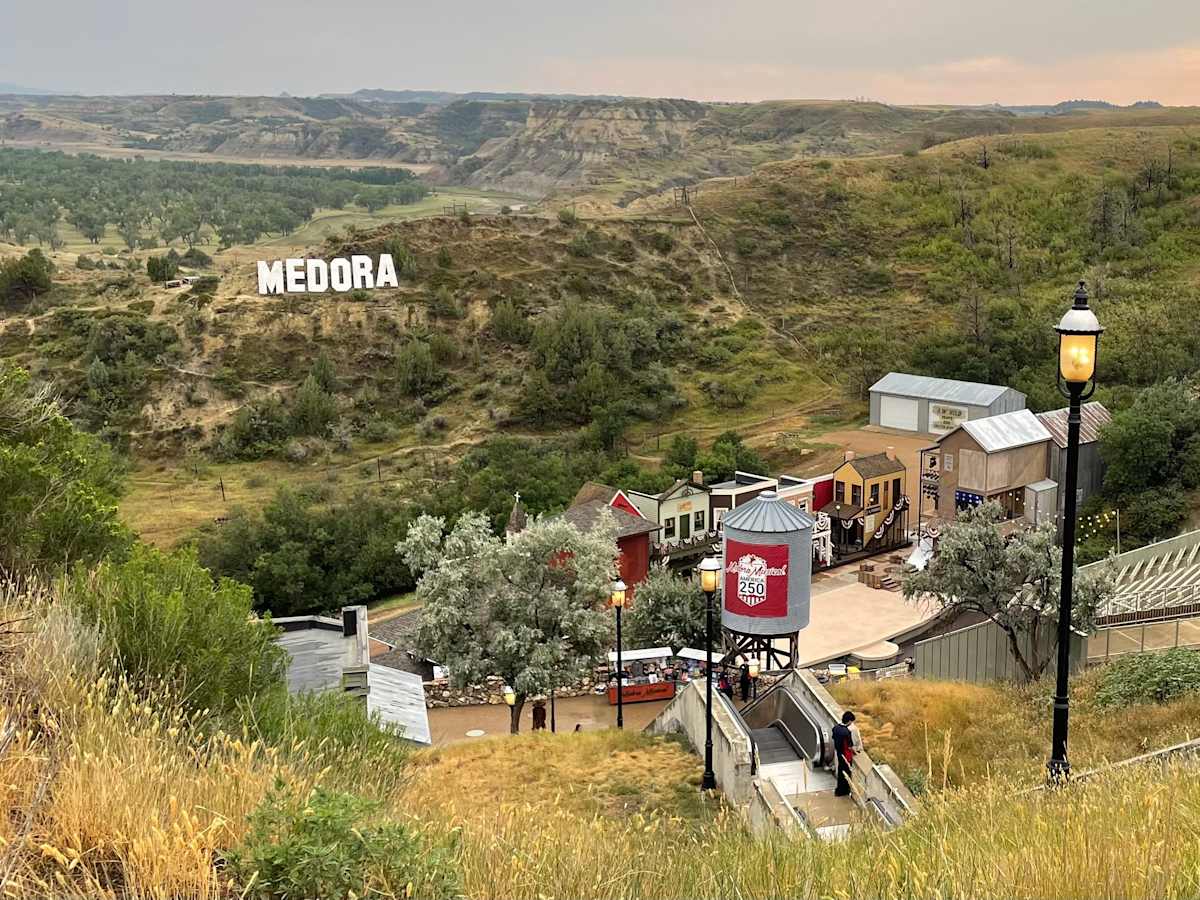
Photo: The above photograph was taken shortly before we were allowed to enter the Burning Hill’s Amphitheatre. The staff had wiped off the seats and the sky had cleared. As you can see, the amphitheatre was built in a gulch. 2863 dry seats looked down on the stage.
Food: The Medora Musical offered an interesting looking “Pitchfork Steak Fondue” buffet for $54.55 in a corner of the parking lot – but we had decided earlier to skip the dinner because of our late lunch that day in Bismarck.
The July 31 Performance
The Burning Hills Amphitheatre has undergone many improvements over the years. It is a lovely outdoor venue, complete with nice seats (with backs), great lighting and sound, a beautiful backdrop (overlooking the Badlands), and some niceties (e.g., escalators and an elevator to help you get to your seat).
We were somewhat concerned prior to our visit about the high temperatures that Medora had been experiencing that summer, with highs over 100 at times, but the passing rains had lowered the air temperature into the seventies. The sky was partly cloudy, and the wind was light when the show began.
I noted earlier Harold Schafer’s vision was to host a musical that “would build in popularity each year as long as exciting changes and improvements were made.” As noted above, improvements had been made to the venue. Likewise, while the general format of the show remained constant, the specifics (dialogue, musical numbers, costumes, entertainers) changed from year to year. This year, for the third year in a row, the Medora Musical was produced in partnership with a company called RWS Global (which also produces entertainment for the cruise ship industry).
This year’s show featured two acts. The first act had musical numbers with names like: Welcome to America’s Celebration, Saluting our Flags, Medora’s Early Days, and TR’s Elkhorn Ranch. The second act continued with musical numbers such as: Saluting our Veterans, Good Times in a Small Town, and North Dakota Medley.
The second act also featured a “Guest Entertainer.” Three different variety acts had been scheduled for the 2026 season. While were there (July 16 to August 9), Murray SawChuck, the “renowned magician and comedian” performed. He lived up to his billing. I found him to be very entertaining.
The show’s cast consisted of two hosts, twelve “singers and dancers,” and the six-member “Coal Digger’s Band” (base, fiddle, electric guitar, acoustic guitar, drum, and keyboard). On the day of our performance the keyboard portion of the show was either previously recorded or performed backstage – as the keyboardist had died unexpectedly earlier that week. At the start of the second act, a keyboard (decorated with flowers) was placed on stage, and one of the show’s hosts spoke a tribute to Michael Lewis Smith. RIP!
The program also highlighted 14 members of the (mostly RWS Global) “creative team” and the 45-member “staff” that put the show on during the 2026 season.
The amphitheatre’s stage resembled the main street of a small western town, including a hotel, post office, and combination feed/stable/blacksmith. Parts of the set were on rails, which were used several times during the performance to “open” the town to the Badlands behind. When the set was opened – horses would ride, cannons would blast, and fireworks would fire.
In the first years of the drama, back in the Old Four Eyes-era, the show was a drama about Theodore Roosevelt. The Director of Entertainment & Attractions, wrote in the program, that years ago, as horseback riders rode on the surrounding hillsides, the following words were spoken, “Washington founded our nation, Lincoln preserved it, but Theodore Roosevelt revitalized it – his dreams were durable, his acts direct, he was a man of forthright action and no fear.”
This year, Theodore Roosevelt was one of the “singers and dancers,” but his role seemed relatively minor to me – more entertainment and less history. As Frederick Walsh once said, “… but that’s history; that’s the way things happen.”
I enjoyed the show from start to finish. It was the kind of family-friendly show that Harold Schafer had envisioned way back in 1965. It was the kind of show that would bring people back from year to year. It was the type of show that a Mr. Bubble buyer would take his or her family to.
Medora Today
Today, Medora seems to be run (at least for the most part) by the non-profit Theodore Roosevelt Medora Foundation (Medora.com). It is, in a sense, a company town; or if you prefer, a “foundation” town. Medora today has a more “Disney” look to it, than when I first started visiting the area. It will be interesting to see how the new Theodore Roosevelt Presidential Library will change things over time – as Medora transitions into a year-round tourist destination.
Over the years, Medora.com has attempted to expand the entertainment options beyond just the Medora Musical. This summer there were other shows being performed at the Burning Hills Amphitheatre and downtown (e.g., Rebels & Outlaws: Country Music’s Best, Medora Gospel Brunch, Teddy Roosevelt Show and Brunch, T.R. The Strenuous Life, and The Teddy Roosevelt Show and Dinner). Damn near like Branson, Missouri.
This summer Medora also hosted a series of traveling shows under the banner of “Burning Hills Live,” featuring the likes of “Hotel California: A Salute to the Eagles,” on June 22nd. There are also some back-street tours and trail rides to do, if you are so inclined. The foundation also owns the nearby Bully Pulpit Golf Course (one of Golf Digest’s 100 Greatest Public Golf Courses). There is a lot to do in Medora today, in addition to the Theodore Roosevelt Presidential Library and the Medora Musical.
CORRECTION!
Forget all that stuff I wrote earlier about my sister’s brother-in-law, Reinhardt, performing in Medora. My sister reported that the topic had come up when she was packing for her trip. At that time, her husband corrected her, saying something like, “Reinhardt never performed in Medora!”
After some more discussion (including with Reinhardt), it was determined that Reinhardt performed in a different North Dakota outdoor drama, which was called Trail West (later The Custer Drama). That outdoor play was performed on the west banks of the Missouri River, just south of Mandan, at Fort Abraham Lincoln State Park. And obviously, Reinhardt had not played the role of Theodore Roosevelt – which, I must admit, was a figment of my imagination. Instead, Reinhardt played the role of Sitting Bull. Sorry about all of that!
Dr. Frederick G. Walsh – The Custer Drama
I had completely forgotten about The Custer Drama until the above information was conveyed to me. Slowly, very slowly, I began to remember a little about that show. Later, after I did some research, I noticed that there were some connections between the Medora and Mandan (Fort Abraham Lincoln) productions.
The connection between Old Four Eyes (the predecessor to the Medora Musical) and Trail West (later called The Custer Drama) was Dr. Frederick G. Walsh. He was involved in both productions. Walsh wrote, rewrote, and/or co-wrote both Old Four Eyes and Trail West.
Walsh was approached in 1958 (around the time that Old Four Eyes was first performed in Medora) by the Mandan, North Dakota, Chamber of Commerce. The chamber wanted a similar “tourist” play, about General George Custer and his 7th United States Calvery, to be performed outdoors at or near Fort Abraham Lincoln (south of Mandan).
Trail West was written by Frederick G. Walsh and W. T. Chichester (another professor at North Dakota State University). The Custer Memorial Amphitheatre was hastily constructed near Fort Abraham Lincoln. The 2000-seat amphitheatre had a 110-foot-wide stage.
Photographs suggest that the amphitheatre’s set was simple. The back wall consisted of high wooden planks – typical of a 1870-era army fort on the plains, with a large gate in the middle, and lookout towers along the perimeter. The set also included a troop barrack and a house for Custer and his wife Libbie.
The set, like at Burning Hills, allowed the performing horses to enter and leave the stage. Instead of the Badlands in the background, there were miles of rolling hills behind The Custer Memorial Amphitheatre – on which the actors (soldiers and Indians) rode their horses and pulled their wagons as the drama progressed.
The drama boasted the distinction of being located on the exact trail used by General Custer and his men when they left the fort on May 17, 1876 (at the start of their ill-fated expedition to “Custer’s Last Stand” – on the Little Bighorn River, in Montana). This was a key factor for Walsh, making “the audience feel, my goodness, that they were right there. They recognized that this was not artificial scenery. This is life. This is the reality. And so there is that kind of fascination with that kind of production” at both Medora and Mandan.
The Trail West cast of 80 was significant, with 70 speaking parts, including Sitting Bull. Over 26,000 attended the first year (1959). The title of the show was later changed to The Custer Drama. To the consternation of the Mandan Chamber of Commerce, the “locals” (like my family and me) did not support the show (which was popular with tourists) and the show was eventually canceled in 1968.
Both historical dramas (Old Four Eyes and The Custer Drama) died in the mid-1960s. Harold Shaefer resurrected one of them – Old Four Eyes, which was transitioned to the more entertaining but less historic Medora Musical.
Conclusion
I enjoyed the Medora Musical. It was entertaining throughout. The amphitheatre, with the Badlands in the background was (almost) worth the admission price alone. I am glad that we didn’t get rained out. I wish that the “rainout” policy was more buyer friendly.
Since I returned home, I received a text from the Medora Musical. It read, “12,572 guests. ONE record-breaking week. … Last week officially became the largest single week of attendance in Medora Musical history.” The Theodore Roosevelt Presidential Library is bringing new life to an old idea.
I think that is safe to say that without Dr. Frederick G. Walsh, there would be no Medora Musical today. His play, Old Four Eyes, and the amphitheatre that he designed and built, set the stage (pun intended) for the Medora Musical.
I think that is safe to say that without Harold Schafer, there would be no Medora Musical today. It was his vision and money that has kept the Burning Hills Amphitheatre filled since 1965, and Medora going and growing.
I think that it is safe to say that without Dr. Frederick G. Walsh, Harold Schafer, and the Medora Musical, the Theodore Roosevelt Presidential Library would never have been built in Medora, North Dakota. Think about it!
In his oral history, Walsh said this about North Dakota, its people, and North Dakota State University: “I came here and found it was a magnificent place to live because of the people. Essentially it boils down to that. You know, climate – what you can say bad about North Dakota climate, you can say bad about Florida climate – it's just a difference of degrees and kind. … It always boils down to the people, and the people of North Dakota were supportive and certainly at the University I couldn't have had a better job anywhere in this world than I had at North Dakota [State University]. I woke up in the morning singing, I went to work looking forward to being there, and there was not a day that I didn't want to go to work.”
That was what Walsh had to say about North Dakota, but his words echoed the words of Theodore Roosevelt (“the romance of my life”) and Harold Schafer (“Do the best you can where you are with what you have”). Walsh’s words could have also been said by me.