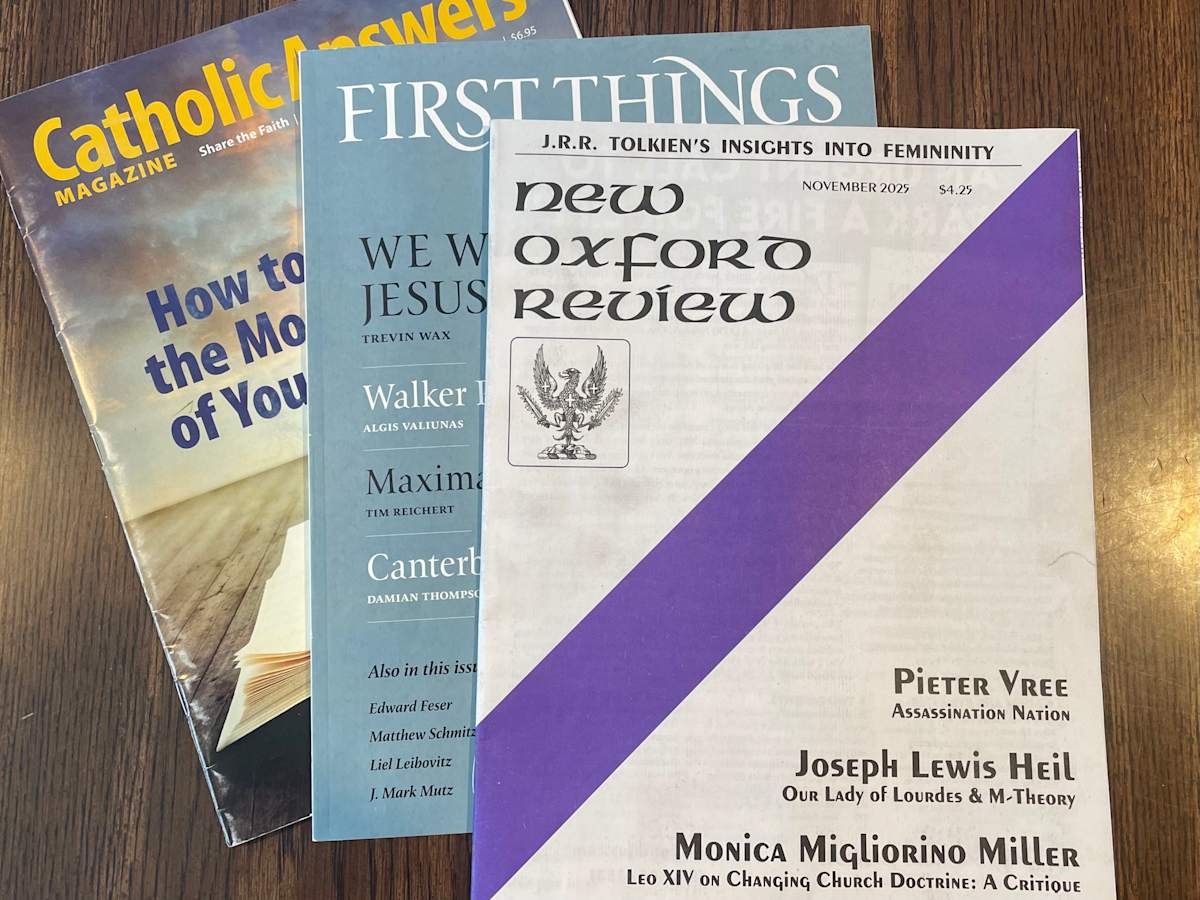
The New Oxford Review (NOR), per its website (newoxfordreview.org), “is an orthodox Catholic magazine that explores ideas concerning faith and culture. … [It] was founded in 1977 as an Anglo-Catholic magazine in the Anglican tradition, taking its name from the 19th-century [i.e., 1830s and 1840s] Oxford Movement. Inspired by the Movement’s leading luminary, St. John Henry Newman, and the dynamic papacy of St. John Paul II, the NOR converted to Catholicism in 1983.” Karl Keating, the founder of Catholic Answers (as noted in my previous article), is one of the magazine’s contributing editors.
A typical issue of the New Oxford Review begins with an extensive section of “letters” (with some editor/author replies). Then, under the heading of “The NEWS you may have Missed,” there are several pages of tidbits regarding cultural issues in the news. Then the new articles; the November 2025 issue, for example, contained three articles (“A Critique of Leo XIV’s Comments on Changing Church Doctrine,” “Can Recent Scientific Development Explain Supernatural Phenomena?” and “Tolkien’s Insights into the Feminine Soul"). The November issue also contained three regular columns entitled “New Oxford Notebook” (by the magazine’s editor, Pieter Vree), “Revert’s Rostrum” (by Casey Chalk, a regular contributor), and a “Guest Column” (in this issue by Thomas J. Kronholz). The magazine concludes with one or more “Books in Review.”
Pieter Vree versus Pope Francis
Over the past couple of years, Pieter Vree, in his “New Oxford Notebook” column, has been critical of the pontificate of Pope Francis.
· The October 2023 column was entitled “The Latest Episode of the Francis Folies.” … “As for the Pope’s ‘being unclear,’ well, that’s the never-ending story, isn’t it? … If there are divisions in the U.S. Church – and only a naif would claim there aren’t – the Pope has furthered them. He’s pushed traditionists and conservatives to the margins with both his words and deeds while demonstrating an overwhelming preference for the progressive.”
· The April 2024 column was entitled “Fiducia Supplicans: A Fine Mess.” Released in December 2023, Fiducia Supplicans (“On the Pastoral Meaning of Blessings”) “permits priests to impart ‘spontaneous’ blessings on couples in ‘irregular situations,’ including ‘same-sex couples’….” This document was not favorably received by many Catholics, including the bishops representing the continent of Africa. As to how Pope Francis handled the African dissent, Vree wrote, “We have entered a strange new era in Church history in which rules that apply to some cultures do not apply to others [Africa] – one in which the Supreme Pontiff, heretofore the visible source of the unity of the Church, is the one sowing division.”
· The November 2024 column was entitled “Indiff’rent Strokes.” … [Pope Francis said to an interreligious assembly of Singaporean youth] … “There’s only one God, and each of us has a language to arrive at God … Some are Sikh, Muslim, Hindu, Christian, and they are different paths [to God].” Vree wrote, “In blurting out his slaphappy opinion of the supposedly wonderful and God-gifted diversity of religions in a slapdash manner, Francis did a great injustice to the Catholic religion. … Loose comments? The pontificate is littered with them.”
· The June 2025 column was entitled “Farewell, Francis. Hello, Leo XIV.” … “Well, that’s finally over. Pope Francis died on April 21, bringing to a close a chaotic pontificate characterized by chronic confusion and polarizing polemics. The late Pope, an imprecise thinker, writer, and speaker, was known to engage in studied ambiguity and to issue pointed barbs. Over the course of his 12-year reign, he disappointed Catholic progressives, angered and alienated Catholic traditionalists, and alternately delighted and perplexed the vast majority in the middle. … He was irascible as a leader, erratic as a decision-maker, and vindictive to those who dared to disagree with him. … The best-case scenario would be that Leo retains the best aspects of Francis’s pontificate – his concern for the poor, his advocacy for peace, his eagerness to reach out to believers on the margins – while restoring neglected or jettisoned elements of Catholic tradition, including celebration of the Tridentine Latin Mass. Above all, we may hope that he embraces orthodoxy. … If the Church can endure a pontificate like that of Jorge Mario Bergoglio, she can endure almost anything.”
I believe that many of the views expressed by Vree were shared by other Catholic “conservatives” and “traditionalists” (like me) – but it was unusual to see them in print – so forcefully presented. Vree, in his various columns, did note the many cases where others in the magisterium (e.g., the African bishops) challenged Francis in real time – and how Francis ignored or vindictively responded to their criticisms.
In a sense, Vree’s writings (and “traditionalist” opinions) seemed to be somewhat dangerous. The Catechism of the Catholic Church gets into the nuts and bolts of apostolic succession, bishops, popes, the magisterium, and the (supposed and desired) collegial character of the Church’s hierarchy in paragraphs 857-896. I won’t dive any further into this subject, except to ask, “Why was Jorge Mario Bergoglio selected, during the 2013 conclave, to be the successor to Saint Peter? What did the electors, on their own or with “Divine assistance” (cf. CCC 892), see? It is a serious question because “whoever despises them despises Christ and him who sent Christ” (cf. CCC 862).
Pope Francis and Mercy
In my book A Catholic Prays Scripture (Volume 4): concerning God’s “word” and the “future,” I wrote about Pope Francis, and his love for a book of fiction entitled The Betrothed. That book bleeds “mercy,” while being critical of two of its main characters, “The Cardinal” and “The Priest.”
In my book, I included the following quote from Pope Francis, “I have read The Betrothed, by Alessandro Manzoni, three times, and I have it now on my table because I want to read it again. Manzoni gave me so much.”
I believe that is what the cardinals saw when they made Jorge Mario Bergoglio the pope – his desire for mercy. I believe that is what the Holy Spirit desired for the Church at that time – more emphasis on God’s mercy.
I also believe that his great desire for mercy, for everyone, including same-sex partners and other religions (e.g., Sikh, Muslim, Hindu), is what got Pope Francis into trouble with the traditionalists in the Church. His inability to precisely mesh and intertwine his spirit of “mercy” with the doctrines of the Church caused great consternation for everybody, including him.
BUT like Vree’s best-case scenario, I pray that Francis’s concern for the poor carries over to Pope Leo. I believe Pope Francis, during his reign tweaked the Church in that direction. That is what I believe the Holy Spirit desired in 2013. I suspect it is still desired today – it is just a matter of how to get there.