This post is the second in a series of five, concerning the parables, that I intend to release within the next month. For the most part, these posts are excerpts from the third chapter (A Parable Prayer) in my book A Catholic Prays Scripture – Volume 4: concerning God’s “word” and the “future.” The first post in this series was posted on May 17, 2026.
In my previous post, I noted that parables contain a story element, but I did not address whether the stories are “true” or “fiction.” All of us have our favorite stories. Some of them are about things that have happened to us. Others are just good stories – funny, sad, hopefully interesting. Other stories are probably in between – based on some true facts but embellished some. The fish in the fish-story is often a little bigger than the fish that was caught, or the fish that got away.
Jesus didn’t say whether a parable was or was not an account of a “true” event. We know that women have found coins; good Samaritans have helped people; and fathers have welcomed home lost children. But we do not know whether the parables in the Bible are true stories or just stories.
But, then again, it really is not important whether the parables are true – indeed most of us consider them to be fictionalized stories rather than true stories. Likewise, I think it is worth noting that it is not really that important whether the parables, the creation story in Genesis, or the story of Jonah and the whale are “literal.” What is very important is what we learn from them.
Capon’s Categories
I became interested in parables years before I wrote my book when I came across a series of three books by Robert Farrar Capon entitled (in the order in which they were written): The Parables of the Kingdom, The Parables of Grace, and The Parables of Judgment. I tend to think in a very logical manner, with what Capon, an Episcopalian priest, called right-hand power. Capon’s three books on the parables, in contrast, provided a left-hand perspective of the parables.
It became apparent, as I read Capon’s books, that the parables could be interpreted in more than one way and in ways that were sometimes significantly different. The parables of Jesus were not as simple as they first appeared. Maybe that is why they often confused his disciples and why the disciples sometimes asked Jesus for help as they tried to understand them. Regardless of perspective (left- or right-handed), I liked the way that Capon categorized the parables.
· Kingdom – before the feeding of the 5000 in Mk 6, Mt 14, and Lk 9. (Aland 1-145, as explained below).
· Grace – between the feeding of the 5000 and Jesus’ triumphal entry into Jerusalem (Aland 146-268).
· Judgment – between the triumphal entry into Jerusalem and the beginning of the passion narrative (Aland 269-367)
Aland Sections
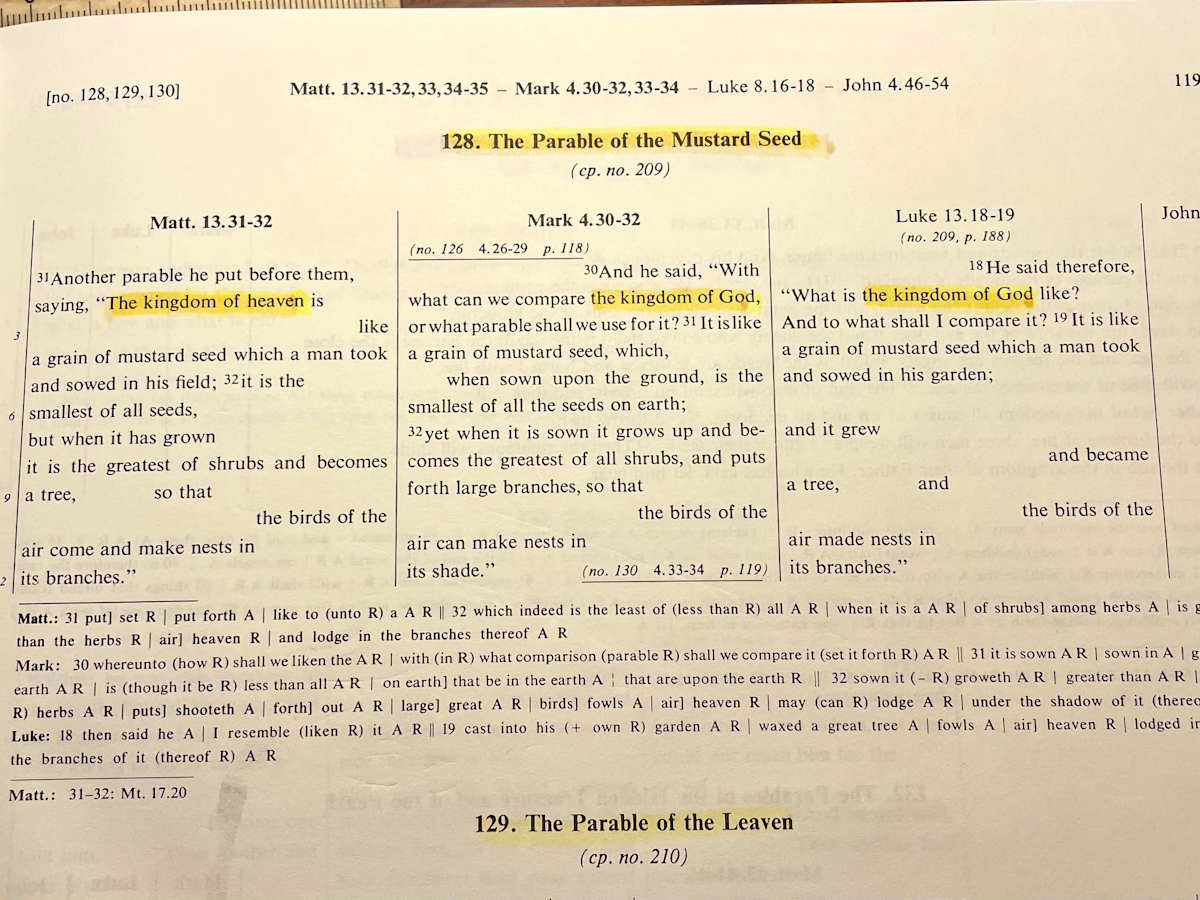
One of the resources that our Bible study used to study the gospels was a book entitled Synopsis of the Four Gospels. This book, edited by Kurt Aland, arranges the four gospels side by side from their prologues to their various endings. The four gospel accounts are subdivided into 367 sections and placed in a sort of chronological order (e.g., nativity, teaching, passion, death, resurrection).
This organization of the gospels allows the reader to readily compare the gospel accounts – to determine which parables are in each of the gospels, to determine how the parables differ, and to see the nuances of the gospel writers.
In the photograph that accompanies this post, I have included a photograph of Aland Section 128, The Parable of the Mustard Seed. If you closely examine this photograph, you can see how that parable (Mt 13:31-32, Mk 4:30-32, and Luke 13:18-19) looks in “parallel.”
In the next three sections of this post, I will list the parables that make up the three categories that Capon established. You can see how as Jesus lived (chronologically), the emphasis of his parables changed from his kingdom – to grace – to judgment.
The format of each parable listed is the same: the parables name (Aland Section) = the relevant verses from the gospels of Mathew, Mark, and Luke. The emboldened verses are the verses that are read on Sundays during the Catholic Church’s three-year liturgical calendar. Note that there are no parables in John’s gospel.
The Parables of the Kingdom
The Sower (122) = Mt 13:1-9, Mk 4:1-9, Lk 8:4-8
The Lamp (125) = Mt 5:15, Mk 4:21-25, Lk 8:16-18
The Seed Growing Secretly (126) = Mk 4:26-29
The Weeds Among the Wheat (127) = Mt 13:24-30
The Mustard Seed (128) = Mt 13:31-32, Mk 4:30-32, Lk 13:18-19
The Yeast (129) = Mt 13:33, Lk 13:20-21
The Hidden Treasure (132) = Mt 13:44
The Pear of Great Price (132) = Mt 13:45-46
The Net (133) = Mt 13:47-50
The Parables of Grace
The Unforgiving Servant (173) = Mt 18:23-35
The Good Samaritan (183) = Lk 10:29-37
The Importunate Friend at Midnight (186) = Lk 11:5-8
The Rich Fool (200) = Lk 12:16-21
The Unknown Hour (203) = Mt 24:43-44, Lk 12:35-40
The Barren Fig Tree (207) = Lk 13:1-9
The Great (Wedding) Feast (216) = Mt 22:1-14, Lk 14:15-24
Of Salt / Simile of Salt (218) = Mt 5:13, Mk 9:49-50, Lk 14:34-35
The Lost Sheep (219) = Mt 18:12-14, Lk 15:1-7
The Lost Coin (220) = Lk 15:8-10
The Prodigal Son (221) = Lk 15:11-32
The Squandering Steward (222) = Lk 16:1-9
The Rich Man and Lazarus (228) = Lk 16:19-31
The Persistent Widow (236) = Lk 18:1-8
The Pharisee and the Tax Collector (237) = Lk 18:9-14
Parables of Judgment
The Laborers in the Vineyard (256) = Mt 20:1-16
The Two Sons (277) = Mt 21:28-32
The Wicked Tenants (278) = Mt 21:33-46, Mk 12:1-12, Lk 20:9-19
The Fig Tree (293) = Mt 24:32-36, Mk 13:28-32, Lk 21:29-33
The Flood (296) = Mt 24:37-42, Lk 17:26-36
The Faithful and Wicked Servants (297) = Mt 24:45-51, Lk 12:41-46
The Ten Virgins (298) = Mt 25:1-13
The Talents / Ten Gold Coins (299) = Mt 25:14-30, Lk 19:11-27
An Illogical Parable?
In the first part of this series I said that some of the parables seem to be a bit illogical to the modern mind (or at least my mind). One of the parables in that category is the Parable of the Laborers in the Vineyard.
In that parable, found only in Mt 20: 1-16, a householder early in the day hires some laborers to work in his vineyard for the wage of one denarius a day. The householder hires more workers throughout the day. At the end of the day, the householder pays the first batch of workers the one denarius promised – and then pays the workers who worked only one, three, six, or nine hours the same one denarius. The workers who had worked the entire day in the scorching heat took exception to the householder’s generosity. They grumbled.
I tend to agree with the workers who were in the field all day. While the householder is righteous (doing what he promised), his actions do not seem to be fair. I struggle with this parable. We live in a culture that likes to be fair. I suspect that Jesus is telling me that his mercy overrides fairness. That, no doubt, is good news for me. Maybe the householder’s wage policy is more equitable than fair?
As I noted above, the full parable can be found only in Mt 20:1-16. The last verse in the parable (the kicker verse) reads, “So the last will be first, and the first last.” Aland notes that this verse aligns with similar verses in Mark (10:31 – “But many that are first will be last, and the last first”) and Luke (13:30 – “And behold, some are last who will be first, and some are first who will be last.” Note how the three “kicker” verses differ in degree (“will” versus “many” versus “some”).
Maybe that is why I am bothered by this parable. I am among the first. Heck, a large majority of Americans are among the first. What does this parable mean in a DEI world? Is this parable illogical? Am I illogical? Am I too logical? Even in the parables on judgment, Jesus writes of his mercy. I continue to struggle with this parable, but not as much as I used to – and I am pleased that Christ’s mercy seems to override fairness.
Who is Christ?
One question you might want to ask yourself as you read the parables is, “Who, if anyone, in the parable is Christ?” That question may impact what you learn from the parables about Jesus.
· Is Christ the women who lost the coin – or the coin that was lost?
· Is Christ the “pearl of great price” – or the merchant who “sells all” to buy the pearl?
· Is Christ the Good Samaritan – or the man beaten and left half-dead?
· Is Christ the father of the prodigal son – or the fattened calf slaughtered for the celebration feast?
Jesus’ invitation to enter his kingdom comes in the form of parables, a characteristic feature of his teaching. … Jesus and the presence of the kingdom in this world are secretly at the heart of the parables" (CCC 546).
I pray that as a people, as a Church, as a Christian community, and as members of God's kingdom we can separate the weeds from the wheat and come to a common understanding of God's kingdom, the grace that he offers us, and the judgment that he speaks of.