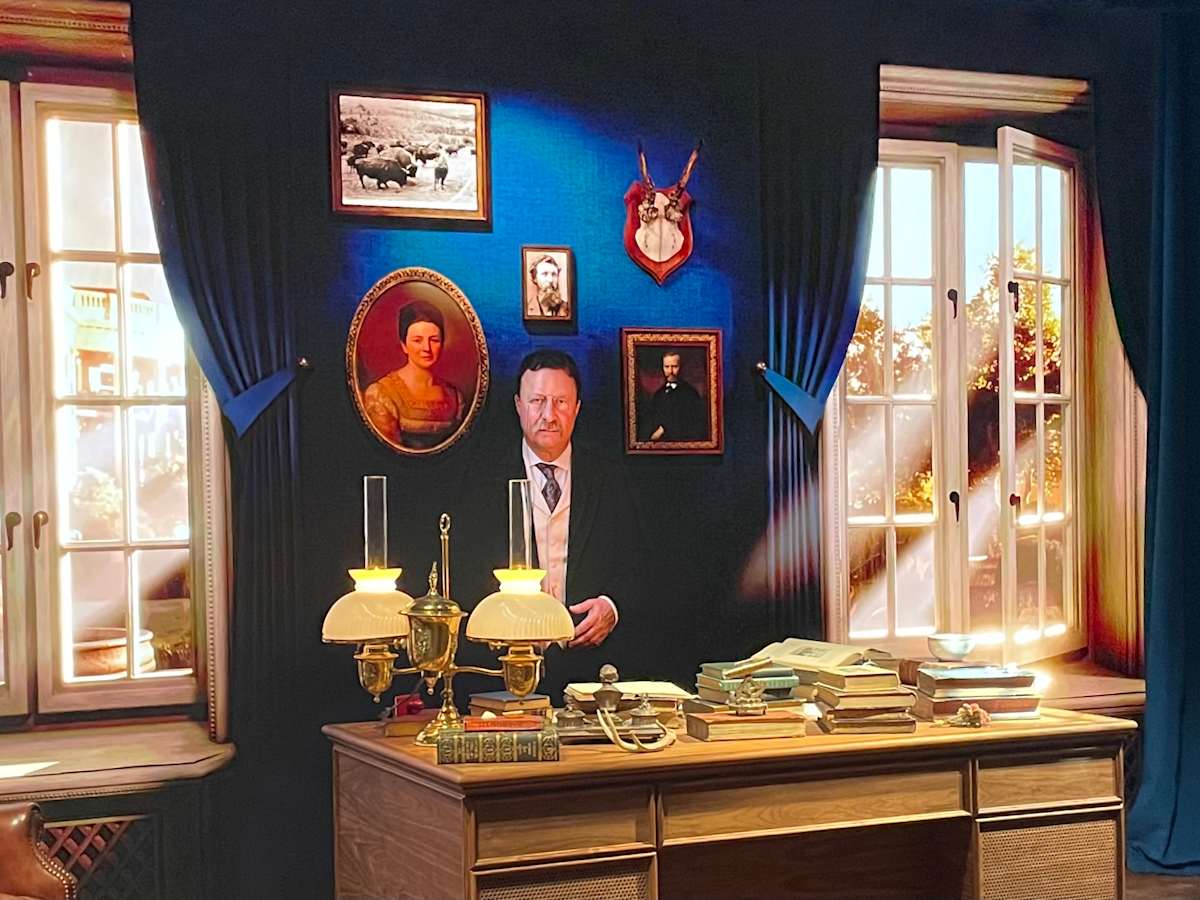
I first heard about the Theodore Roosevelt Presidential Library (TRPL) a year or so ago, when I stumbled upon a post on social media describing the status of the library’s construction in Medora, North Dakota. That post said that the library was scheduled to open on July 4, 2026 (the 250th anniversary of America).
My wife and I had talked about visiting this country’s presidential libraries, and I was looking for ideas as to where to go on our 2026 road trip. I was born and raised in North Dakota; the state is near and dear to my heart. When I later received an invitation to my 60th and “last” Bismarck High School reunion (scheduled for late July 2026) that did it. We would visit the Theodore Roosevelt Presidential Library in 2026.
And once the social media algorithms detected my interest in the TRPL, I was flooded with posts on the construction, the architecture, and the planned exhibits – which piqued my interest even more. Suspecting that tickets might be difficult to secure, I reserved our tickets (Friday, July 31, 10 AM) before the museum even opened.
As the date of the opening approached, the social media posts heated up. The TRPL was being praised for its architecture – how it blended into the North Dakota Badlands. Some videos of the interactive “AI enhanced” exhibits started to be posted. And then came the visit by President Trump and the July 4th opening ceremony (with lots of coverage on CSPAN). Things got wild and my expectations went through the roof.
Sometimes when one’s expectations are through the roof, one is letdown with the actual real-life experience. That was not the case at the TRPL. I loved it. It was the hit of our 2026 road trip. In this post, I will write about the TRPL and my experience there. Hopefully, this post will prompt you to take a visit to Medora and help you make the most of your hours at the Theodore Roosevelt Presidential Library.
Location
The Theodore Roosevelt Presidential Library is in Medora, North Dakota, just south of Interstate-94, 130 miles west of Bismarck (the state capital) and 25 miles east of the Montana/North Dakota state line.
The population of Medora (160 residents in 2024) swells during the summers with seasonal employees and tourists. Many of the tourists come to visit Theodore Roosevelt National Park and/or attend an outdoor performance of the Medora Musical. The population of the town will swell even more in the future because of the new library.
The Theodore Roosevelt Foundation handles most of the touristy activities (e.g., food, housing, entertainment, shopping, tickets) for the area, and some lodging is available in Medora. A new hotel (Hotel 1883) opened recently in Medora, no doubt in part because of the opening of the library.
The nearest city of any size is Dickinson, North Dakota, about 30 miles to the east of Medora. Dickinson, with a population of 25,679 (in 2020) has a goodly number of hotels and eating establishments. It is also home to Dickinson State University (1392 students), which has partnered with the TRPL to gather TR’s documentary records and handle much of the library’s “data” and “artificial intelligence” activities – via the Theodore Roosevelt Center at Dickinson State University (the TRC@DSU). Much of this collected data is now online and free for anyone who wants it.
The Theodore Roosevelt Presidential Library campus in Medora sits high on a butte on the southwest side of the town, adjacent to the Burning Hills Amphitheatre (where the Medora Musical is performed).
The TRPL Campus (Map)
The TRPL campus and the Burning Hills Amphitheatre share some parking. The TRPL’s main parking lot (with some – but not enough – handicap spaces) is just to the east of the walkway that leads to the library’s entrance. A second parking lot is a bit further way. Some of the parking spaces in the second lot are covered (solar panels). If both of those lots are full, move on to the nearby amphitheatre “overflow” parking.
The TRPLs main building has two wings, which share a common rooftop terrace, which is referred to as the “conservation roof.” Quoting Architectural Record, “A sliver of prairie gently buckles upward to shape a low-slung green roof that spans two volumes [wings] and shelters a breezeway between them. From afar, this 96,000-square-foot man-made swell nearly disappears amid nature's vastness.”
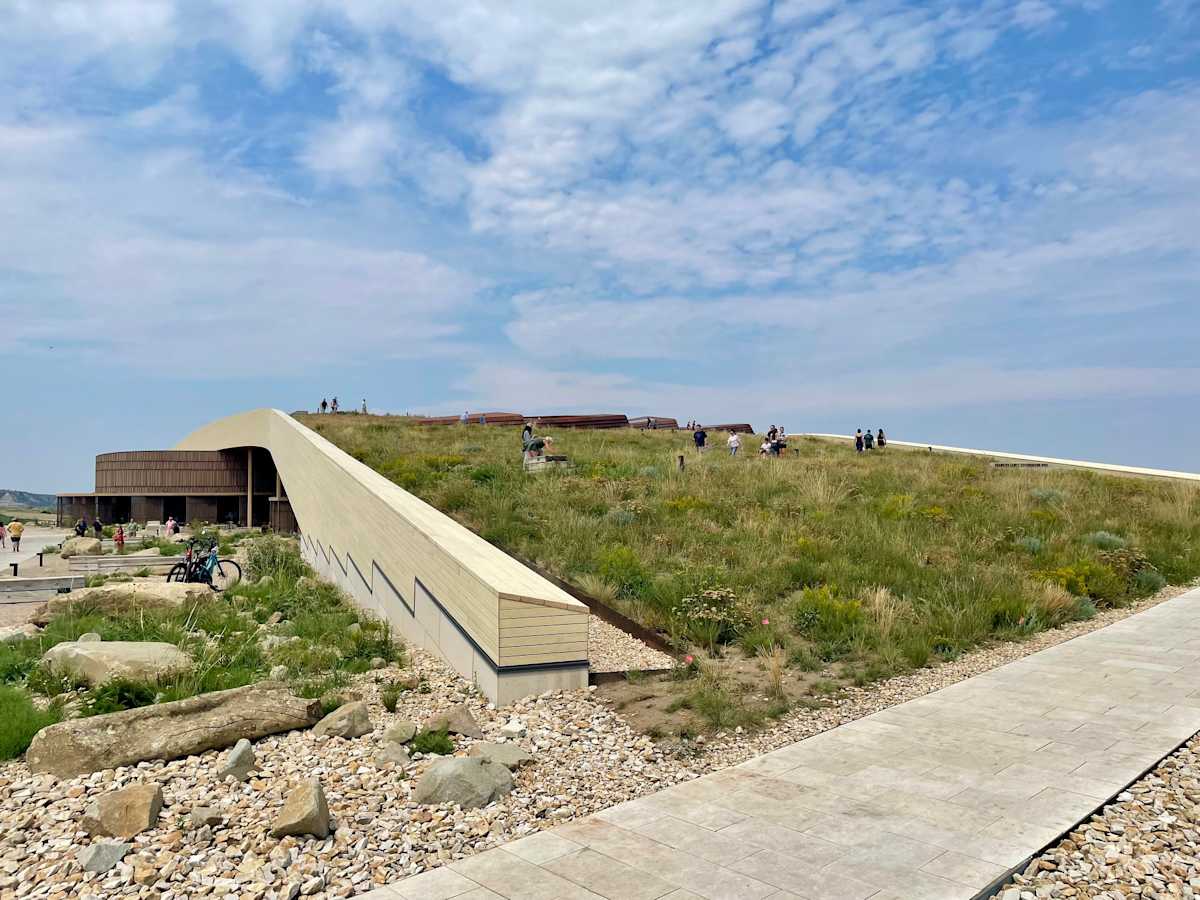
Photo: The “conservation roof” is pictured above from the TRPL’s main parking lot. The entrance to the museum is pictured on the far left. The wide walkway from the parking lot to the entrance is to the extreme left. Note the people walking on the zig-zag path (not visible) that leads to the top. They are walking on top of the buildings east wing – the library’s auditorium and classrooms. Approximately 140,000 native plugs (plants and grasses) were planted on the roof. If you make it to the top, you will enjoy a spectacular 360-degree view of the Badlands. Skylights on the roof allow light to enter the building.
A one-mile boardwalk loops out into the prairie from near the entrance of the two-winged building. Along the boardwalk you will find: a medicinal garden, the “Elkhorn Ranch” picnic area, a sunken boardwalk, an outdoor classroom, an overlook (of the Badlands), and an outdoor amphitheater. The entire boardwalk is visible from the museum entrance.
The Main Building (Map)
Except for sharing the same “breezeway” and “conservation rooftop,” the main building actually seemed like two buildings (to me) – but the TRPL refers to them as wings.
In this post, I will primarily discuss the “public” areas of the building. The TRPL, per the map provided to each guest, has many office and storage areas, the three largest are located on the east side of the east wing (near the parking lot), the west side of the west wing, and the south side of the west wing.
The east wing features a central lobby with a large (300-seat) auditorium to the north. To the south lie two classrooms and restroom facilities. We did not attempt to enter this wing during our visit, nor did we observe any other guests headed that way. Towards the end of our visit, I did note some people (employees) gathered in the lobby, possibly organizing an outside activity that was being set up along the boardwalk.
The west wing contains the library and museum where we spent most of our time. See “The Museum” section of this post below.
The breezeway between the two wings was a nice place to linger. The walkway from the parking lots fed into it, and it was, for all practical purposes, the start of the boardwalk. Via the shade from the conservation roof and the air flowing between the two building wings, it was indeed a breezeway. At the far end (away from the entrance) there were a few (almost always occupied) rocking chairs with a nice view of the terrain. Near the entrance there were some picnic tables.
The Museum
Library or Museum: Per its title, the TRPL is a “library,” but it comes across (at least to me) as more of a museum with galleries with things to look at and experience. I realize that the difference between libraries and museums is blurring BUT you will find me using the term museum frequently beginning now. In any case, I suspect that the TRPL is more of a digital library – via the TRC@DSU mentioned earlier.
The entrance to the museum (i.e., the west wing) opens into a “main lobby” with the “store” (giftshop) to the far right, and lockers (for visitors), restrooms, and the relatively small Salt+Scoria Restaurant to the left. The lobby, shop, and restaurant make up the first public layer (east to west) of the museum.
The lobby is spacious, beautiful, and unique. Rammed-earth walls, 30 feet in height, stretch 240 feet across the lobby. The walls (photo below) were designed to resemble the sedimentary striations of the North Dakota Badlands, with uneven layers of multi-colored “earth-tones” mimicking the dirt, sand, stone, gravel, mud, dust, and scoria that you can view from the conservation rooftop. Workers added some rebar and concrete to these “natural ingredients” and then rammed the mixture into forms (12 inches compressed to 8 inches), four feet at a time, as they worked their way towards the exposed-timber ceilings above.
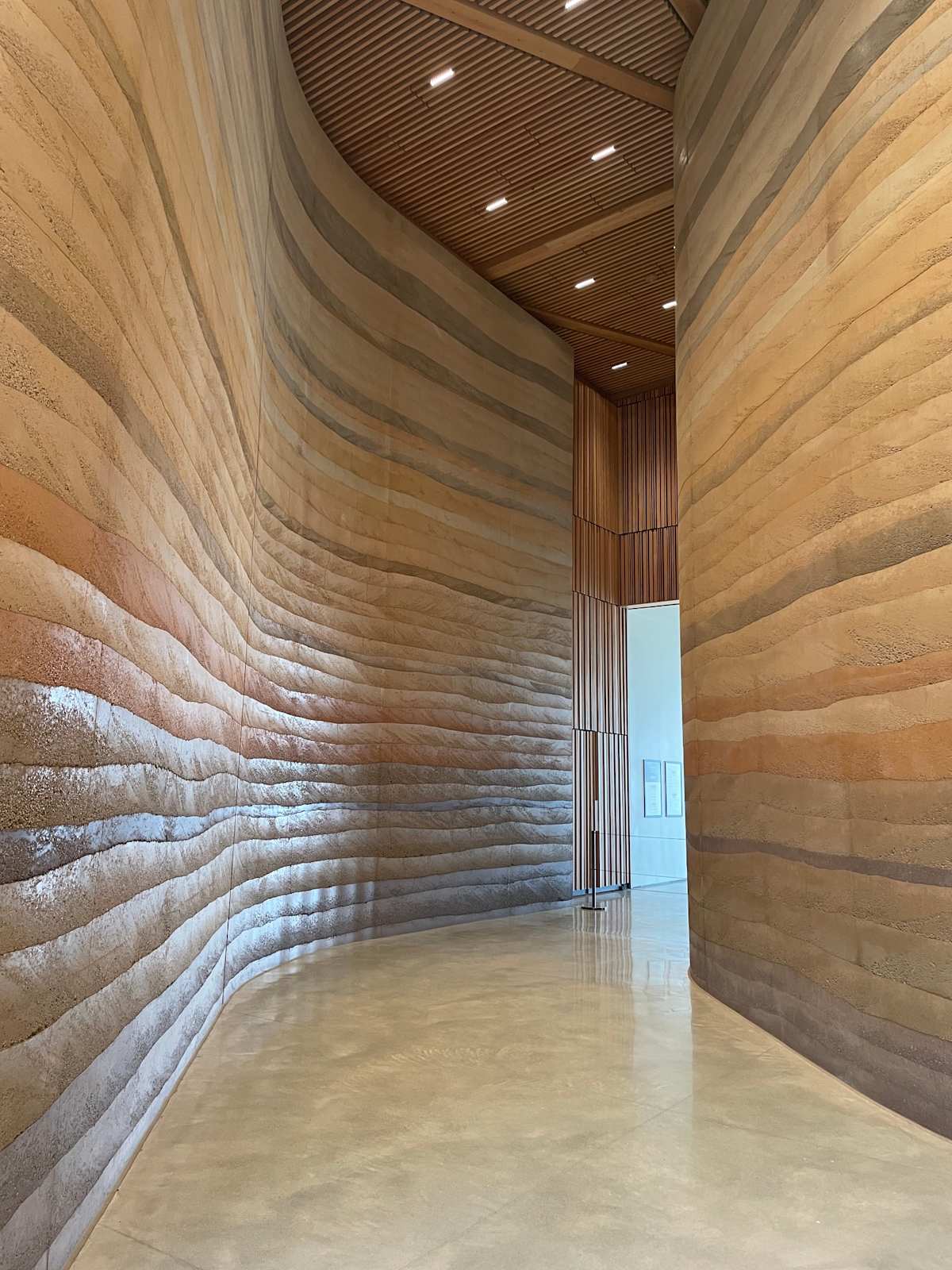
The lobby walls are also historic, in that “earth” walls were the "house" walls built by many of the early North Dakota settlers – who often relied on prairie sod and soils for their first homes. And on a personal note, my best friend’s father used “rammed earth” technology (forms and dirt) to build his home east of Bismarck during the 1960s. It is not a common construction technique, but it does offer some definite advantages (e.g., inexpensive materials that make for great insulation).
The Exhibit & Event Gallery is the second public layer of the museum. Large doors in the center of the west wing’s lobby open into this large rectangular gallery (much wider than deep), which was not open during our visit. Smaller doors to the south and north of this gallery open into the museum’s orientation area and lobby (near the gift shop). This gallery is designed to handle the temporary/traveling exhibits that the TRPL will host in the future.
The Permanent Gallery
The Permanent Gallery (the third and most prominent layer of the west wing) lies to the west of the “Exhibit & Event Gallery” (behind a wall). The TRPL defines the permanent "exhibits" as "Experience Galleries" and "Narrative Galleries:
· “Experience Galleries are the hands-on, immersive stops — a recreated childhood parlor, a rancher's cabin, a campfire on the prairie, the facade of the White House.”
· “Narrative Galleries are the connective tissue between chapters. They're quieter, reflective spaces that carry the throughline of Roosevelt's story.”
The Experience Galleries are visually rich and steeped in artificial intelligence. The Narrative Galleries consist of more traditional museum displays – things on shelves to look at and read.
Chapters, Clusters, and Galleries
Since I had not done my homework, I stumbled my way through the exhibit galleries, not quite sure where I was going next (and not taking the time to read the map that was given to me when I entered). Luckily for me, the museum has a nice flow that pretty much routes you chronologically through the various “chapters” of Roosevelts life.
The TRPL, in their literature and on their website, refers to eight chapters in Roosevelt’s life. For example, “The Library tells Theodore Roosevelt's story the way he lived it — in order, from a boy at a bedroom window to a former president on the world stage. Eight chapters carry you from the brownstones of New York, out to the buttes of the Dakota Badlands, into the White House, and beyond.”
In the rest of this section, I will write about individual galleries and “clusters” of galleries, that are (for the most part) chronologically positioned in the permanent exhibit. Some of my terminology will differ from that used on the TRPL’s website.
Cluster: A cluster (my term) is a group of galleries that – via their entrances, exits, and arrows on the map – are meant to be viewed together and in sequence. These galleries sometimes have a common theme (e.g., family, politics, military). The cluster letter (A-G) are also mine.
A Football Field Analogy
After some reflection, I began to think of the permanent exhibit (its orientation and flow) as a football field.
· The permanent exhibit space (at 30,000 square-feet) was almost as long as an American football field (between the goal lines).
· The entrance to the permanent gallery was located on the near side of the southwest endzone (the near endzone).
· The permanent exhibits flowed from the near side of the field to the far side (and back) – while generally moving towards the northeast endzone (the far endzone) – from Gallery 1 to Gallery 27 – from TR’s birth to his death (and legacy).
· The TRPL’s “Narrative Galleries” (per the map I was given and my mind) were actually ONE long “Narrative Gallery” (with many displays) that ran the entire length of the museum between the hash marks (down the center of my imaginary football field from endzone to endzone). See the "note" below.
· The “Experience Galleries” (Exhibit Galleries 1-27) are located between the right and left hash marks and the corresponding right and left sidelines.
· You entered and exited the Experience Galleries from the Narrative Gallery, much like a running back might run to the right or left after being handed the ball between the hashmarks.
Most of the “Experience Galleries” are clustered (see below). Others can be entered and exited directly individually from the Narrative Gallery. Two of the Experience Galleries are open to (i.e., part of) the Narrative Gallery.
Note: The TRPL has recently updated their online map of the galleries. The map that I had received just showed a single "Narrative Galleries" section (between my hashmarks). The new map now breaks that one area into four "narrative" sections: A (Young Adulthood), B (Political Education), C (Modern Presidency) and D (Final Years). For all practical purposes, it is still one long open area - one "Narrative Gallery."
The “Trailblazer Compass”
As you enter the museum from the lobby, you are given (optional, but highly recommended) something called the Trailblazer Compass.
The Trailblaze Compass appears to be a simple wooden token with a compass printed on it (i.e., the letters N, E, S, and W printed on the four corners of a circular grid – with twelve other lines to indicate intermediate directions, such as NNE, NE, and ENE). The wooden token is attached, through a couple of slots, to an adjustable cloth wristband. That simple looking wooden token apparently contains the “electronics” that links the bracelet to the various interactive exhibits (and associated artificial intelligence) located in the museum.
After receiving your “Trailblazer Compass” you head over to one of ten or so terminals that link your compass to your face (via a photograph which is taken) and to other information about you (e.g., your email address).
You can then proceed directly into the permanent gallery, ready to search for hidden animals, design your own cattle brand, design your own campaign poster, have a conversation with TR, or have your picture incorporated into a variety of situations via the “photo stations” that are sprinkled throughout the exhibits.
The Exhibit Galleries
Note: I am tempted to provide details on the various exhibit galleries – but I won’t. I will simply note the gallery numbers and titles, with a little information on how they are clustered and how they flow together. For very good descriptions of the various exhibits, go to the TRPL website using this link. Via the gallery titles (in most cases) you will be able to read about each of the galleries and what they contain. This link also provides you with information on the eight "chapters" of Roosevelt's life.
Cluster A, Galleries 1-3: After leaving the “Orientation” area (and getting your Trailblazer Compass) you will move into Galleries 1 (A Call to Adventure), 2 (Roosevelt Family Parlor), and 3 (Roosevelt Museum of Natural History). Per my football field analogy, these three galleries are located between the near goal line and the 15-yard line on the near side of the field. When you exit Gallery 3, you will be entering the central “Narrative Gallery” (between the hash marks) for the first time. The nearby narrative displays concern Roosevelt's "Young Adulthood."
Cluster B, Galleries 4-8: When you are finished with the nearby narrative “displays,” proceed on to the left side of the field to Galleries 4 (Memory Train), 5 (Loss), 6 (Elk Horn Ranch), 7 (Storytelling Campfire), and 8 (Ranch Activities). Per my football field analogy, these five galleries are located between the near goal line and the 50-yard line on the far side of the field. When you leave Gallery 8, you will be once again returning to the central Narrative Gallery (between the hash marks). The exit from the "Memory Train" to "Loss" is a bit confusing. It is at the far end of the railroad coach (on the right). I noticed that a few visitors missed it at first (returning to the Narrative Gallery instead of continuing on).
Cluster C, Galleries 9-12: When you are finished with the nearby narrative “displays,” proceed back to the near side of the field to Galleries 9 (Assembling the Rough Riders), 10 (Pre-Battle Camp), 11 (Battle of San Juan Heights) and 12 (Post-Battle Outcomes). Per my football field analogy, these four galleries are located between the 15- and 50-yard lines on the near side of the field. Exception: When you leave this cluster of galleries, you will not reenter the central Narrative Gallery. Instead, you will enter Cluster D directly (as described below).
Cluster D, Galleries 13-15: In this cluster you will find Galleries 13 (Path to the Presidency), 14 (Vice Presidency), and 15 (White House Façade). Per my football field analogy, you are still on the near side of the field between the 50- and 20-yard lines, approaching the far endzone. When you exit Gallery 15, you will be returning to the central Narrative Gallery on about the 50-yard line.
Galleries 16-17: Something strange happens here. The hash marks on the field have temporarily moved closer to the sidelines – and the central Narrative Gallery has thus widened. Gallery Exhibits 16 (Conversation Bronze) and 17 (Roosevelt’s White House) are now seemingly part of the Narrative Gallery, filling in the extra space created by the expanding hash marks.
Gallery 18 (Talk with TR) is one of two galleries (not a part of a cluster) that can be directly accessed from the Narrative Gallery. The entrance, on the far side of the field, is located at about the 35-yard line (approaching the far endzone). In this case, the entrance to the gallery is also the exit. Note: The one set of restrooms, within the permanent gallery, is just south of Gallery 18.
Cluster E, Galleries 19 & 20: In this paired cluster you will find Gallery 19 (White House Gang) and 20 (Roosevelt Family Room). Per my football field analogy, these two galleries are on the far side of the field, along the sidelines, between the 50- and 20-yard lines (far endzone). When you exit Gallery 20, you will be back in the central Narrative Gallery and very near the entrance to Cluster F (below).
Cluster F, Galleries 21-23: Cluster F contains Galleries 21 (East Africa), 22 (In The Arena), and 23 (Bull Moose Campaign). Per my football field analogy, these three galleries are on the far side of the field, along the sidelines, between the 20-yard line and the far goal line. When you exit Gallery 23, you will be back in the central Narrative Gallery.
Gallery 24 (The Amazon) is the other gallery which is directly accessible from the Narrative Gallery. This gallery contains a very cool 13-minute film about TR’s trip down an Amazon River tributary after he left the presidency. DON’T MISS IT! Since it is on the near side of the field on the far goal line, it is easy to overlook. DON’T. Since the doors are often closed during the 13-minute film, it is easy to skip. DON’T!
Cluster G: This cluster, the last, contains Galleries 25 (Sagamore Hill), 26 (January 6, 1919), and 27 (Legacy). January 6, 1919, is the date that TR died. Gallery 27 exits the museum (the field) into what is called Gallery 28 (The People’s Library).
I hope that the above information on clusters and galleries will help you navigate the museum someday. The gallery titles reflect the chronological life of TR and the layout of the museum. Just remember that most (but not all) of the galleries and gallery clusters can be entered from the central Narrative Gallery that runs SW to NE through the museum. The layout is meant to flow chronologically but you can seek out specific Experience Galleries (e.g., Talk with TR) at any time from the central Narrative Gallery.
My Question to TR (Gallery 18)
“What if you could ask Theodore Roosevelt anything — and hear him answer, in his own words? Now you can. At the podium in this gallery, you come face to face with a life-size, conversational Theodore Roosevelt. Step up, ask your question out loud, and the president responds directly to you — his answers drawn from the vast record of what Roosevelt actually wrote and said across his lifetime.”
The previous statement is a quote from the TRPL website, as are the two paragraphs below.
“At the heart of the library’s digital strategy is Box 1, a knowledge base powered by Microsoft AI technology. Archivists have uploaded hundreds of thousands of Roosevelt’s archival documents — letters, speeches, writings, and images — from 32 separate collections across 18 institutions.”
“Behind the experience is a partnership between the Library, Microsoft's AI for Good Lab, and the AI studio LemonSlice. The system was trained on Roosevelt's own writings, speeches, and papers, and built with safeguards designed to keep its answers rooted in the historical record rather than a modern interpretation. It's clearly presented as an AI experience — a glimpse of tomorrow's tools in service of a century-old story.”
During our visit, we had initially missed this gallery, moving directly from Gallery 15 to Gallery 19. I had previously seen social media posts on the “Talk with TR” gallery, and I had seen a video of Trump asking a question to TR, so before we left the museum, I searched for TR and found him.
When I entered the gallery, I marveled at the life-size, conversational AI avatar of Theodore Roosevelt (as pictured at the start of this post). In addition to being life-sized, the avatar looked very life-like. He was standing behind his White House desk. I noticed a picture of a buffalo behind him and a picture of a bucking horse (with rider) on the wall to his left. Thus, I thought my question (below) to be acceptable and appropriate.
The library’s website, noted that, the avatar “can answer questions about Roosevelt’s life, leadership, and legacy in his own words, with natural vocal intonation, body language, and mannerisms. The experience is designed to feel like a real conversation, not a pre-recorded clip, and is rated PG for all ages.”
Shortly thereafter TR (the avatar) solicited questions, so I stepped up to the podium and asked the following question.
My question: “When did you think of Wild Bill Cody?”
An explanation of the question: I botched the question. I meant to ask “What did you think about Wild Bill Cody? I was somewhat flustered by the question-asking process (e.g., a button had to be pushed before you spoke). The above question was actually my third attempt – the first to get through to TR. I was also bugged by the noticeable delay between the questions and TR’s answers. My question was doomed from the start.
I had asked about Wild Bill Cody because I had recently read a book about him called Wild Bill Cody and the Mormons (as noted in my recent July 26 and August 2 blog posts). From reading that book, I knew that TR and Buffalo Bill were contemporaries, both had hunted buffalos, and that Cody had once written TR a letter asking for a political favor. I also knew that history was unclear as to whether they had ever met. I did not know whether AI was aware of Cody’s letter to TR.
TR stalls: About eight seconds went by with “private thoughts,” “… ah hmmm” and “hmmm” being muttered by the avatar before I received the following answer (which my wife recorded, thus a transcript).
TR's answer: “I couldn’t place particulars of my opinions on Wild Bill Cody. I am only thankful that he is solid in my memory. He was a figure of myth in the frontier, and his Wild West Show shaped how many Americans saw the West. For details I have given my views (unintelligible words).”
My analysis: The response was not very impressive – but then again, neither was my misspoken question. Wild Bill Cody did indeed shape “how many Americans saw the West.” And there are some questions about what Will Bill Cody did or did not do. There are even some questions concerning whether some of the stories in Cody’s autobiography were myths (i.e., lies). But Wild Bill Cody was not a “figure of myth in the frontier.” Cody was a real person who sent Roosevelt a real letter.
My Grade: Given all the above, including my botched question and the lag in the system while AI created an answer, I would give the exhibit a “D” (because of the avatar’s “figure of myth” misstatement). I was also not impressed by the long lag time and unintelligible words. Still a little work to do here.
My Personal Journal
Shortly after I left the library, I received an email from the library that, in addition to thanking me for my visit, listed eight links “from the journal of Bob Burdett” (as collected by the Trailblazer Compass that I was wearing).
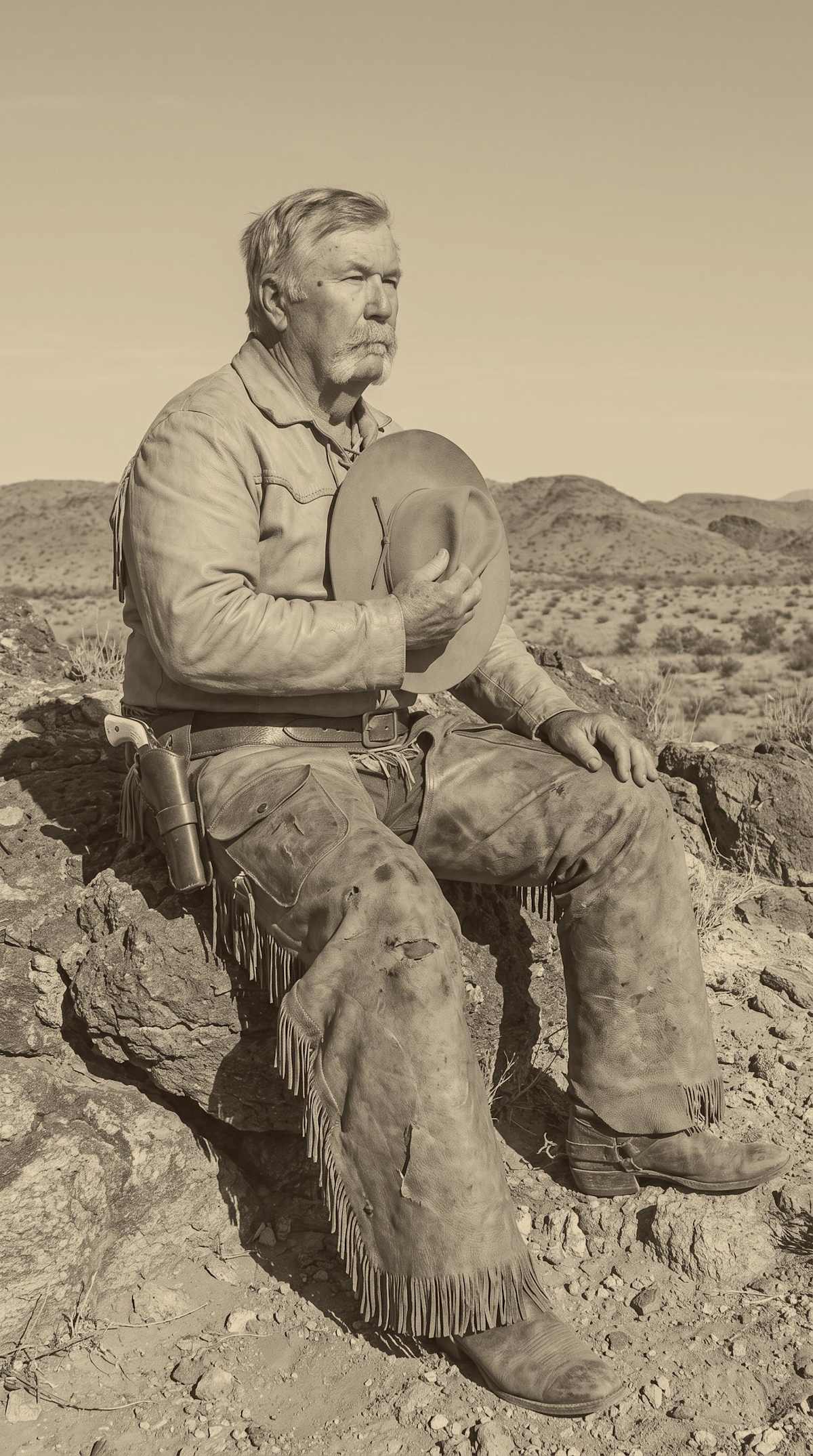
Seven of the links were to photos that were AI-generated at the seven photo stations that I had visited in the museum. One of those photos (below) labeled “Ranching in the Badlands,” pictured me sitting in the Badlands, in cowboy garb, holding my hat over my heart. Other photos (links) were to me “serving in the Navy” (like TR), “joining the Rough Riders” (like TR), and Journeying into the Amazon (like TR).
The email also had a link to a poster that I created for my presidential campaign, which said to “Vote for Bob,” listed my campaign themes (“Reform, Prosperity, and Integrity”), and listed my pledge to “Cut Red Tape, Serve People”). I (my face) was pictured on my poster wearing a suit and holding my top hat high. The poster looked very professional.
My wife and sister got similar emails documenting what they did at the museum. My wife had a link to a campaign video that she had recorded from the back of a railroad car.
The emails (personal journals) were a nice touch. They provided tangible evidence of our experience at the Theodore Roosevelt Presidential Library.
Likes and Dislikes
I loved the museum. We spent about four hours there and could easily have spent a few more (e.g., viewing the narrative displays and walking the one-mile boardwalk). If you have a late/afternoon time slot, you may want to get there early and do the conservation rooftop and boardwalk before entering the museum.
I loved the architecture, the way that the library blended into the Badlands, the earth-toned rammed-earth walls in the lobby, the breeze blowing through the breezeway, the views from the conservation rooftop, and the layout of the galleries.
I loved the “Trailblazer Compass” technology and how it allowed me to interact with the various “experience” activities and "photo stations" located throughout the museum.
I liked the way that the museum told TR’s story: using the Memory Train and Loss Galleries to tell about the deaths of Roosevelt’s first wife and his mother, “on the same day in the same house.” I also liked the way that the museum used the “conservation film” to tell how Theodore changed from a buffalo hunter to one of the nation’s first environmentalists.
And I learned some things, mostly regarding his third-party “Bull Moose Campaign” for the presidency (when he got shot during an assassination attempt) and his subsequent adventure in the Amazon. The Amazon was my favorite gallery. I could feel the mist from the waterfalls (in my mind).
My only dislike involved the lack of, and visibility of “handicap parking.” I spoke to one of the museum’s staff and they acknowledged the problem. They were already thinking about changes and improvements.
I recently received an email saying that I was one of the first 50,000 people to visit the new library. I Highly encourage you to put the Theodore Roosevelt Presidential Library on your “must see” list. Book your slot early (and preferably early in the day) as they do run out of time slots, especially on busy summer weekends.