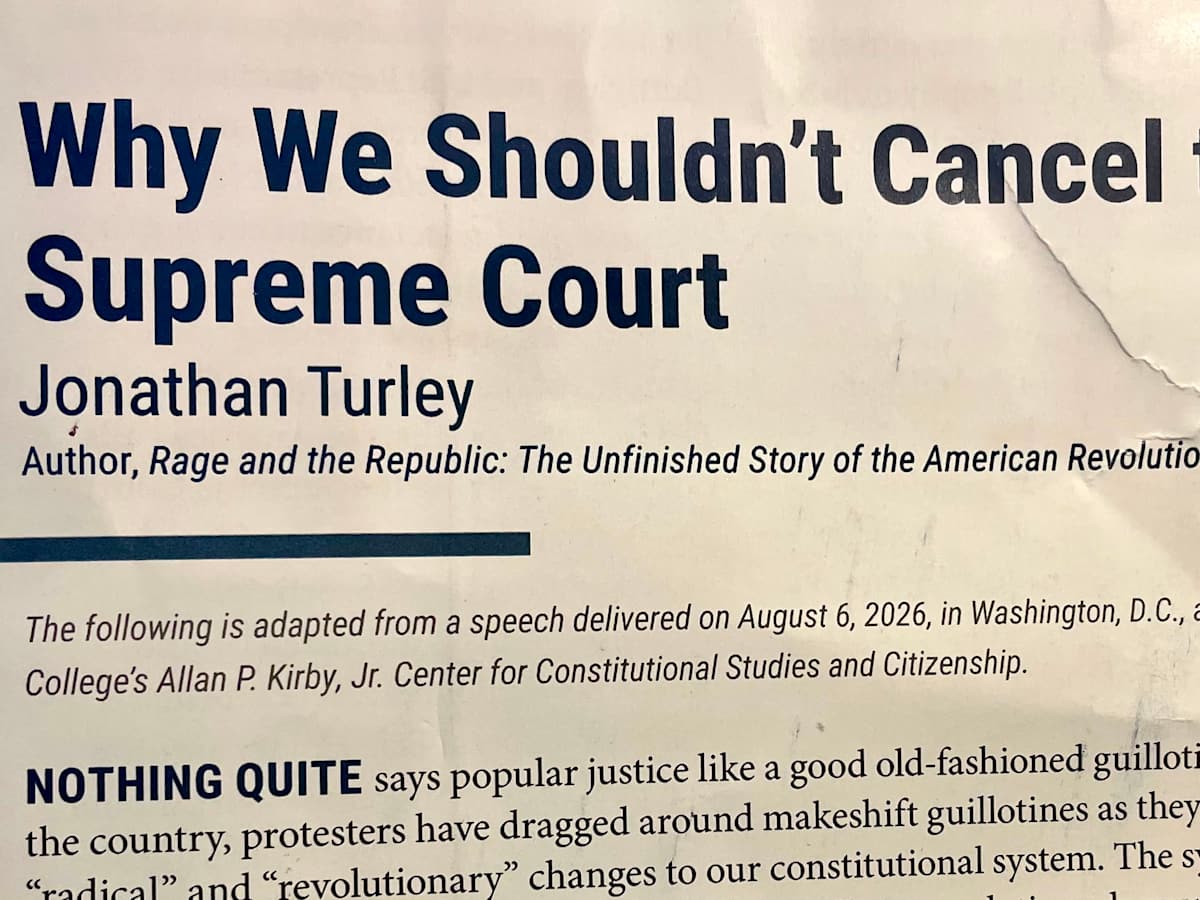
The title of this post is a quote from an article recently written by Jonathan Turley, entitled “Why We Shouldn’t Cancel the Supreme Court.”
Note: Jonathan Turley is a professor at Georgetown Washington University Law School. He has written for several publications, including The New York Times, USA Today, and The Wall Street Journal. He is also the author of two books concerning “rage:” The Indispensable Right: Free Speech in an Age of Rage and Rage and the Republic: The Unfinished Story of the American Revolution. The article, published in the September 2026 edition of Imprimis, was adapted from a speech he delivered on August 6, 2026, in Washington, D.C., at Hillsdale College’s Allan P. Kirby, Jr. Center for Constitutional Studies and Citizenship.
Note: Unless otherwise noted, the quotes that follow are from Turley’s article.
Turley’s article came in the mail while I was reading Who Killed the American Dream? – a book by Thom Hartmann concerning the Supreme Court’s 1886 “decision” in the case of Santa Clara County v. Southern Pacific Railroad, which “ruled” that corporations are “persons” under the Fourteenth Amendment (as reviewed in my previous post).
Hartmann (America’s #1 progressive talk show host), in his book, touched upon the topics of revolution and Supreme Court “packing.” Turley’s article in the mail came at a good time. It provided some perspective on what progressives, Democrats, Progressive Democrats, or whatever you want to call them are trying to accomplish TODAY (as in the upcoming November election).
Eliminate the Supreme Court?
Per Turley: “There is a radical movement rising in the U.S. with chilling parallels to the French Revolution. Demands for the elimination or packing of the Supreme Court and other measures are ripped from the French revolutionary handbook. Most worrisome … offering the Supreme Court up to this movement has become a litmus test for Democratic presidential candidates.”
In his article, Turley goes on to note how the likes of Kamala Harris, Pete Buttigieg, Ro Khanna, Gavin Newsom, Eric Holder, Elizabeth Warren, and the Democratic Socialists of America have embraced this cause. The platform of the latter “calls both for dissolving the Supreme Court and for creating a unicameral legislature by eliminating the U.S. Senate.” I would add Thom Hartmann to Turley’s list of those who want to cancel the Supreme Court.
Turley notes that the way of thinking noted above, “runs completely counter to our nation’s founding principles. A non-partisan, independent judiciary serves two essential purposes: it plays a vital role in preserving the separation of powers, which prevents all government power from being concentrated in one place, and it stands as a bulwark in defense of minority rights against a majority faction.”
In his article, Turley noted that our early courts, after the nation was founded, were “openly biased,” but as university-based law schools were created (beginning with William & Mary in 1779), that partisanship “came to be tempered by professional standards …”. “Even today … what critics call partisanship is actually deep and good-faith jurisprudential differences on both ends of the court.”
Turley backed the above statement by noting that “44 percent of cases that come before the Supreme Court are decided unanimously.” Turley seems to be more forgiving of the justices and their “deep and good-faith jurisprudential differences” – than Hartmann. Hartmann, in his book, called those he disagreed with “corrupt.”
I found it interesting that in his article, Turley noted that: “And sometimes, as history shows, the Court can get things wrong.” I believe that Hartmann, in his book, gave us an example of such a mistake. Our country, via its Constitution and three branches of government, seems to be able to peacefully work through such mistakes.
Revolution
Turley began his article by noting that: “Across the country, protesters have dragged around makeshift guillotines as they call for ‘radical’ and ‘revolutionary’ changes to our constitution. The symbol of the French Revolution remains a chilling reminder of how revolutions devour their own.”
Note below the major difference between the “guiding light” of the American Revolution 250 years ago and the “guiding light” of the French Revolution that followed (1789-1799). “Both revolutions were based on Enlightenment ideas.”
“But America’s revolution was closely tied to the political philosophy of John Locke, who held that our rights come not from the government, but from God. The institutional arrangements of the Constitution, including the independent court system, were designed to protect these God-given individual rights” (my bold).
“Conversely, the French Revolution was inspired in the end not by Lockean principles but by the political philosophy of Jean-Jacques Rosseau, which extolled the ‘general will’ of the people and opposed institutions (including courts) that interfered with that will” (my bold).
That is the key problem today. As we, as a society, reject God, and turn ourselves into gods, “we the people” are changing our political philosophy from Locke to Rosseau; and I fear that the outcome will not be pretty in the end.
A Time of Rage
Turley concludes his article by noting that America was born in rage. “It was rage that fueled the Boston Tea Party.” Per Hartmann (as noted in my previous post) that rage wasn’t about “taxation without representation;” it was about “tax breaks for giant corporations without representation.” Today’s rage is no doubt fueled in part by economic disparities within our culture – between corporations and individuals, between the very rich and everybody else, and between the young and the old.
Turley notes that in these times of rage, “we must stand as a people to prevent extremists of any ideological bent from politicizing or destroying our constitutional judicial system.”
Turley ends his article with two observations:
· “The history of canceling courts is a history replete with unhappy endings. Courts are by necessity one of the first targets of revolutionaries.”
· “In revolution after revolution, newly-established courts carried out the purported will of the people with terrible consequences. In an age of rage, it is too often reason itself that is canceled.”
Warning
Our next national election is just a couple of weeks away. Try to control your rage and apply reason to your vote. Try to convince your fellow Americans to do the same.
Beware of the terminology being used by the candidates. Note that, in many cases, attacks on things like “corporate capitalism” and “oligarch capitalism” are also attacks on the economic system that has been good for this country for 250 years.
And beware of any Democrat congressional candidates who say they will work with Republicans; they won’t (on any issues of significance). Their leadership and the progressive wing of their party will not permit that to happen. The last six years have established that fact.
I can imagine how you might guillotine a supreme court justice or an oligarch – but how do you guillotine a corporation? – how do you guillotine America?