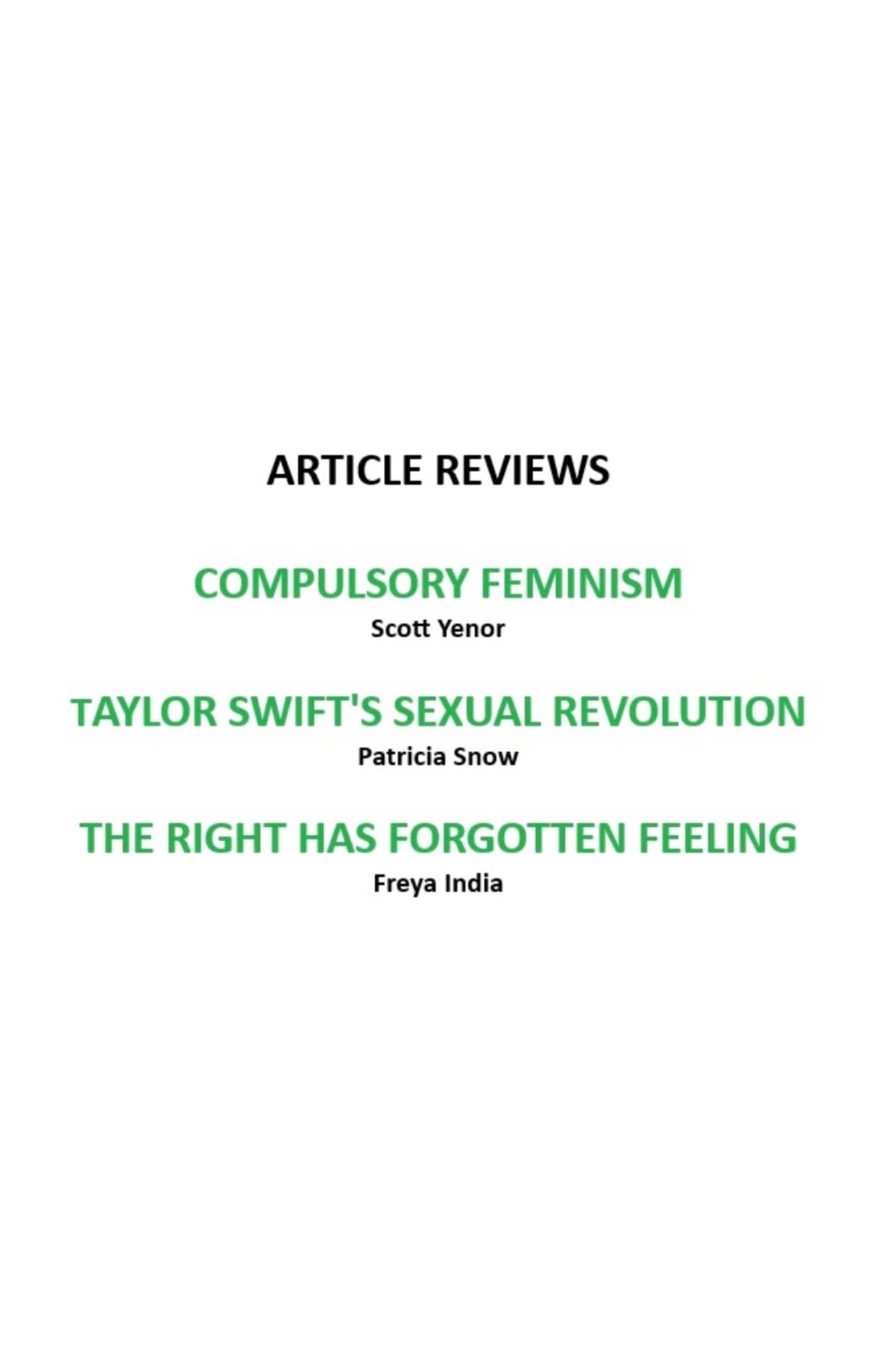
As I noted in one of my recent articles, I read magazines with a pen or pencil in hand, underlining or otherwise marking the things that interest me, and then ripping out and saving the articles that are heavily marked up.
Over the last year or so, I ripped out and saved three articles from First Things that were focused on the mental and emotional health of young women, especially self-described liberal women. I suspect that I was interested in these articles, in part, because I am the grandfather of a young woman (and a young grandson). I am interested in how they think politically; what trips their triggers and why.
A Pew Research study from 2020 reported that, more than half of self-described young white liberal women (56.3% of those between 18-29) say they’ve been diagnosed with a mental health condition. This percentage was roughly twice as high as the percentage reported by conservative women in the same age group. Why the disconnect, and how does the term conservative, as used above, equate with the term religious?
In this article, I will start by reviewing the three articles in the order that I read them. Then I will attempt to bring their main points together and suggest what might be done to improve the emotional and spiritual health of young women.
Note: Fairly lengthy sections of the articles below can be viewed on the First Things website. Complete articles can also be purchased via that website (Store/Back Issue).
Compulsory Feminism
This article, by Scott Yenor, was published in the March 2024 issue of First Things.
Scott Yenor is a man, unlike the authors of the next two articles. When the article was written he was a professor of political science at Boise State University. He has recently been hired by the Heritage Foundation to direct its Center for American Studies.
Yenor begins his article by noting that shortly after America was founded, a French diplomat, political philosopher, and historian named Alexis de Tocqueville noted that “the American ‘spirit of freedom’ was balanced by settled norms that guided young men and women toward domestic life. [and that] These norms added up to a sexual constitution that rested on the foundational assumption that men and women had different and complementary roles.”
Yenor goes on to note that, for the last two generations America has been “undergoing a far-reaching transformation of the male-female dance. … Put simply: Civil rights law and related court decisions have criminalized the old sexual constitution. [and that] Our society was transformed because feminist ideas became compulsory, backed up by the threat of legal punishment for those who continued to act as if men and women were different.”
That is the gist of Yenor’s argument – that it wasn’t Gloria Steinem and Hugh Hefner that changed our sexual constitution, but the laws and court rulings that came later, and the corporate Human Resource departments that were created to define the new workplace – where men and women are the same. In his article, Scott spends considerable ink describing the various acts, titles, and court decisions that got us where we are today.
So where are we today? Per Yenor, “We have replaced the old “stereotypes” with new, confused ones. Men are thought to be scum. Independent women are taught to have interests that are difficult to reconcile with men and marriage. Education and careers come first. … Marriage is delayed. Childbearing is deferred.”
As regards young women, Yenor notes:
- “The anti-discrimination sexual constitution encourages women to ‘see’ bias, misogyny, and patriarchy lurking everywhere.”
- “Merely suggesting that girls might consider becoming mothers and wives someday will be greeted with howls. Women are encouraged to celebrate their divorces and abortions.”
- For the first time, young women are attending churches in fewer numbers than young men.
- The mental health among women under thirty-five is declining, affecting young liberal women most deeply.
- “As women become sensitive to the experience of discrimination, they vote for left-wing parties that advocate ever greater expansion of civil rights. … Women, and especially young single women, are the backbone of left-wing political parties in the modern world.”
Yenor further notes that, compounding the above, there is a decline in marriageable men, that men are weaker and lazier than they used to be, and “fewer men and women are as lovable as they were in preceding generations.”
Yenor suggests, as a start, that statesmen (government leaders and business owners) support the maternal instincts of young women and champion motherhood as a salutary aspiration (starting with more flexible work arrangements).
Taylor Swift’s Sexual Revolution
This article, by Patricia Snow, was published in the November 2024 issue of First Things.
Early in her article, Snow noted that: “Women’s liberation and the sexual revolution came to prominence together and were intimately connected from the outset, fueled by access to the birth-control pill … [and] If your average sexually active 1970s coed was uneasy about anything, it was … what her parents would say if they knew what she was doing … until the parents, not wanting to be left out, embarked on their own experimenting, transgressing, and divorcing.”
Snow then described the societal consensus that developed back then concerning what constituted acceptable fraternization (from casual hookups to premarital sex) – for all parties, men and women, including those young women just yearning for acceptance and intimacy.
Snow concludes her introduction by noting: “The conflation of women’s liberation with sexual promiscuity … has been insulated against objections by a female temptation to conform, by a woman’s readiness to surrender herself, which, absent an awareness of the God to whom her allegiance is supremely owed, can end in her exaggerated capitulation to men. … If the new regime isn’t working for young women, their default position is to blame themselves. If the prevailing ideology can’t be criticized, then it is best to keep one’s suffering to oneself.”
Enter Taylor Swift, who was born in 1989. Patricia noted that by the time that Taylor was old enough to date, “the more sex and better sex” lie was embedded in the culture. But, Swift, “when she suffered the predictable consequences, she didn’t blame herself or suffer in silence. She didn’t pretend to be okay but went public with her humiliations, mapping the dark side of the female experience ….”
Snow then discusses the lyrics of the songs that Swift has written concluding: “This, in a nutshell, is the dynamic driving Swift’s Eras Tour: consensus-seeking young womanhood coalescing around another young woman’s truth-telling.”
Snow concludes her article with some of her views involving young women, morality, and religion:
- … “it is to women more than men that the sphere of religion has been entrusted.”
- “Too many young women are being raised in a cult that we might call Christianity without Christ, a perilous contradiction in terms. For Swift and her friends, the cross is still there, but Christ is not on it, which means that the suffering and the self-offering are theirs alone.”
- “In a world without God, women haven’t ceased to be zealous for right and wrong. They are still trying to adjudicate morality, but in frustrated, often self-contradictory ways.”
Snow concludes: “Whatever happens to Swift going forward – whether she marries Travis Kelce or finds herself on the heartbreak treadmill again – she has moved the needle for young women … [but] I can’t help but wonder just how momentous the effects could be, if all that impassioned female solidarity – all that zeal for truth-telling and stubborn refusal to give up on love – were mobilized in the service of an unambiguously righteous cause.”
The Right Has Forgotten Feeling
This article, by Freya India, was published in the May 2025 issue of First Things.
It turned out to be my favorite of the three articles reviewed herein. It had a different “voice” than I was used to reading. India was not looking at the issue from the outside or as an academic; she was a young woman in the moment.
India noted that she had recently stumbled into a world that she had never known – the world of Christianity, unlike the world that she grew up in – “a place where Christianity – and conservatism – were seen as not only backward and archaic, but cringeworthy, embarrassing, belonging to another world.”
India further discussed the world in which she had lived and her place in that world; “I was sensitive and sentimental, as many young girls are, and had this idea of love, of life, that kept getting broken and beaten out of me. My family fell apart and so did I. Dating was disorienting and inhumane; … I wanted vows and commitments. I wanted guidance and guardrails. … I thought the problem was me. I’m not sure anymore. … Girls and young women are hurting.”
India went on to note that she had been drawn to Christianity, “not through reason or intellect, but through feeling … not just emotion but intuition.” She further observed that, “Most young women I know think of Christianity as controlling and patriarchal, if they think of it at all. They see conservatism as outdated and oppressive. … Many are moving far to the political left, much more so than previous generations of women. I think I know why. The right has forgotten feeling.” She later added that young women today, “look to the left, which speaks their language … at least it listens.”
In the rest of India’s article, she suggests that the right consider speaking differently to young women – to speak about their feelings:
- about “how hard it is to grow old without a family,
- about their being “born into a world already desecrated,,
- about “how it feels to hold on to hopes of love and loyalty in a world of Tinder and hookups,”
- and then “show them another way.”
As to the latter, India states, “In a world where nothing is permanent, where no vows can be expected to last, give them institutions, commandments, a world that takes commitment seriously, a world of the timeless and eternal. … Help young women see that there are things in this life that should be held sacred, and that includes young women themselves. Give them words to resist, permission to reject.”
My Thoughts
I believe that all three articles highlighted some of the political and cultural issues impacting the mental health of young women in America today.
As regards Scott Yenor’s article, he approached the issue from the political side and with an academic perspective – almost 180 degrees away from what India sees – “endless abstract arguments for marriage, but very little talking to young women who ache for vows that last.” While I agree with much of what Yenor writes, I suspect that that ship has sailed. The various civil rights laws enacted did correct many inequities encountered by women in the past – and those laws are now embedded in our justice system. While that ship has sailed, I believe that the Trump administration has changed the ship’s course a bit, by mollifying some of the more odorous aspects of DEI.
As regards Patricia Snow’s article, I agree with her premise linking women’s liberation with the sexual revolution and the impact of that linkage on the mental health of young women today. I, fortunately or unfortunately, am not a “Swifty,” her biographer, or very familiar with her repertoire of songs (and their lyrics). I have no reason to doubt the thesis expressed in Snow’s article, especially that Taylor’s frustrations with today’s “male-female dance” (Yenor’s term). As I read Snow’s article and listen to some of her songs, I do feel Swift’s pain. Snow attributes some of this pain to “the disproportionate price young women have been paying for everyone’s sexual freedom.”
As regards Taylor Swift – the performer, I did catch the last thirty minutes of Taylor Swift: The Eras Tour – The Final Show on ABC a few days ago. I DVRed the show, turned the captions on, and wrestled with the lyrics – looking for the kind of things that Snow attributed to her. I am still wrestling with the last song on the show. Is karma her boyfriend, a guy on the Chiefs, a god, a cat, a breeze in her hair on the weekend, a relaxing thought, or all the above? My conclusion: The song is interesting and very catchy, but karma is not terribly Christian.
As regards the Freya India article, it was my favorite, probably because of its sincere first-person tone. It was like watching a woman being swept down a rampaging stream and calling for help. I first had to fully understand her predicament and then consider what I might be able to do to help her. I should note that my first tendency is to call such rants or complaints stupid and ignore such whimpering. Get your act together girl and do the right thing! But India convinced me that I (society) was a big part of her problem. She asked for help – for people to at least listen. I could do that much.
What to do? That is the question that crossed my mind after I reread the three articles herein. They all concluded that young women need help dealing with the sexual morass that they face. On questions like this, it often helps to approach them from a macro (government, business, church) perspective – and/or a micro (you, me) perspective.
I won’t dwell on the macro issues to any extent. Governments and businesses are doing things (e.g., child credits, non-traditional working hours) to make things easier for women that choose to prioritize mothering over careers. They currently seem inclined to do more – and they should. As to the church, and the Catholic Church in particular, I would suggest that it be BOTH welcoming and true to its commandments and beliefs. As India suggested, “give them institutions, commandments, a world that takes commitment seriously, a world of the timeless and eternal.”
As to the micro issues for you and me, I would suggest that, per India’s suggestion again, that we should at least listen – and then try to feel and commiserate. And then, if we are so inclined, think about acting – doing something. In some of my previous posts, I have written about Charlie Kirk. That (the above) is what Charlie was trying to do – listen and respond accordingly to audiences with a lot of unhappy women. He tried to gently guide them, to acknowledge the desecrated world they were born into, to acknowledge their worth, to present them alternatives.
If you are a young man or a young woman, I would suggest that you work to make yourself more marriable and lovable (in a chaste way). Men, get off the couch, turn the video games off, work on those “bread-earner” skills that make you more attractive to women (who instinctively are looking into the future for someone who can feed her kids). Both sexes should work to improve their human virtues (prudence, justice, fortitude, and temperance) and theological virtues (faith, hope, and charity) – to make themselves more marriable and lovable.
If the statistics are true, and more men are returning to church today than women, I suggest that those men invite their ladies to accompany them. Collectively they can develop a higher calling and understanding of things like covenants and vows – and what they mean. Collectively they can work on their human and theological virtues.
Lastly, we can seek out and/or support the organizations and fellowships that are offering alternatives to the secular world. In addition to the Church, I suggest the “Fellowship of Catholic University Students” (FOCUS, focus.org).
I suspect that there are some young women, older women, and “progressive” men out there that would prefer that I call them “stupid” instead of suggesting that they are “misguided.” They can deal with the stupid; they can call me a misogynist, among other things. Dealing with the term “misguided” and responding to the points that the three article writers and I have made is more difficult to do.